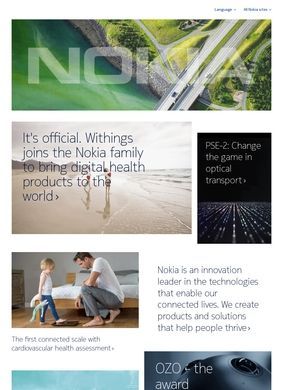
Spend five minutes on the Nokia site and it becomes obvious who it is built for: people who buy and run telecommunications networks, not people shopping for a phone. That distinction trips up casual visitors, because the Nokia brand still carries the memory of indestructible handsets, and the actual corporation now sells IP routing hardware, cloud-native core software, and private wireless to operators and governments. The site is organized around that reality, and once you accept the framing it reads coherently.
Four divisions structure the business
The company splits its work into four divisions, and the navigation mirrors them well enough that you can find your way without a guide. Network Infrastructure covers fixed and wireless plumbing, including optical and IP routing. Mobile Networks is the 4G and 5G radio access piece, plus the private wireless setups that factories, ports, and mining sites increasingly want. Cloud and Network Services groups the core network software, the management tooling, and the enterprise-facing products. Then there is Nokia Technologies, the patent and brand licensing arm, and that last one is worth pausing on because it explains the consumer confusion that follows the company around. Each of these four lines gets its own landing area, with product families nested underneath, so the structure scales with the catalog instead of flattening it.
Device manufacturing through licensing
If you came looking for a smartphone, the site is honest about the arrangement even if it does not shout it. The company licenses its name to third-party manufacturers who design and build the consumer devices: smartphones, tablets, accessories. Nokia itself is not assembling them. That is a meaningful thing to understand before you treat a review of these handsets as a review of this company's own product quality, and the technology division's pages make the licensing model clear if you read them rather than skim.
Patents as a revenue stream
Brand licensing sits alongside a much larger patent portfolio, and this is where a chunk of the company's value lives. Nokia holds standards-essential patents across cellular technology, and licensing those patents is a deliberate revenue stream, not a footnote. Anyone who only knows the brand from old handsets tends to miss how central this portfolio has become to the modern business. For anyone trying to understand why a network-equipment maker also shows up in disputes and agreements with handset giants, the structure laid out here answers the question. The separation between the equipment business and the intellectual-property business is cleaner on the site than the popular narrative would suggest.
The official site therefore serves two very different audiences with one identity. Carriers and enterprises get the substance: data sheets, product families, deployment information. Consumers get an explanation of why the device in their pocket says Nokia but was made by someone else. Both groups are accounted for, though the consumer is plainly the secondary one.
Research division and corporate resources
Bell Labs is the part of this I would steer a curious reader toward first. It is the research division, and its remit is fundamental and applied work in communications rather than next-quarter product polish. Having that lineage attached to a vendor's site changes the texture of the whole resource, and it is one of the more genuinely distinguishing things about the company as a reference point. The Bell Labs material reaches into long-horizon research that most equipment suppliers simply do not fund.
Beyond the divisions and the labs, the site carries the expected corporate furniture competently. There is a newsroom running at the cadence you would expect from a publicly traded firm. The investor relations section is substantial, which makes sense for a company listed on Nasdaq Helsinki and the New York Stock Exchange, and anyone tracking the stock or the filings has a clear path to them. A careers portal handles recruiting across a genuinely global headcount. The sustainability and ESG reporting section is fairly detailed, which matters more for institutional buyers and investors than for a passing reader but earns the space it takes up.
Technical tone for network operators
Headquartered in Espoo, Finland, Nokia presents itself with the restraint you tend to see from European industrial firms. The tone across the divisional pages stays technical and measured, which suits the audience. A telecom operator evaluating optical transport does not need marketing persuasion; it needs specifications, roadmaps, and evidence that the supplier will still be standing in ten years. The Nokia site reads as though it knows exactly that.
Product taxonomy requires orientation
One fair criticism is that the breadth can overwhelm. The product taxonomy is deep, and the line between a Network Infrastructure offering and a Cloud and Network Services one is not always obvious to a newcomer. Someone who already works in the field will navigate it on muscle memory. A student, a journalist, or a small enterprise dipping a toe into private wireless will spend a while orienting before the structure clicks. That is the price of covering this much ground, and Nokia has chosen coverage over simplicity.
It is also worth being clear-eyed about what this listing represents in a business directory of this category. Nokia is not a regional installer or a reseller. It is one of a small number of companies in the world that actually builds the radio access networks, the core software, and the transport gear that carry mobile and fixed traffic at national scale. The site reflects that scale, sometimes to its detriment in terms of approachability, but never in a way that feels padded or evasive.
My verdict is a qualified yes, aimed squarely at expectations. If you arrive wanting consumer device reviews or a quick read on whether to buy a Nokia phone, this is the wrong door, and the licensing model means the handsets are only partly the company's responsibility anyway. If you arrive as an operator, an enterprise weighing private wireless, an investor, or someone trying to understand how 5G infrastructure actually gets built and sold, the Nokia site is a deep, well-kept primary source that rewards the time you put into it.
It helps to remember who the company is really writing for. The buyer of an optical transport system or a core network platform is a procurement team inside a carrier, a public safety agency, or a national operator, and those buyers read product documentation the way a general reader reads recipes. Where a consumer-facing brand would lead with lifestyle imagery, Nokia leads with the product family, the technology generation, and the deployment context. That choice can feel cold to a casual visitor, but it is the right register for the people the company actually sells to, consistent across every division on the site.
The strongest reasons to consult it are the divisional depth, the Bell Labs research material, and the transparency about the brand-licensing setup, which together make Nokia easier to understand than its reputation might suggest. The weakest point is sheer density: this is a resource that assumes you know what you are looking for. Go in with a specific question about networks, patents, research, or the company's financial footing, and it answers well. Wander in expecting a phone showroom, and you will leave a little confused, though better informed than when you started.