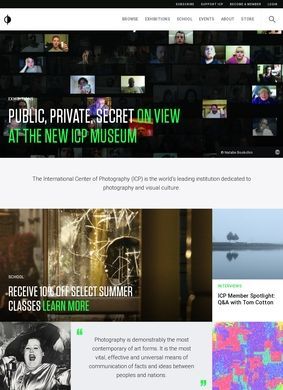
Can a single organization in Lower East Side Manhattan be both a museum people line up to see and a school turning out 3,500 photographers a year? The International Center of Photography manages exactly that, and the answer to whether it works comes down to how seriously it treats both halves. The museum at 84 Ludlow Street runs rotating shows that lean into the actual history and present of the medium, with current programming that pairs a fashion-photography retrospective, "Yves Saint Laurent and Photography," against the genre survey "Photobooks USA 2000-25" and solo work from Stephen Shore and Ryan McGinley. That mix tells you something: this is a place comfortable holding a couture archive and a contemporary photobook fair in the same building.
Museum exhibitions and programming
What keeps the place from being a static gallery is everything bolted onto the exhibition schedule. There are film screenings, photobook clubs, and speaker programs, plus the unhurried social side of it, like the Cameras and Coffee community meetups where people show up to talk shop. None of that reads as filler added to justify a ticket price. It reads as the behavior of an institution that wants photographers in the room, not spectators looking at framed prints on a wall.
Film screenings, photobook clubs, speaker events
The teaching operation is where the scale really shows. The School at International Center of Photography enrolls more than 3,500 students a year across one-year certificate programs, part-time courses, and short workshops, a serious throughput for a single school attached to a single museum. The structure gives someone several honest ways in: a full certificate track, a weekend class, or an open-enrollment course without signing up for a year of their life.
School enrollment across multiple formats
The fully online yearlong programs are the part worth pausing on, because they push the offering past anyone who happens to live within subway distance of Ludlow Street. Three are named outright: Documentary Practice, Writing and Photography, and Curatorial Practices. That last one is telling. A program in curatorial practices at the International Center of Photography treats the work around photographs (the writing, the editing, the exhibition-building) as a discipline in its own right, not an afterthought to making images. Admissions for the 2027 online programs are already open, so the calendar is built well ahead.
Online yearlong programs in documentary, writing, curation
Below the adult certificate level, there is youth and teen programming running alongside the open classes. Putting kids and career-changers under the same roof is a deliberate choice, and it widens who the place is genuinely for. Anyone researching photography schools through a business directory will find institutions with a narrower scope; the International Center of Photography is one of the few where the full pipeline, from teenager to working curator, runs inside one address.
Youth programming alongside adult certificate tracks
On the museum side, tickets are sold online, which removes the friction of planning a visit around a counter. The exhibition slate rotates, so the building rewards repeat visits in a way a permanent collection display would not. Someone who came for the Stephen Shore work has a different reason to return when the photobook survey or the McGinley pieces are up. That churn is the point of a museum dedicated to a living medium, and the International Center of Photography programs with that in mind.
Rotating exhibitions reward repeat visits
Around the visiting and studying sits the support structure. There are individual and corporate donation programs, memberships for people who want an ongoing relationship past a single ticket, and a school-outreach initiative aimed at the classroom. The outreach piece extends the International Center of Photography teaching mission outward to schools that will never send a student to a certificate program. An institution exporting its resources to teachers is thinking about the medium's future audience beyond its current paying one.
Memberships, donations, school outreach initiatives
If there is a fair caution, it is simply one of breadth. A body running a ticketed museum, a 3,500-student school, online degrees, youth classes, membership tiers, and school outreach is carrying a lot, and a first-time visitor could reasonably struggle to figure out which door is theirs. The flip side is that the breadth is real depth, not padding. The programs name specific instructors' shows, specific disciplines, specific enrollment windows. That specificity is the difference between an organization that does many things and one that merely lists many things.
Managing breadth without sacrificing depth
On outside reputation, Google Maps shows a handful of visitor reviews for the International Center of Photography, and Yelp has a small cluster as well. Neither platform produces the volume you would expect from a consumer-facing brand, which is consistent with an institution whose audience is professional and academic rather than tourist-casual. The photography community tends to register its view through grant committees, press coverage, and the careers of alumni. The review counts are low, but that reflects audience composition, not obscurity. The International Center of Photography's reputation lives in the field, not on consumer rating sites.
Professional reputation beyond consumer rating sites
Taken together, the International Center of Photography is the rare place where looking at photography and learning to make it happen in the same institution, and neither side feels like a marketing wrapper for the other. The exhibitions are credible and current, the curriculum is named down to the program, and the outreach pushes the whole thing past its own walls. The open admissions window for the 2027 online programs and the rotating exhibition calendar give two concrete reasons to engage with the International Center of Photography now rather than file it under future possibilities.