Photography schools that have been running since 1910 are rare enough to make you look twice, and the New York Institute of Photography is exactly that: an operation older than most cameras anyone alive has handled, now delivered entirely online. The longevity is the first thing worth registering. A name that has survived glass plates, film, and the full shift to digital has watched the craft turn over several times, and the curriculum here reflects a school that adapted instead of closing.
Three self-paced courses
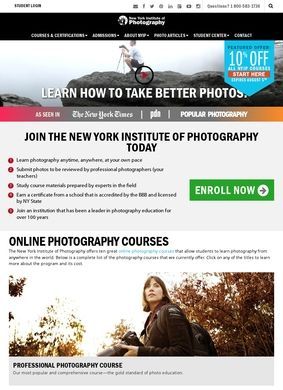
The teaching model is built around three self-paced courses, and the structure is plain enough that a prospective student can size it up quickly. The Professional Photography Course is the flagship, and it is broad: manual camera control, lighting, composition, then a run through the genres a working photographer gets hired for, including portraiture, weddings, commercial work, and nature. The Fundamentals of Digital Photography sits a tier below, aimed at beginners who want to understand their camera and basic post-processing before moving to something heavier. A Graphic Design Course rounds out the catalog, covering production design for print and web, and it is the newest of the three, showing that the New York Institute of Photography is still expanding its curriculum instead of coasting on the photography name.
Working with mentor photographers
What separates the New York Institute of Photography from a stack of recorded video lectures is the feedback loop. Each course pairs the student with working professional photographers who review submitted work one on one, and that personalized critique is the part of distance photography education hardest to replicate with a free tutorial library. You can watch a hundred videos on exposure and still not know why your own portraits fall flat; a mentor looking at your specific frames is a different kind of instruction. The New York Institute of Photography backs this with a student forum and community, plus a gallery where students show finished work, so the experience is more than a purely transactional enrollment.
Without a fixed class schedule
Self-paced is the right phrase to take seriously when considering the New York Institute of Photography. There are no scheduled class times and no cohort moving in lockstep, which suits a hobbyist fitting study around a day job and suits anyone building part-time income from photography without dropping what they already do. The flip side is the one self-directed learners always face: the structure assumes you will keep submitting work and engaging with your mentor, and the school cannot do that part for you. People who thrive on deadlines may find the open-ended pace a test of their own discipline more than of their photography.
Who is each course for?
The audience the New York Institute of Photography is built for comes through clearly across the three courses. Aspiring professionals get the genre breadth and the commercial training. Hobbyists who want to move past automatic mode get the fundamentals track. The people chasing a side income from weddings or portraits get both the technical grounding and the working-photographer feedback that tells them whether their results are saleable. It is a coherent lineup, with each course sitting at a sensible point on the path from first camera to paid assignments.
Tuition pricing and trial period
Tuition is positioned as a fraction of what a traditional photography school charges, and a current promotion advertises savings of up to $290. Pricing claims like that are worth treating with a cool head, since "a fraction of traditional cost" is a comparison the buyer should run themselves against whatever brick-and-mortar program they were considering. What gives the offer more weight is the 14-day risk-free trial attached to every course. A two-week window to start the material and back out is a meaningful hedge for anyone unsure whether self-paced online study fits how they learn, and it lowers the stakes of the decision considerably.
Accreditation and catalog details
Several practical details fill in the picture for a serious shopper. An academic catalog is published as a downloadable PDF, which lets a prospective student read the full course breakdown before paying for anything; that kind of upfront disclosure tends to come from a school confident in what it is selling. Military benefits are noted, pointing to GI Bill eligibility or service-member discounts that matter to a specific and underserved slice of would-be students. The New York Institute of Photography also holds BBB accreditation, a credential that carries real meaning in the distance-education space where the line between a legitimate school and a content mill is often invisible from a homepage. If you found the school through a business directory listing or a general search, the BBB status is worth verifying directly before enrolling.
Free resources beyond paid courses
Beyond the paid courses, the site runs a library of free material: photography articles, career guides, and student success stories. The career guides and articles double as a low-commitment way to gauge the school's voice and competence before spending anything, and the success stories, taken with the usual grain of salt that any school's own testimonials deserve, at least show what graduates went on to do. The resource depth suggests an operation that functions as a publishing house alongside its teaching role, not a bare enrollment funnel.
There are honest limits to weigh. Photography is a doing craft, and no online program, however well mentored, fully substitutes for an in-person studio, a working set, or a teacher physically adjusting your hands on the gear. The genre breadth of the flagship course is a strength for orientation but means each specialty gets surveyed and not exhausted; a student who already knows they want to shoot weddings exclusively might eventually outgrow a generalist syllabus and need focused workshops elsewhere. None of this undercuts the New York Institute of Photography, but it frames what the program is good for: building a solid, transferable foundation and a feedback habit, not delivering a finished specialist's expertise in a single enrollment.
Weighed together, the New York Institute of Photography presents as a long-running, credentialed distance school with a sensibly tiered set of courses, genuine human feedback, a low-risk trial, and enough free material to evaluate it honestly before enrolling. The 1910 lineage is more than a marketing footnote; it is evidence of an institution that kept teaching through every technological upheaval the medium threw at it. The Graphic Design addition shows it is still moving. The combination of mentored critique and self-paced flexibility lines up well for a beginner who wants structure without a campus, or a hobbyist hunting part-time income, provided the student supplies the discipline the format demands.