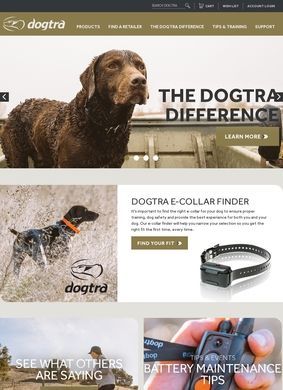
Dogtra is a manufacturer and retailer of professional dog-training equipment and pet containment systems, based in Garden Grove, California, and in the trade for more than 30 years. Its catalogue runs on electronic field gear: remote training collars, GPS trackers, virtual fences, and bark-control units, backed by the batteries, straps, antennas, receivers, and transmitters that keep any of it working. The audience is specific. Dog trainers, hunting-dog handlers, and owners who want more precision than a leash and a treat pouch can give them.
The gear on the shelves
The range is wide enough to match a collar to the animal. Products are sorted by dog size and temperament, spanning roughly 10 to 100-plus pounds, so a handler with a small, soft spaniel and one working a large, hard-headed shepherd are shopping the same catalogue for very different tools. Named model families do the sorting for Dogtra: the 200iQ, the 280X, the ARC-X, and the 1900X series each aim at a different mix of range, waterproofing, and stimulation control.
That model-by-model spread is the core of what Dogtra sells. A buyer is meant to land on a specific unit, not a generic "training collar," and the site pushes toward that choice on purpose. It is a catalogue organized around the job the equipment has to do, which is the right instinct for tools a working handler depends on daily.
Remote training collars
Remote e-collars are the heart of the line. The 200iQ, 280X, ARC-X, and 1900X series cover the spread from close-range obedience drills to long-distance field control, with the higher models built for bigger dogs and more open ground.
The spread of models is the whole point. A close-range obedience collar and a long-distance field unit are different tools for different jobs, and setting the 200iQ beside the 1900X series lets a buyer match the hardware to how far and how hard they actually train. The point of a Dogtra collar, for a trainer running a dog at distance, is graduated control: a range of stimulation levels and a transmitter that reaches across a field, with the model names mapped to those differences instead of leaving a buyer to guess.
That is the difference between a tool a professional will trust and a gadget that ends up in a drawer.
GPS tracking and virtual fences
Two other lines sit next to the collars. The GPS side of Dogtra includes the PATHFINDER2 MINI COMPASS and the COMPASS HANDHELD, tracking units carrying offline map capability, which matters to anyone running dogs where cell coverage drops out. Offline maps are the detail that separates a serious tracker from a phone app that dies at the edge of service.
The containment side is the Smart Fence and the GPS Fence, virtual-boundary systems that trade buried wire for a mapped perimeter. Between the two, the brand covers both halves of the "where is my dog" problem: keeping the animal inside a line, and finding it once it crosses one. For a hunter or a rural owner working over open ground, that pairing is the practical case for Dogtra, and it is coverage a suburban fence brand does not attempt.
The two GPS lines answer different needs. A tracker such as the COMPASS HANDHELD is for the owner who lets a dog range and wants to follow it; the Smart Fence and GPS Fence are for the owner who wants the dog to stay put without trenching a wire across the yard. Buying both from one maker means the collar, the tracker, and the fence are meant to work together, which is part of what a catalogue built over three decades buys a customer.
Bark control and replacement parts
The third group is quieter, in every sense. Bark-control collars from Dogtra, the Smart NoBark, the YS300, and the YS600, work on nuisance barking on their own, with no handler holding a transmitter, which suits an owner whose real problem is a dog that barks at the window all day while the house sits empty.
Underneath all of it, Dogtra stocks the unglamorous parts that decide whether a collar lasts a season or five: batteries, chargers, collar straps, antennas, receivers, and transmitters, sold as separate components. A company that keeps the spare antenna and the replacement strap in stock is one expecting its hardware to stay in service for years, which is the right posture for gear priced as field equipment. That parts shelf is a quiet signal about how the company sees its own products, as things to repair instead of replace.
Buying from Dogtra and what owners report
The buying experience is built to cut down on guesswork. Orders over $199 ship free from Dogtra, an "E-Collar Finder Quiz" walks an unsure shopper toward a model, and a trade-in program takes older GPS devices against new ones. The quiz does real work in a category where the wrong collar is an expensive mistake and a mis-paired one is a frustrating afternoon.
Behind the storefront sits a stack of educational material: a training blog, product manuals, and pairing guides, plus a dedicated page of user testimonials. For gear that needs setup and periodic fiddling, that Dogtra library is part of the product, and its presence tells a buyer the company expects questions and has answered the common ones in advance. The pairing guides in particular address the step where most e-collar owners get stuck, matching a receiver to a transmitter, which is exactly the moment a frustrated buyer would otherwise reach for the phone.
The trade-in program deserves its own mention. Taking an older GPS unit against a new one is uncommon in this corner of the market, and it tells a repeat buyer the company would rather keep them in the ecosystem than sell one box and move on. The free-shipping line at $199 sits low enough that a single collar or tracker often clears it, so even a one-item order tends to qualify.
Reaching the company is straightforward. The site lists a Garden Grove street address, a toll-free support line with stated hours of Monday through Friday, 8:00am to 4:30pm Pacific, a support email, and links to its Instagram, Facebook, and YouTube accounts. A physical address and a staffed phone window are what a buyer wants before spending a few hundred dollars on electronics that need pairing and, eventually, service.
The outside record backs the hardware up. Dogtra's Trustpilot page carries a 4-star rating across a large base, with one view of the listing showing more than 1,100 people reviewed and company replies attached to individual complaints; TopConsumerReviews reads that same standing as a 4.3-star average from over a thousand reviews and singles out the customer service for praise. Product-level ratings for Dogtra on Chewy run in the same territory: the 200C training collar system at 4.5 out of 5 across 53 ratings, the 1900S at 4.6 from 122 ratings, and the iQ Plus at 4.3 from 40.
A German shepherd breeder's blog adds a longer-view account, five years of steady use and praise for the build, though that one is a single owner's word rather than an aggregate score.
Those replies on the Trustpilot page are worth their own note. A company that answers complaints in public is treating its reviews as a support channel, and the same habit shows up in the Chewy threads. Every Dogtra product page routes back to the same Garden Grove support line and the weekday service window, and the testimonials page and the Chewy listings keep filling with entries from handlers who have run the same collar across several seasons.