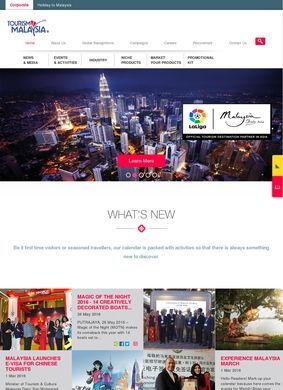
"Malaysia Truly Asia" has carried this site for years, and it still anchors how Tourism in Malaysia presents the country: a single destination promising rainforest, city, coast, and a tangle of cultures and kitchens, all under one slogan. The agency behind it, the Malaysian Tourism Promotion Board, sits under the Ministry of Tourism, Arts and Culture, which tells you immediately what kind of resource this is. It exists to sell Malaysia abroad, and the site reads accordingly. The current centrepiece is Visit Malaysia 2026, a campaign aimed squarely at lifting international arrivals, and it comes with its own published strategic roadmap.
Strategic planning and marketing priorities
That difference is clear when you start clicking around. A lot of national tourism portals stop at glossy photos and a few suggested itineraries. Tourism in Malaysia goes further by exposing the machinery that drives the promotion: there is a published six-pillar Strategic and Marketing Plan covering 2022 through 2026, and it names its priorities plainly. Boosting domestic travel sits alongside building partnerships, splitting promotional spend roughly 70/30 between digital and traditional channels, courting influencers, and producing original content. You rarely see a promotion board lay out its own playbook this openly, and for anyone trying to understand where the country is steering its tourism effort, that document lays the direction out in concrete terms.
Destination content organized by region
The destination material itself is organised the way a traveller would actually approach the country. Coverage runs across Malaysia's states and cities, then branches into nature, culture, and the food, which Tourism in Malaysia treats as a full category with its own dedicated section. Sitting beside the headline Visit Malaysia 2026 push is the MyFEST Year of Festivals campaign, which leans on the calendar of events to give travellers a reason to time a trip. There is also the i-Tourism Travel Buddy mobile app, pushed out through Google, Yahoo, and Bing, which extends the destination pitch onto a phone for people already in planning mode.
Trade partners and business intelligence
What gives Tourism in Malaysia more weight than a typical inspiration site is the second audience it addresses. A good chunk of the operation speaks not to holidaymakers but to the travel trade: tour operators, agents, and partners who move actual bookings. The media and press room reflects this, carrying news releases, signed memoranda of understanding, and reports from trade missions across markets as varied as Switzerland, Pakistan, Thailand, Chinese Taipei, Singapore, and Vietnam. It is dry reading for a casual visitor, but it is exactly what a partner planning a campaign or a package wants to find on a board's own site. Tourism in Malaysia clearly built this section for them.
Publishing visitor data and market statistics
The agency backs that up with hard numbers. Tourism in Malaysia publishes visitor arrival statistics, spending data, and market intelligence aimed at trade partners, which is the sort of material most national boards keep behind a login or never release at all. On this point Tourism in Malaysia is unusually forthcoming. I went looking for the festival schedule and ended up reading arrival figures instead, which says something about how much substance is buried a layer or two down. There is also an operational footprint behind the website: overseas offices and a steady presence at international trade fairs, among them World Travel Market, the Vietnam International Travel Mart, and the Travel Malaysia Fair in Singapore.
Why split the content across two domains?
One structural point worth knowing before you arrive: the consumer-facing inspiration content lives in two places. The government domain here handles the institutional and trade side, while a separate consumer portal runs at malaysia.travel. The split is deliberate, and it explains why parts of this site feel more like a government agency's working desk than a holiday planner. A first-time visitor expecting wall-to-wall itineraries might be momentarily thrown, then find that the deeper planning and booking-oriented browsing happens on the sister site. Tourism in Malaysia uses the official domain to do the institutional heavy lifting and leaves the dreamy browsing to its consumer counterpart.
Building campaigns on established brand identity
Some of the framing here is durable marketing language that has outlasted several campaigns. "Malaysia Truly Asia" has been the through-line for a long time, and Tourism in Malaysia keeps building new initiatives, VM2026, MyFEST, the app, on top of that established identity instead of reinventing it each cycle. Tourism in Malaysia treats the brand as a fixed point and lets the campaigns rotate underneath. Whether that consistency reads as confident or simply familiar depends on how many times you have seen the phrase, but it does give the whole presentation a recognisable shape.
For the trade reader, the value is concrete and easy to name: roadmaps, MoU announcements, mission reports, and the raw arrival and spending statistics that let a partner size up the market. For the traveller, Tourism in Malaysia works best as a starting frame, the official word on where the country wants attention directed, with the heavier planning handed off to malaysia.travel. The clear naming of campaigns helps too. When a board commits to a dated effort like Visit Malaysia 2026 and then publishes the strategy underneath it, you can at least judge the ambition against a stated plan, which gives the campaign something measurable to be held to.
It is worth saying that the breadth can also dilute focus. Between the destination promotion, the festival calendar, the app, the trade portal, the statistics, and the strategic documents, Tourism in Malaysia is doing a great many things at once, and a visitor who only wants to know what to do in Penang next month has to wade past a fair amount of institutional material to get there. The information is present and detailed; the path to it is not always the shortest. That is the trade-off of a single official hub trying to serve both the partner and the tourist under one roof.
Taken together, the offering is wide. Tourism in Malaysia carries the slogan-level branding, the dated campaigns with real strategy behind them, the food and culture and state-by-state coverage, the festival programming, a mobile companion, and a genuine layer of trade intelligence with numbers attached. The destination content tells you why to go; the strategic plan and statistics tell you how the country itself is thinking about getting you there. The split between this official domain and malaysia.travel makes sense once you understand it: institutional weight here, holiday dreaming over there. The value of the official site is precisely the material that does not usually get published at all.