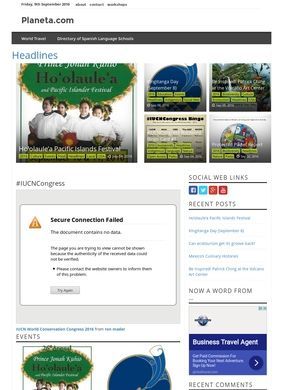
Planeta calls itself a "Global Journal of Practical Ecotourism," and the word practical is doing real work in that phrase. This is editorial content built for people who travel with some intention behind it: writers, educators, guides, and travelers who want context before they book a trip. The geographic focus lands squarely on the Americas, with Mexico, the US Southwest, and indigenous cultures getting the most sustained attention, though the coverage extends outward from there across Latin America more broadly.
A site that has been publishing since the mid-1990s on a single subject accumulates something newer projects cannot replicate: depth of coverage and a recognizable editorial voice. Planeta reads like a working library assembled by someone who has been paying attention to sustainable travel since before the term was fashionable, closer to an archive than to a tour company's promotional page. Three decades of consistent output on a niche subject is a credibility marker in itself, whatever the current design or social numbers say.
Regional depth in the Southwest and Mexico
Much of the strongest material concentrates on the US Southwest. The Mojave and Sonoran Deserts get coverage, along with specific landmarks: Hoover Dam and the Seven Magic Mountains installation outside Las Vegas. That kind of regional concentration points to firsthand familiarity, not generalized coverage assembled from secondary sources. Anyone planning a trip through that corner of the country could pull genuine orientation from these pages, the sort of background that helps a visitor understand why a place is worth the drive before standing in front of it. The Hoover Dam and Seven Magic Mountains entries, for instance, are grounded enough to be genuinely useful, not decorative.
Bilingual publishing across the Americas
Mexico runs as a parallel thread throughout, and the bilingual structure is worth noting. Content is published in both English and Spanish, which is not a small editorial decision for a publication covering the Americas. It widens the audience in a meaningful way and reflects the cross-border reality of the regions being written about. A traveler heading south, or a Mexican reader looking north, can use the same resource in their own language.
Thematic organization of editorial material
The thematic sections give the site its shape: Art, Nature, Water, Cities, Indigenous cultures, Celebrations, and Headlines. Water as a standalone category is a telling editorial choice, given how central scarcity and rivers are to the desert regions Planeta covers. The categories read as the work of an editor who organized material around the actual subject matter, not around whatever generic menu a template offered.
Travel directory and educational resources
Planeta runs a World Travel Directory alongside its editorial content, which extends the site from reading material into something closer to a reference tool for finding operators and destinations. Spanish-language learning resources are included as well, a sensible companion to the heavy Latin American focus, and a logical fit for travelers who want to do more than point at a menu when they arrive.
Workshops for ecotourism professionals
The educational side goes further. Planeta hosts workshops and training programs tied to ecotourism, which positions it as a resource for practitioners and educators, not solely for people planning a vacation. That dual audience, the working professional and the curious traveler, is consistent with the "practical" label in the site's own description, and helps explain why the publication has lasted three decades. The social footprint covers Facebook, LinkedIn, YouTube, and Twitter. A presence across those four channels, including the more professional LinkedIn and the video-oriented YouTube, lines up with a publication that treats ecotourism as a field of practice and education rather than a hobby interest.
Reaching the people behind the site runs through a single "Making Contact" form. No phone number and no direct email turn up anywhere across the public pages, which leaves that form as the only visible way to get a response from the editors. For a long-running editorial publication this is a defensible setup, since the work being offered is the articles and not a product or a booking, but a reader hoping to confirm who sits behind the masthead has to send a message and wait for a reply that may or may not come quickly. A line or two about who runs Planeta and from where would strengthen the trust the longevity already earns, and would help readers separate this journal from the several larger entities that share the name.
From search results to editorial reputation
On the question of external reputation, a search came up empty, and that needs an honest caveat. No notable third-party reviews of Planeta as an ecotourism journal surfaced. The complication is the name itself: "Planeta" is shared by several unrelated and much larger entities, including the Grupo Planeta publishing house, a payment processor, and a satellite imagery company. Those names crowd out the search results entirely, which means this particular Planeta has either operated quietly enough to avoid the review ecosystem or simply gets buried under bigger namesakes. A prospective reader cannot lean on a crowd of outside voices to vouch for it.
The verdict comes down to the content itself, and there the case is reasonably solid. The clear thematic organization, the genuine regional depth in Mexico and the Southwest, the bilingual reach, and the extra layers of a travel directory, language resources, and training programs all point to a real publication with a defined purpose and a long track record. The weak spots are the absence of any verifiable outside reputation and the form-only contact path. Those gaps exist, and readers should go in aware of them. That said, Planeta has published consistently in a focused area for roughly three decades, and that record is harder to dismiss than a few five-star reviews elsewhere would be.
Content as the primary measure of value
The individual articles and the thirty-year editorial history are what the assessment rests on. External indicators that would normally confirm a site's standing are not here to consult, so readers will have to judge the pages directly, which is ultimately not the worst way to evaluate a publication whose whole claim is that the writing is worth reading.