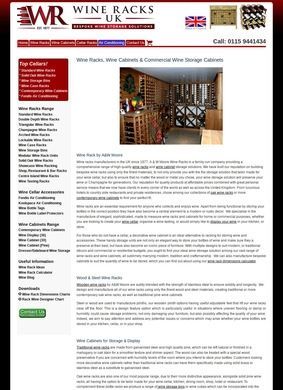
A growing wine collection needs somewhere to age quietly instead of turning to vinegar, and that is the problem Wine Cabinets, the trading face of A&W Moore Wine Racks UK, was built to solve. It answers with furniture and joinery built to order: bespoke racks and handmade storage that a British workshop has been turning out for more than four decades.
The range starts small, at a single rack, and climbs all the way to a temperature-controlled room lined floor to ceiling. The workshop label matters here: these pieces are built in-house, not bought in, which is why the material and size options run as deep as they do.
Racks, bins, and built-in storage
The core of the catalogue is racking, made in several materials so the piece suits the room as much as the collection. Wine Cabinets produces custom racks in solid oak, solid pine, a wood-and-metal mix, and all-metal, which spans the range from a warm traditional cellar look to something leaner and more industrial. Traditional racks sit next to built-in solutions designed to slot into an alcove or under a stair.
Beyond the open racks, the line includes wine storage bins for bulk keeping, lockable designs for bottles worth securing, and display racking meant to be seen rather than tucked away. There are also cabinets with chiller displays for people who want a few bottles at serving temperature out in the living space. The materials and formats are the whole point: this is a maker that expects the buyer to arrive with a specific spot and a specific number of bottles in mind.
Solid oak, pine, and metal options
Material choice is where a rack stops being generic. Solid oak is the traditional pick, heavy and warm and priced accordingly; solid pine is the lighter, cheaper cousin; the wood-and-metal and all-metal versions answer a different taste entirely.
Wine Cabinets making all four to order means a buyer is not forced to bend a room around a fixed product line. That flexibility is the practical argument for a workshop over a flat-pack rack from a general retailer.
Lockable, display, and bin storage
The format options matter as much as the wood. A lockable rack is the sensible answer for a shared house or a collection with a few genuinely valuable bottles.
Display racking treats the wine as decor, angled and lit to be looked at. Wine storage bins go the other way, packing volume in for someone cellaring by the case. Wine Cabinets covering all three under one roof means a single order can mix a locked cabinet, a display run, and bulk bins without stitching together three suppliers.
Cellars, wine walls, and climate control
The bigger jobs are where Wine Cabinets moves from furniture into building work. It designs and installs full wine cellars with climate-control systems, and builds bespoke wine rooms and wine walls, the glass-fronted, floor-to-ceiling installations that have become a feature in higher-end homes. This is the part of the business that needs measuring, planning, and fitting, well beyond a single delivery van.
Commercial clients get their own track. Wine Cabinets supplies shops, restaurants, and bars, and works with hotels and the wider hospitality trade, the sort of customer that needs storage to look right on a floor and stand up to daily use. The reach is described as global, so the workshop is not limited to installations at home in the UK. Fitting hospitality venues also means the racks have to clear a different bar: quick access for staff, a finish that reads well to customers, and durability under constant handling that a home cellar never sees.
Cellar design and air-conditioning
Temperature is the whole game in wine storage, and Wine Cabinets treats it that way. Its cellar work includes air-conditioning systems, with Fondis units and split-system options named specifically, the sort of detail that separates a genuine cellar builder from a company that sells shelving and calls it a cellar.
A room full of bottles without climate control is just an expensive cupboard; the conditioning is what makes the storage earn its keep. Naming the equipment brands instead of hiding behind a vague promise of climate control is the sort of specificity a buyer can confirm with an installer beforehand.
Champagne, magnums, and large-format bottles
Standard racks assume a standard bottle, and real collections rarely stay that tidy. Wine Cabinets makes specialised storage for champagne, magnums, and large-format bottles, the awkward shapes that will not sit in an ordinary slot. For anyone who has tried to wedge a magnum into a rack built for a 750, that is a small thing that turns out to matter a great deal. It is also a quiet signal that the maker deals with serious collections, where the big formats pile up over time.
Reaching Wine Cabinets is easy. A phone number is displayed prominently and more than once, and a contact page sits at a clear address, with an email route offered for international enquiries. The one gap is that no physical address appears on the homepage, a minor oddity for a manufacturer, though the prominent phone line covers the practical need to get a quote or a measurement booked.
The outside review record is sparse, and it should be read honestly. The Trustpilot profile for the site carries just five reviews, all of them five-star, on an unclaimed page that notes no history of asking for reviews, and I take that combination as a mild point in its favour: a tiny sample, but an unsolicited one. The Facebook page shows "Not yet rated" with two reviews.
Nothing turned up on Google, Yelp, Tripadvisor, Glassdoor, a general business directory listing, or the Better Business Bureau. Worth flagging, a separate American site at WineRacks.com carries 124 reviews, but that is a different company and its rating says nothing about this one.
For the private collector who has outgrown a wine fridge and wants storage measured to a specific wall, or for a restaurant that needs racking to look sharp behind the bar, Wine Cabinets is a sensible first call. The next step is straightforward: ring the number on the site with the room dimensions and bottle count to hand, and ask directly about climate control and large-format storage, since those two details are where a bespoke build earns its price.