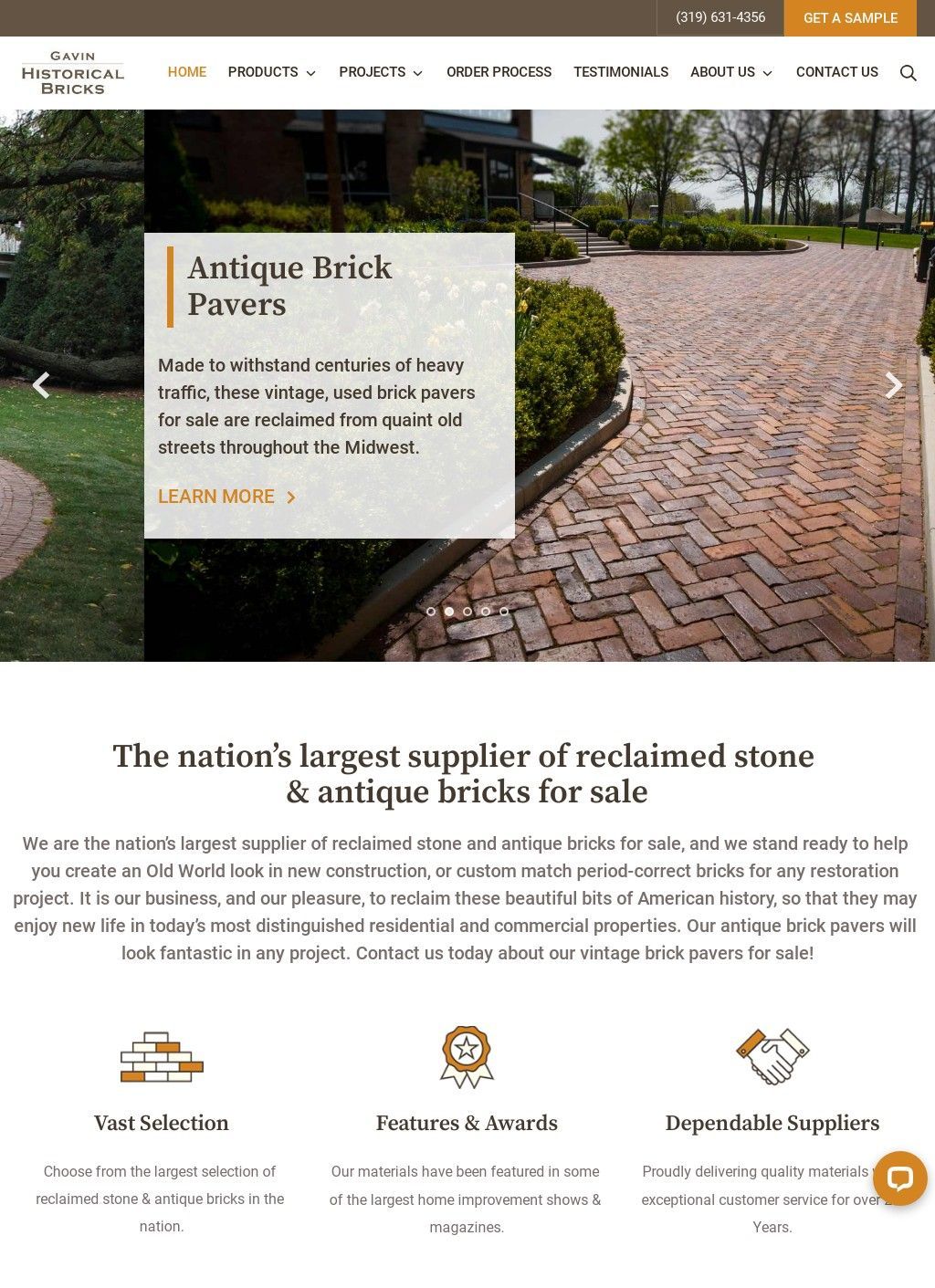
Clinker bricks are what pulled me in first: warped, over-fired survivors of 1920s kilns, the kind that gave Arts and Crafts bungalows their lumpy, blistered character. Historicalbricks.com, the site behind the Antique Brick listing, treats those irregular castoffs as a product line worth its own description rather than a footnote, and that tells you early what sort of operation this is. Antique Brick deals in reclaimed and antique building materials pulled from demolition sites across the Midwest, then sorted, sold, and shipped to people who want the real thing instead of a factory imitation of age.
Reclaimed brick selection by color
The reclaimed brick selection is where the site spends most of its attention, and the colors get named out with some care: reds, yellows, oranges, grays, salmon, creams. Anyone matching an addition to a century-old wall needs that range, since a modern red brick sticks out like a fresh filling in an old tooth. Antique Brick, going by the historicalbricks.com inventory, is aiming squarely at that matching problem, and it claims to hold the largest selection of reclaimed bricks, pavers, and cobblestone available. That is a big claim and one I cannot independently check, but the breadth on display at least makes it plausible rather than empty.
Beyond wall brick, the paving side runs deep. There is genuine salvaged cobblestone lifted from historic streets, plus street pavers, common pavers, Belgian blocks, European cobble, and specialty material for driveways. Anyone who has priced out a cobblestone drive knows the difference between reproduction units and stones that already spent a hundred years under wagon and car traffic, and the site is clearly selling the latter. The worn surface and mismatched edges are the point, and Antique Brick prices them as the selling feature.
Stone and masonry materials
Stone gets its own footing too. Old English Stone, Medina sandstone, and Berea sandstone appear alongside wall stone and stone veneer, which widens the appeal past strict brick work into full masonry restoration. For interior and lighter jobs there is thin brick veneer offered in flat, corner cap, and top cap varieties, brick flooring tiles, and firebrick meant for fireplaces. That last group is a smart inclusion, since a homeowner rebuilding a hearth needs firebrick that can take the heat, and having it sold next to the decorative pieces keeps a single project on one invoice from Antique Brick.
How many bricks fill one order?
The one operational detail that keeps coming up is the 50 square foot minimum order, paired with nationwide shipping. That threshold reads as reasonable for masonry, where freight on heavy pallets only makes sense above a certain volume, but it does quietly rule out the person hunting for a dozen bricks to patch a garden bed. Worth knowing before anyone gets attached to a color.
Sourcing supports sustainability efforts
The company frames much of this around keeping material out of landfills, and for once that angle reads as more than marketing gloss. Reclaimed brick and stone are, by definition, diverted waste: every pallet of salvaged cobblestone is a pallet that did not get crushed into fill. The sourcing story, demolition sites throughout the Midwest, gives the sustainability claim a concrete backbone instead of a vague green badge. Restoration architects and preservation-minded homeowners tend to care about provenance, and Antique Brick leans into that by naming where things come from and roughly when they were made.
The customer base spans residential and commercial, from restoration and historical reconstruction jobs to new builds chasing an Old World look. Those are two fairly different buyers. One needs an exact match to something that already exists; the other wants the aged aesthetic on a blank slate. The Antique Brick catalog seems built to serve both, which is either admirable range or a lot to keep in stock, and I lean toward the former given how specifically the materials are broken out.
Reaching the company directly
On reaching an actual person, the site does well. A phone number sits in plain view, an email address is published, and there is a contact page set aside for inquiries. For a business selling heavy, made-to-match materials that almost always require a conversation about quantities and freight before an order makes sense, that direct line is not a nicety, it is a necessity, and Antique Brick puts it where a buyer will find it.
The weaker spot is outside validation. I went looking for independent reviews of historicalbricks.com and came up short. Searches turned up unrelated things: Etsy antique brick listings, a general guide to identifying old brick, a Reddit thread arguing over what salvaged brick is worth, and a Better Business Bureau profile for a differently named company in Little Rock that has nothing to do with this operation. None of that speaks to Antique Brick one way or the other. So there is no chorus of star ratings to lean on here, positive or negative, which leaves the site to stand on its own catalog and presentation.
That absence is not damning. Niche building-material suppliers rarely accumulate the review volume that restaurants and consumer gadgets do, because their customers are contractors and specialty homeowners who transact over the phone and by the pallet, not through public feedback forms. Still, a prospective buyer spending real money on freight-heavy orders would reasonably want a reference or two, and none surfaced. Asking the company directly for recent project examples seems like the sensible move ahead of any large order.
Taken as a whole, Antique Brick comes across as a serious, specialized salvage supplier with a genuinely deep catalog and an honest environmental angle, let down mainly by the near-total absence of outside reviews I could find. The material knowledge on the page is real, the contact route is open, and the sustainability pitch holds up. If the reclaimed inventory matches what the descriptions promise, this is a strong resource for a restoration or an Old World build; a first-time buyer just has to budget for the 50 square foot floor and do a little of their own vetting before wiring payment. Cautiously worth a call.