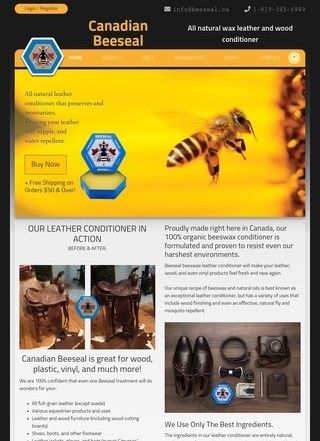
A 1kg tub of beeswax conditioner sits at one end of the range and a 75g pocket tin at the other, and between those two sizes is most of what Canadian Beeseal is about: a leather dressing made from Canadian beeswax, olive, canola and coconut oils, a couple of essential oils, and vitamin E, blended and poured in Canada. That ingredient list is printed plainly on the site. A company that names tea tree and lemongrass instead of hiding behind "natural oils" is inviting the buyer to check the label, and the people most likely to check are exactly the saddle and boot owners this product is aimed at.
Product range and sizing options
The Canadian Beeseal catalogue is small and legible. Conditioner comes in 75g, 150g, 1kg and 2kg, there are bundle packs for stocking up, a 100g saddle soap, and shoe-shine kits, which is close to the whole line. There is no attempt to spin a dozen near-identical SKUs out of one formula, and the sizing runs sensibly from a tin kept in a tack trunk to a tub a stable or a cobbler would work through over a season. Free shipping kicks in over $50 within Canada and the USA, with international shipping available beyond that, so the pricing nudges buyers toward the larger tubs or a bundle without pretending the small tin does not exist.
Leather types the wax targets
What sells a leather product is knowing what it does to a particular kind of leather, and Canadian Beeseal spreads its net wide here. The same wax is pitched at saddles and tack, work boots, western and dress footwear, leather jackets and gloves, sofas, car and motorcycle seats, and the odds and ends people forget about until they crack: belts, wallets, knife sheaths. The through-line is a wax-and-oil dressing meant to feed and weatherproof rather than strip or shine, a coherent thing to sell across all those uses. A saddle and a work boot want the same treatment, so applying one conditioner to both is honest, not a stretch.
Tea tree and lemongrass oils
The essential oils deserve a closer look. Tea tree and lemongrass are not there for scent alone; both have a reputation among leather people for helping keep mould off tack stored in damp barns, a real problem for anyone with a saddle sitting through a wet spring. Whether the quantities in this particular blend do much on that front is not something the site proves, and it is fair to stay sceptical until tried. Still, it reads as a considered inclusion, and it fits the equestrian buyer Canadian Beeseal clearly has in mind. Someone treating a bridle they ride in weekly cares about mould in a way a person waxing a wallet never will.
Behind the wax's ingredient list
The vitamin E and food-grade oils point at the same buyer sensibility. Canadian Beeseal is pitched at someone who does not want petroleum distillates or silicone near leather they intend to keep for years, and Canadian Beeseal leans into that positioning without turning preachy about it. The made-in-Canada, beeswax-first story is consistent from the product page down to the ingredient breakdown.
Sold through independent leather retailers
One of the more persuasive things about Canadian Beeseal is not on its own site at all. Canadian Beeseal turns up stocked and referenced by third-party sellers, Moccasins Canada, Montana Leather, and the Tony Pappas boutique among them, and the company says it reaches 300-plus retailers worldwide. Those retailer listings do not carry visible aggregate star ratings in search, so there is no tidy score to quote, but a conditioner that independent leather shops choose to carry has cleared a bar that a purely direct-to-consumer brand never has to. Shops that sell boots and moccasins do not stock a Canadian Beeseal dressing that damages what they sell.
What Nick's boot owners are saying
There is also a thread on the r/NicksHandmadeBoots subreddit where owners talk about using the wax over the long haul. It is anecdotal and small, one discussion, no scores. Still, the Nick's crowd is famously fussy about what goes on their boots, so the fact that the conversation exists at all is a modest point in the product's favour. Canadian Beeseal has been operating since 2016, and that stretch of time squares with a product that has quietly seeped into enthusiast talk instead of appearing overnight.
Blog posts on leather care
The Canadian Beeseal blog rounds out the picture. It runs care and how-to articles, the sort of "how do I treat a dry saddle" or "what to do with salt-stained winter boots" material that a conditioner company is well placed to write. Used honestly, that content does double duty: it helps a buyer apply the product properly and it signals that the people behind Canadian Beeseal know leather. It is the kind of resource a first-time buyer of saddle wax would want before opening the tin.
Engagement without star ratings
Reputation beyond the retailers is worth stating plainly. The Facebook page carries roughly 6,781 likes with about 810 accounts "talking about this," an engagement figure rather than a star rating, so it should not be read as one. No Google, Trustpilot, Yelp or BBB score with a real count surfaced in search. For a product bought as much through shops and word of mouth as through the website, that is not surprising, but a buyer who leans on aggregate ratings will not find a big number here.
How buyers can contact Canadian Beeseal
Reaching Canadian Beeseal is straightforward enough. There is a contact page for inquiries, and active accounts on Facebook, Pinterest, Instagram and YouTube, so a question about which size suits a particular saddle has somewhere obvious to land. The landing page does not push a phone number or email at the visitor the moment it loads, a mild point against it for anyone who prefers to call before ordering, though the contact route and the social channels close most of that gap. English and French support is offered too, worth noting for a Canadian brand shipping across a country with two official languages.
The Canadian Beeseal formula is transparent and the uses are broad without being incoherent, the hard part to get right in this category. The retailer footprint and the boot-forum chatter give it outside grounding that many small conditioner brands never build. Against that, the review trail is soft: engagement numbers instead of ratings, one Reddit thread, no scored platform. None of that contradicts the product; it just means the proof leans on where the wax is sold and who reaches for it.
The Canadian Beeseal price ladder is sane, and the range does not try to be more than a beeswax dressing sold in four sizes with a soap and shine kit alongside. For an equestrian owner with a drying saddle, or a boot owner who wants something food-grade on leather meant to last a decade, Canadian Beeseal is an easy candidate to shortlist, and the four-size ladder lets a buyer test the small tin before moving up to a 2kg tub. The made-in-Canada, named-ingredient story reads well on a second pass, and the retailer network is a sign that other people in the trade already trust it, which is about as far as the published evidence takes the case.
Business address
Canadian Beeseal
604 Rue des Érables,
Marbleton,
Quebec
J0B 2L0
Canada
Contact details
Phone: 8193456949