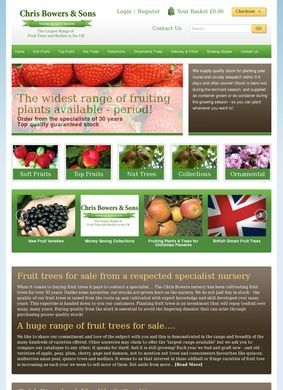
Fruit Trees for Sale is the trading name of Chris Bowers & Sons, a mail-order fruit nursery in Wimbotsham, Norfolk that has been growing and selling plants for more than thirty years. The site sells one thing and sells it deeply: fruit. Apple, pear, cherry, plum, apricot, quince, mulberry, medlar and Asian pear trees fill the tree side of the catalogue, and the soft fruit side runs through strawberries, blueberries, raspberries, blackcurrants, redcurrants, gooseberries and blackberries. There are grape vines, kiwi plants, sweet chestnuts and rhubarb as well, so the range stretches past what most people mean when they say fruit garden. For a single-category specialist, Fruit Trees for Sale covers a lot of ground without drifting into bedding plants or ornamentals to pad the catalogue.
How trees are offered by form and rootstock
What gives the listing weight is the way the trees are offered, not the species count. The same apple variety can be bought as a supercolumn, an espalier, a fan-trained form, a stepover, a dwarf or a full standard orchard tree, each grown on a chosen rootstock. Rootstock and trained form decide whether a tree suits a patio pot or a half-acre orchard, and Fruit Trees for Sale is built to serve both ends of that scale. A stepover apple bordering a vegetable bed and a standard plum destined for a paddock are different beasts, and the catalogue treats them as such. A reader with a single courtyard wall and a reader planning rows of standards are shopping the same catalogue, just down different branches of it.
Growing stock on the nursery's own ground
Stock is grown on the nursery's own ground rather than bought in from a wholesaler and relabelled. A fruit supplier whose staff have watched a variety actually crop in their own field will know things a reseller simply cannot, and that is the setup here. The plant-health credentials back this up: DEFRA inspection and passport certification, plus a Gold Standard quality mark. Those are not decorative badges. They are the paperwork a serious propagator carries, and seeing them named puts Fruit Trees for Sale on firmer ground than a reseller who can only vouch for the box a plant arrived in. Plant health is the quiet thing that decides whether a sapling thrives or imports a problem into your soil, and the certification here speaks to that.
Guidance before and after purchase
Around the plants themselves sits a layer of help that a beginner will lean on. Fruit Trees for Sale supplies growing guides, a printed catalogue you can request, and expert advice by phone and email both before and after a sale. Buying a fruit tree is a long commitment, often a decade or more before a tree settles into full cropping, and a supplier that talks through pollination partners, spacing and rootstock choice is doing the part that catalogues alone cannot. Fruit Trees for Sale leans into that advisory role, which fits a customer base stretching from someone with a balcony to an owner replanting an orchard. Thirty-odd years of trading means the staff have answered most of these questions many times over.
Customer reviews across multiple platforms
The third-party picture is large and mixed, which is more informative than a wall of uniform five stars. Trustpilot carries something like 1,803 reviews, Reviews.io adds about 446, and Yell lists the business with user reviews attached too. A Smart.Reviews score sits at 3.6 out of 5. Read the themes and a consistent shape appears: people praise the breadth of the range and the quality of the advice, then a recurring strand of complaint turns up around customer service after the sale and the condition some plants arrive in.
From product strength to delivery friction
That split is worth taking seriously. The expertise and the choice are the reasons most happy customers come back. The friction tends to land at the edges of the transaction, where a plant has travelled by courier or where a query needs chasing once money has changed hands. Live plants are fragile freight, and a nursery shipping nationwide will always carry some arrival damage, so the honest reading is that Fruit Trees for Sale wins its stronger reviews on product and knowledge while leaving room to tighten the delivery and aftercare experience. Anyone placing a large order would do well to inspect on arrival and raise problems quickly.
None of that undercuts the core proposition. A 3.6 average across well over two thousand combined reviews is the profile of a busy, long-running operation that genuinely ships volume, not a quiet outfit with a handful of curated testimonials. The advice praise in particular lines up with everything else Fruit Trees for Sale claims about growing its own stock.
Contact details and response times
Contact details are easy to find: a phone number, an email address and a full postal address at Whispering Trees Nurseries in Wimbotsham. The site states that emails sent before 5pm get a same-day reply, which sets an expectation most retailers never bother to put in writing. Given the aftercare complaints in the reviews, an easy contact route is exactly the thing a buyer wants confirmed, and Fruit Trees for Sale puts it in plain sight.
One claim sits at the top of the offer and deserves a flag: Fruit Trees for Sale describes itself as holding the largest range of fruit trees in the UK. No shopper can verify that from the outside, and it should be read as the nursery's own framing. The depth on show makes it plausible, but it is a self-description, so weigh it as one.
The practical case for Fruit Trees for Sale is straightforward. The species list is wide, the trained-form and rootstock options are unusually deep, the plants are home-grown under inspected conditions, and the advice is part of the package. The reservations cluster after the click-to-buy moment, around delivery condition and follow-up. Pricing and current stock are not visible without browsing the catalogue, and seasonal availability will shape what any one variety looks like on the day an order lands. Fruit Trees for Sale is plainly a specialist that knows its plants, and the range it offers a patio grower or an orchard owner is its strongest card.