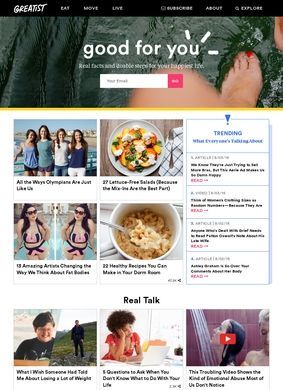
A 30-day yoga plan that walks a beginner through one pose set at a time, plant-based eating guides that map out what to put on the plate, original series with names like "The Lift" and "Crash Course": this is the sort of structured, free content that fills out Greatist. It is a digital health and wellness publication, owned by Healthline Media (part of RVO Health), and it reads less like a single blog than a small library sorted into shelves.
Four main content sections
The four main shelves are Health, Food, Fitness, and Product Reviews, and each one is wide. Under Health you get women's health, men's health, mental health, sexual health, skin and hair, sleep, weight loss, relationships, and even pets and travel. The Food vertical runs through nutrition, supplements, recipes for every meal of the day, cooking guides, and write-ups on kitchen gear. Fitness covers strength training, HIIT, yoga, running, cycling, stretching, and workout plans aimed at specific goals. None of these are token sections with two articles propping them up; the breadth goes deep, and a reader who comes in for one stretching routine can stumble into a sleep guide or a recipe roundup without leaving the site.
Health, Food, Fitness verticals
What gives the writing some weight is that the content is positioned as evidence-based and science-referenced. Media Bias/Fact Check, which scrutinizes publishers for accuracy and slant, rates Greatist as Pro-Science and Mostly Factual, with a left-leaning editorial tilt. That last point is worth knowing going in: a reader who expects clinical neutrality on every social-adjacent topic should keep the lean in mind, though the Mostly Factual mark means the health claims themselves survive a fact-check. For a consumer site handing out nutrition and exercise advice at no charge, an outside rating that lands on the right side of the science line counts for something.
Science-based health information
The Product Reviews section is its own animal. It spans health products, fitness equipment, food and cooking items, beauty, home goods, and sleep products, which means a fair slice of Greatist is shopping guidance. Sites that mix editorial health advice with product picks usually carry affiliate arrangements behind the recommendations, and a reader treating those reviews as buying help should read them with that in mind. The reviews sit next to the instructional content, so the line between "here is how to do a squat" and "here is the rack we suggest" is easy to cross.
Product reviews across multiple categories
Beyond the standard verticals, Greatist leans into branded series and programs. "First Gear," "DJ Gr8st," and "Greatist Reads" join "The Lift" and "Crash Course" as recurring formats, and the structured how-to programs, including the 30-day yoga plan and the plant-based eating guides, give the site something a plain article feed lacks: a sense of progression for someone who wants to follow a path instead of grazing. Whether those series stay updated over time is the open question with any publisher that launches a lot of named formats, but the variety on offer is more than decorative.
Branded series and structured programs
On who it is for, the answer is broad by design. Greatist serves a general consumer audience looking for practical, approachable health and fitness guidance, and the pricing model is simply free reading supported by the usual publisher economics. There is no membership wall, no course to buy, no subscription tier dangled at the bottom of each piece. That openness is part of the appeal, and it also explains the heavy product-review presence, since ad and affiliate revenue is what keeps the lights on for a free publication of this size.
Free access model with affiliate revenue
Outside reputation for Greatist sits more on the employer and trust-checker side than the consumer-review side. Glassdoor carries 22 employee reviews, with a 4.8 out of 5 on work-life balance and 89 percent of reviewers saying they would recommend it as a workplace. Scamadviser lists four user reviews averaging 4.7 out of 5. No consumer ratings for Greatist turned up on Google, Trustpilot, Yelp, or BBB, which is normal for a content publisher: people rate a restaurant or a plumber, they rarely file a star review for a website they read for free. The Media Bias/Fact Check assessment is the more useful external measure for what Greatist covers and how it covers it, since it speaks directly to editorial quality rather than customer experience.
Employer ratings and fact-checker assessment
Reaching the people behind it is straightforward enough. There is a contact page at the site's own address, and the footer links out to a full row of social channels: Instagram, Facebook, Twitter, Pinterest, TikTok, YouTube, and Spotify. No phone number or street address appears anywhere on the site, which is unremarkable for an online publisher whose readers correspond by form and follow on social. The Spotify link is a small clue that some of the content runs in audio form, which fits a publisher running named series.
Corporate ownership and editorial standards
One thing to weigh is corporate scale. Being owned by Healthline Media means Greatist is part of a large health-media operation, with the editorial standards and the commercial machinery that come with that. The upside is resources and fact-checking infrastructure; the downside is that the content carries the priorities of a big publisher, product recommendations included. A reader who wants a small independent voice will not find it here. A reader who wants depth across many health topics, backed by a parent company with editorial review, is well matched.
Best used as a reference resource
For practical use, the site works best as a reference to return to. Someone planning a week of plant-based meals, easing into yoga over a month, or comparing sleep products has clear entry points, and the cross-linking between Food, Fitness, and Health keeps related material close. The science-referenced framing means the advice should be checked against a doctor for anything medical, as any general health site warrants, but the Mostly Factual rating from an independent fact-checker is a reasonable assurance on the baseline. Greatist gives a casual reader a lot of ground to cover without asking for a card number, and it keeps the product angle visible enough that the commercial layer is not hidden. That transparency is more than many free health sites manage.