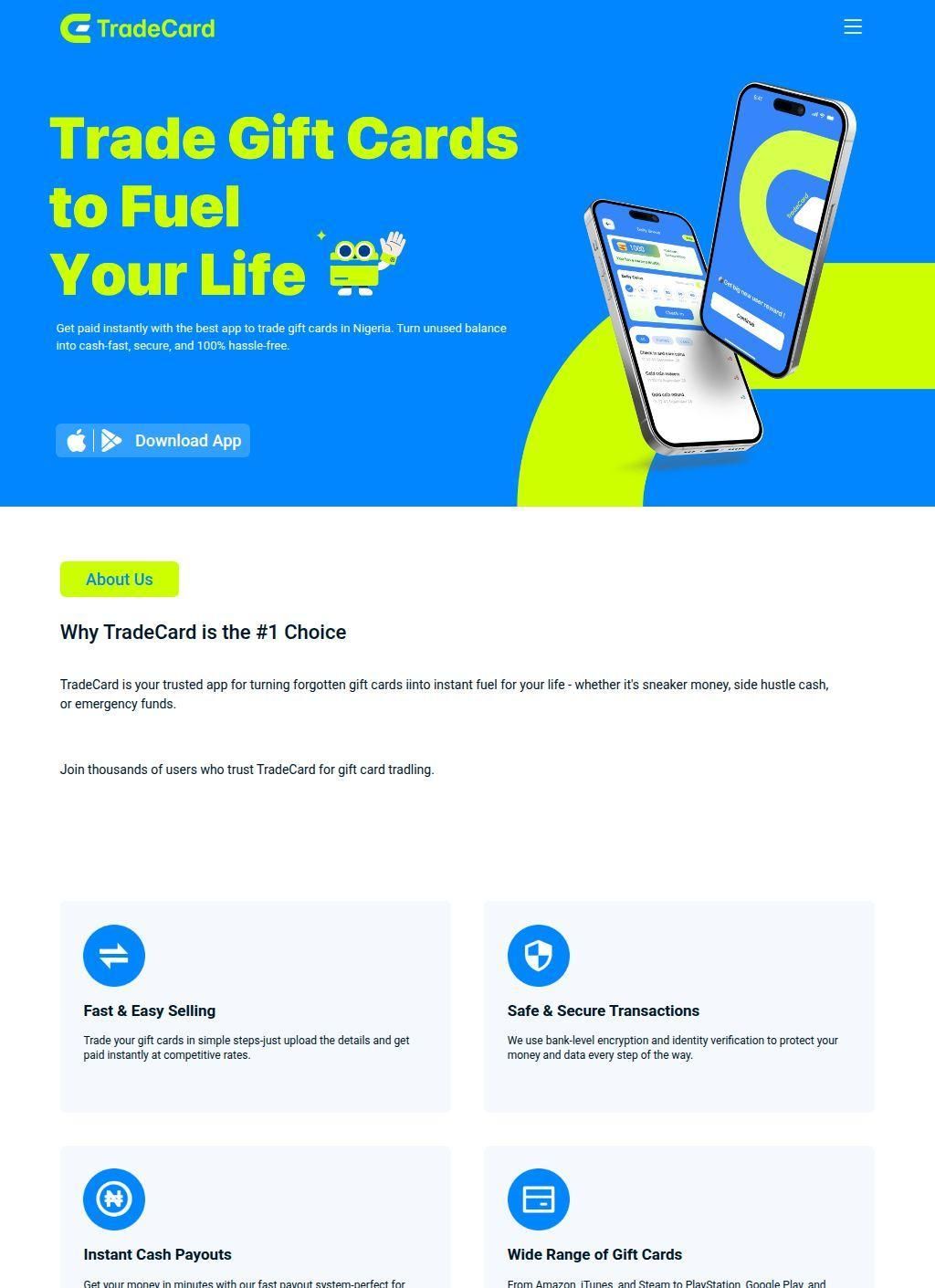
Nigerian gift card trading apps live or die on whether the rate on screen matches the payout in your wallet. TradeCard makes that its opening argument: rates for Steam, Amazon, iTunes, Google Play, and PlayStation cards are posted before a trade, not revealed after a long confirmation chain. Showing the number first commits the operator to it, and it is the right instinct for a market where the gap between quoted and actual rates has cost enough users to make scepticism the default posture.
Electricity bills and mobile services
The platform extends past gift cards into the kind of everyday errands that keep people opening an app between trades. Electricity bills, cable and TV subscriptions, mobile data top-ups, and airtime all clear through the same account. The logic is sound: someone who just cashed out a stray iTunes balance is already logged in and has naira to spend, and TradeCard is positioned to catch that moment instead of sending them elsewhere. A loyalty scheme called TradeCrowd, sign-in through Apple or Google ID, and TradeCard apps on both the iOS App Store and Google Play round out an offering that is clearly built to run on a phone, not grudgingly adapted to one.
eSIM coverage across 180 countries
A third element pushes TradeCard beyond its home market. An eSIM service advertised across more than 180 countries is an odd addition for a gift card desk, but it makes sense if the goal is to stay relevant to users who travel and accumulate foreign app-store balances they cannot easily spend at home. There is also a social initiative called Routes of Hope, run with HAEF Nigeria and focused on commuter savings. The brief gives no size or scope for it, but attaching the brand to transport costs for ordinary commuters at least connects to the same demographic that uses the card-selling service. The cause and the customer base overlap, so it reads as deliberate.
TradeCard holds a 4.3 out of 5 on Trustpilot from 18 reviews, split heavily toward five- and four-star ratings with nothing in the negative columns. A recently claimed profile with no visible review-solicitation campaign reads better than a wall of identical five-star praise, but 18 entries is not enough to draw confident conclusions either. Eighteen is a beginning, and the record is too new to lean on.
The app stores are more textured. Apple App Store reviews in Nigeria include at least one scam allegation alongside positive notes about reliability; the aggregate Apple rating was not retrieved, so the scam claim is one voice among several rather than a pattern. Google Play comments lean positive without a confirmed overall score. Glassdoor lists eight employee reviews, which at minimum confirms there is a staffed company behind the brand. None of these numbers are large enough to settle the question of reliability. Taken together they describe a young platform with a generally positive lean and one unresolved flag worth keeping in mind.
Testing with a modest first trade
For a gift card trading service, where fraud concerns come pre-loaded into user expectations, a single scam allegation does not damn the platform outright. It does, however, make a strong case for testing with a modest first trade and confirming the payout clears before moving anything significant. That is sensible practice in this category regardless of provider.
Email and social contact channels
On the contact side, TradeCard Ltd is named as the registered entity, a useful detail in a sector where anonymity is common. Public-facing contact is email-led: service@tradecard.store for general queries and a marketing address visible through the Trustpilot profile. Social handles under @tradecardofficial run across X, Facebook, Instagram, and TikTok. There is no listed phone number and no street address published anywhere on the site, which means social channels become the practical route for anything time-sensitive like a stuck transaction. The company advertises 24/7 support, which is the right offer for a money-handling app; whether it delivers on that promise is something only a real support request would confirm.
Binance P2P handles gift card liquidation for many Nigerian users, and it brings escrow, a large counterparty pool, and established volume. What it asks in return is fluency with a crypto exchange interface and the willingness to find a peer trader willing to take a specific card type, which is not always straightforward. TradeCard buys directly, posts the rate upfront, and lets the resulting balance flow into a bill payment or data top-up without leaving the app. The scope is narrower, but narrower can be faster and easier when the goal is simply converting a forgotten PlayStation credit into something useful. Pairing an open rate display with a named legal entity gives a user something concrete to act on, and the app-first design fits how people reach for these services in the first place.
The honest caveat is that the external reputation record for TradeCard, while not unfavourable, is short. Eighteen Trustpilot reviews and a mixed Apple App Store picture add up to a platform that has not yet accumulated the kind of public track record that lets you skip a cautious first trade. That is not a reason to avoid TradeCard, but it is a reason to keep the first exchange modest until the payout confirms the process works as described. Once it does, the combination of upfront rates, bill payment, and eSIM service gives the app a durable reason to stay installed past the single transaction most card-selling tools get used for.

Business address
TradeCard
42 Local Airport Road, Ikeja, Lagos,
Ikeja,
Lagos
100001
Nigeria
Contact details
Phone: +234 704 485 7687