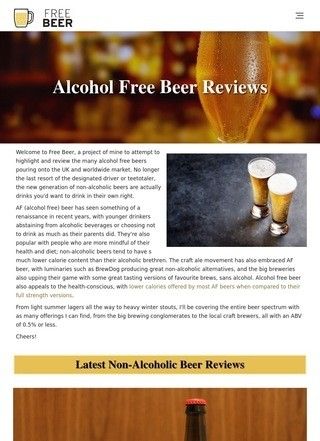
Free Beer is a UK-based website that reviews alcohol-free and low-alcohol beers, and despite the cheeky name it sells nothing at all. What Free Beer does is taste and rate beers in the no-and-low category, then publish written notes on each one. The scope turns out to be wider than the name suggests for a single-focus site: lagers, IPAs, stouts, ales and wheat beers all get their turn, and the selection pulls from both small craft outfits and the big mainstream names that have moved into zero-percent brewing.
How Free Beer rates alcohol-free brews
The structure of a typical entry is consistent. A beer gets pulled apart by aroma, taste and body, then handed a numerical score out of five, in the 4.3 format that other beer sites have picked up and quoted. When an outside brand like Impossibrew cites a Free Beer score in its own marketing, the implication is clear enough: the ratings have earned real credibility in the niche, even if the average shopper has never heard of the place. Editorial recognition from peers is a quieter measure than a pile of public stars, and in a corner this specific it counts for quite a lot.
Coverage runs across products you will find on UK shelves and a few from further afield. The reviewed list takes in Heineken 0.0, Big Drop Brewing, Days Lager, Free Damm, Hobsons Brewery, Free From and the Australian outfit Sobah, among others. That spread is useful because the no-and-low world is uneven: some zero-percent lagers are genuinely good and some are flat and forgettable, and a person browsing a supermarket fridge has little way of telling them apart without having tried a dozen first. Free Beer has done that legwork, and the breadth of the archive reflects it.
Education for newcomers to no-and-low
Yes, and that is what lifts it above a simple ratings feed. Alongside the reviews sit explainer articles aimed at the questions newcomers tend to have, such as "Are They Really Alcohol-Free?" and "How is Non Alcoholic Beer Made?" These are the sort of pieces that answer a real worry rather than fill space, because plenty of people coming off alcohol want to know exactly what "0.0" means and whether trace amounts are a problem. Putting that education next to the tasting notes is a smart call on the part of Free Beer, and makes the whole thing more useful to a reader who is new to the category and slightly suspicious of it.
Finding beers by style and category
The site is also sorted in a way that respects how people actually shop. There is a full archive of every review plus category archives broken down by beer style, so someone who only drinks stout, or who wants a non-alcoholic IPA for a barbecue, can go straight to the relevant shelf. That organisation is the right call for a resource that lives or dies on being browsable. The audience Free Beer has in mind is clear enough: drivers, teetotallers, people watching their fitness, and a growing group simply curious about cutting down without giving up the taste of beer.
Social media updates and contact options
Beyond the website, Free Beer keeps an active presence on Twitter and Instagram under the @FreeBeer_UK handle, where shorter tasting notes go out regularly. That steady posting is reassuring in its own small way. A site that updates its social feeds is a site someone is still tending, which is not always a given with niche hobby projects that quietly stall after a year or two.
On contact, the picture is honest but limited. Free Beer has a contact page covering the basics, and the social accounts give a second route to get a message through. What you will not find is a phone number or a postal address anywhere on the site. For a publisher of reviews that omission is mild and fairly normal, since there is nothing to visit and no order to chase, though anyone hoping to pitch a beer for review or query a score should expect to do it through the form or a direct message rather than a quick call.
No public ratings or review aggregators
There are no Google, Trustpilot, Yelp or Facebook listings for the site itself, so there is no body of public user feedback to weigh. That is common for an editorial project like Free Beer as opposed to a shop, and it does not undercut the work. What credibility Free Beer has comes from the quality of the writing and that peer citation, not from a star count of its own. Read a handful of the entries and judge from there; the notes are specific enough that a verdict forms quickly.
I would point a newly sober drinker or a designated driver here before any retailer's own blurb, since the scoring is independent and the style archives make a shortlist easy to build. Start with the explainer on how non-alcoholic beer is made, then pull up the category archive for whatever you normally drink and work down from the highest-rated few. Free Beer covers enough ground that most people will find something worth trying, and the writing is clear enough that you come away with a genuine opinion instead of a vague impression. If you run a brewery in this space, the contact form is the straightforward way to ask about getting a product in front of Free Beer for a write-up.