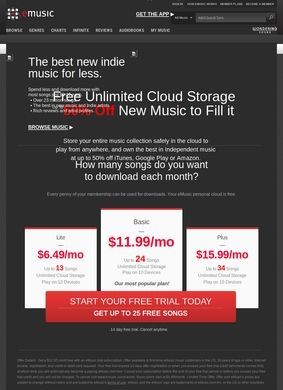
Albums priced from under a dollar up to around $7.49 set the tone for what eMusic is trying to be: a download store for people who care about catalog depth more than chart placement. eMusic sells individual tracks and full albums across genres that get short shrift elsewhere, including Big Band and Swing, Reggae and Dub, Folk and Country, and a Soul, Funk and R&B section that sits next to Classical and Jazz. The platform dates back to 1998, which makes eMusic one of the older surviving names in paid music downloads, and it has spent most of that history leaning toward independent labels and back-catalog titles rather than the major-label releases that dominate the big streaming apps.
Genre navigation and curation tools
Browsing is built around a few clear ideas. There are New Releases for people who want something current, Album Charts that can be filtered across all countries, and a Staff Listens column where editors put their own picks forward. A Spotlight section pushes particular labels and artists into view, which is the sort of curation that helps when the whole point of the site is finding music you would not stumble onto through an algorithm. For a buyer who already knows they want jazz or electronic and wants to dig, the eMusic layout makes sense. The genre navigation is the spine of the place, and it is where eMusic feels most like itself.
Expanding into audiobooks and blockchain
Beyond the download store, the company has stretched into a few other areas. eStories handles audiobooks, eMusic Live exists as a separate property, and there is a blockchain project attached to the brand that issues NFT-style digital music assets. That last piece raises a reasonable question about focus: a music store operating since the dot-com era now also wants to be a Web3 venture, and the two ambitions do not obviously reinforce each other. There is also a blog and a Press section, the usual furniture for a company that wants to look active and established.
Buying tracks versus subscribing
The buying model is a mix. You can purchase albums and tracks outright, and members can subscribe to plans that bundle access in some form. That flexibility is a genuine point in its favour: not everyone wants a monthly commitment, and the option to buy a record and keep it is useful in an era where most services only rent you access. The eMusic catalog focus on niche genres and independent music is the real draw, and if eMusic delivered cleanly on that promise it would be easy to recommend to crate-diggers and collectors. The pricing is low enough that a single good album find can justify a session of browsing, and the staff curation means there is an editorial hand between the listener and a raw search box.
Checking eMusic's reputation across review sites
That is where the picture turns hard, and it turns sharply enough to overshadow everything above. The outside reputation for eMusic is uniformly poor across every platform reported. On PissedConsumer the average sits at 1.5 stars across 51 reviews. SmartCustomer logs 25 reviews at 1.4 stars. ResellerRatings shows just 1.25 stars, though only from four people. Trustpilot's 15 reviews are described as very negative without a clean number attached, and a Yelp page with 19 reviews is marked closed. The Better Business Bureau rating is an F driven by customer complaints. It is rare to see this much agreement across services that usually disagree with each other.
Complaints over unauthorized charges
The complaints are focused, not spread across general dissatisfaction with taste or selection. They cluster tightly around two things: recurring charges that customers say they never authorized, and subscriptions that prove difficult to cancel once started. Those two failures feed each other, and they are exactly the failures that turn a hobbyist music purchase into a dispute with a card company. When the dominant story about a music store is its billing rather than its music, the catalog stops being the headline. The one exception in the reputation picture is internal: Glassdoor's 16 employee reviews average 2.8 stars, which says more about working at eMusic than about being a paying customer.
Missing contact information
Contact access does not help reassure on this front. A Contact Us link sits in the footer next to a Support link, but no phone number and no physical address appear on the homepage, so anyone with a billing dispute has to navigate to a separate support page to even begin. For a site whose chief reputational wound is unauthorized charges, routing the contact option a click away from the front door is the opposite of what would calm a worried customer. The company is headquartered in New York, but you would not learn that from the page itself.
Weighing catalog against reputation risks
So eMusic ends up a genuinely odd case. The store does something the giants mostly do not: it serves independent music and deep catalog at low prices with curation that respects the listener, and the option to buy outright is a real differentiator. I wanted to like eMusic more than the evidence allows. The trouble is that nearly every customer who left a public record left an angry one, and they were angry about money leaving their accounts without clear consent. No amount of good curation offsets that. The published record on eMusic is consistent enough across multiple independent platforms that it amounts to a warning worth heeding, and the site itself offers nothing to address or explain the gap between what eMusic promises and what many buyers report.