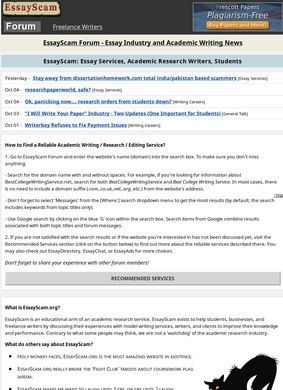
A word counter, a page calculator, a pricing estimator, a text cleaner and an HTML converter sit in the toolbar of Essay Scam, tucked in beside the discussion threads. The site is a public forum, built around talk about academic and essay-writing services, and it has run long enough to describe itself, without much modesty, as the only genuine place online discussing example academic paper services. That is a bold line for a niche this crowded, and the volume of forum activity is what it rests on.
The subject is a messy one. Paid essay services occupy a legal and ethical grey zone, and the market around them is thick with operators that take money and deliver little. Essay Scam plants itself in the middle of that mess as a place to compare notes before anyone hands over cash.
A forum built around scam warnings
The core of Essay Scam is its discussion board. Threads run across essay-writing services, academic integrity, and the day-to-day questions students and writers bring, and the topics move with the market. Recent discussion covers the use of AI in academic writing, which has upended the whole trade, and the particular problem of business-school application essays, where the stakes and the money both climb.
It reads like a working forum, with the back-and-forth of people who have used these services and want to warn or reassure the next person. The threads are not tidy, and that is part of what makes them believable.
Alongside the open talk sit directories of essay-writing services, annotated with reviews and outright scam warnings. This is the watchdog function, and it is the reason a lot of people arrive. Someone weighing up a writing service can look it up on Essay Scam before handing over a card number, which is exactly the moment such a warning is worth having. A forum that has watched operators come and go tends to remember which ones took the money and vanished, and that memory is harder to buy off than a fresh page of five-star testimonials.
The listings are not a polished buyer's guide; they read closer to a running ledger of complaints and endorsements, which is a rougher and in some ways more honest thing. A visitor gets warnings written by people with nothing to sell, next to the occasional plug from someone who clearly does, and learns to tell the two apart fairly quickly.
The writing forum and its threads
The Writing Forum is the engine. Everything else on Essay Scam feeds off the threads: the warnings, the recommendations, the arguments about what counts as cheating and what counts as legitimate help. Because the discussion is public and long-running, a search often turns up an old thread about a service that is still trading under the same name, which is the kind of institutional memory a fresh review site cannot fake. A visitor gets the accumulated experience of many users rather than a single editor's verdict.
The tone shifts from thread to thread, part gripe session, part genuine advice, and a reader has to sift a bit, but the raw material is there in a way polished review pages rarely manage. That sifting is the cost of a forum, and also the reason its verdicts are harder to buy or fake.
Calculators, counters and cleanup tools
The utilities on Essay Scam are more practical than they first look. A word and page calculator and a pricing estimator let a student sanity-check what a piece of work should cost and how long it should run, which is useful precisely because dodgy services rely on buyers not knowing those numbers. The word counter, text cleaner and HTML converter are the small, functional tools writers reach for constantly, the sort of thing people usually keep an extra browser tab open for.
None of them is fancy. They do a job, and having them on the same site as the forum keeps a user from wandering off to find them elsewhere. For a freelance writer juggling several jobs at once, a converter and a cleaner sitting in the same tab as the market gossip is a genuine time-saver.
There is also guidance on spotting plagiarism and on academic integrity generally. That material pushes Essay Scam past a pure gripe board into something closer to a reference: a place to learn how the detection tools work and where the ethical lines sit, as much as a place to complain about a bad experience. For a student trying to understand the rules before breaking or bending them, that guidance is arguably the most useful thing on the site, because it addresses the problem upstream of any purchase.
Plagiarism detection is a moving target, and a plain-language account of how the checkers behave is worth more to a nervous student than one more instruction to be careful.
Who turns to it and why
The audience is broad for such a specific topic. Students researching whether a service is legitimate, freelance and academic writers looking for work or comparing employers, and educators keeping an eye on the market all pass through Essay Scam. Anyone trying to sort a genuine operator from a con has reason to read the threads first.
That breadth is the site's real value. A student and a freelance writer want opposite things from an essay service, and a forum that hosts both ends up with a fuller picture of any given operator than either side would produce alone. Essay Scam benefits from that friction; the arguments between buyers and sellers are often more revealing than any single review.
A writer complaining about non-payment and a customer complaining about a bad paper are describing the same operator from two sides, and both accounts help the next person decide. It is a rare setup, because most review sites hear from only one of those two groups.
The structure around Essay Scam is plain. Home, Writing Forum, About, Disclaimer, Terms and Privacy make up the sections, and the Disclaimer page does more work here than it would on an ordinary site, given the legal sensitivity of the subject. A site that hosts discussion of services skirting academic rules has good reason to spell out where it stands and what it does not endorse.
Advertisers sitting beside the community
One thing a visitor should register early: Essay Scam runs advertiser and affiliate partnerships alongside its community content. That is worth keeping in mind on a site whose whole premise is telling users which services to trust. A watchdog that also carries paid placement is in an awkward position, and a careful reader will weigh the forum discussion, where many independent voices check each other, more heavily than any promoted listing.
It does not sink the enterprise. The community threads are the part with real value, and those are driven by users, not advertisers. Still, the mix means the warnings and the ads share the same page, and a reader has to keep the two straight. Essay Scam has always operated in a grey market, and its own funding model sits in that same grey, which is honest enough if a visitor keeps it in view rather than mistaking every listing for a neutral one.
The forum is public, the archive is deep, and the tools are free to use. On a subject where a single bad choice costs a student real money and possibly a grade, a searchable record of who did what to whom is the thing people come for, and on Essay Scam that record is the main event with the ads off to the side of it.
Business address
EssayScam.org
PO Box 1680,
Orlando,
Florida
32824
United States