A GCSE in Astronomy sits on the National Extension College course list, right next to the maths and English most people expect from a distance-learning provider. That one entry says a good deal about the place: the catalog runs well past the core subjects into corners other correspondence schools skip entirely.
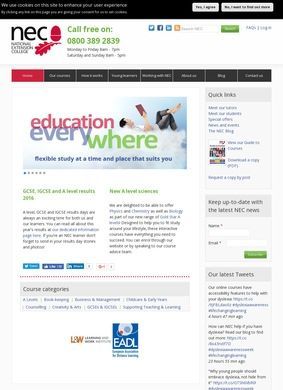
The National Extension College is a UK distance-learning institution, and its range is genuinely wide. More than twenty GCSE subjects, more than twenty A Levels, AS Levels, and International A Levels weighted toward science and maths make up the academic spine, and every one of them is studied remotely, on the learner's own schedule and in the learner's own time. For someone who cannot sit in a classroom, whether through work, health, distance, or a schooling that went sideways, that flexibility is the whole proposition.
The academic core: GCSEs and A Levels
The heart of what the National Extension College sells is exam qualifications for people studying outside a conventional school. Over twenty GCSEs cover the standard ground, maths, English, the sciences, and modern languages, and then keep going into specialized subjects such as the Astronomy course. The A Level list is comparably broad, and the AS Levels and International A Levels fill in around it for students who need a specific route into a science or maths pathway at university.
What makes this workable at a distance is structure. A syllabus studied alone can drift, and plenty of self-teaching attempts die that way, so the National Extension College packages each course with guided instruction and a defined path through the material. That is the difference between holding a qualification at the end and holding a pile of half-read textbooks. The guidance is flexible rather than loose; there is a route mapped out, but the pace bends around the student.
The subject breadth is the standout. Languages extend past the school staples into Latin and a spread of extended options, and the science offering is deep enough to support the International A Levels, which not every distance provider can say. A student rebuilding a set of grades can assemble almost a full curriculum here without going to a second provider for the odd subject, and that single-supplier convenience is worth real money in saved admin and coordination.
Accelerated and fast-track routes
Time is usually the real constraint for an adult returning to study, and the National Extension College answers it directly with compressed options. There are one-year accelerated GCSE courses, guided but flexible, and fast-track A Levels designed to be finished inside twelve months rather than the usual two years. For someone who missed a grade and needs it quickly, for a university place, a career change, or a professional requirement, that speed is the main draw of the National Extension College over a standard school timetable.
The trade is intensity. A single year to cover what a school spreads across two demands real discipline, and the flexible pacing only helps a student who genuinely keeps to it. This suits a motivated adult far better than a distracted teenager, and the National Extension College is fairly honest that the fast-track routes reward people who can manage their own time. Anyone who needs the external structure of a daily classroom should go in with eyes open.
Beyond exams: vocational and creative courses
School qualifications are only half the catalog. The National Extension College also runs professional and vocational courses that have nothing to do with sitting a GCSE, which widens the audience well past school-age learners and their parents.
Functional Skills in English and maths cover the practical numeracy and literacy that employers and training schemes often ask for as a baseline. CMI Management and Leadership certifications aim at people moving up at work and needing a recognized credential to do it. There is bookkeeping and accounting-software training on QuickBooks and Xero, the specific tools small businesses actually run their books on, teaching and education qualifications for people moving into the classroom, and counselling courses, so the National Extension College reaches career-changers and working professionals as much as teenagers chasing exam grades.
Software training tied to named packages is a practical touch, since an employer wants to hear Xero on a CV, not a generic reference to accounting software.
The creative and general-interest end is broader than expected too. Art History, Art Techniques, Critical Thinking, Problem Solving, some AI-related skills, and the language options mean the National Extension College also serves the curious learner who wants a subject for its own sake and no certificate at the end. That mix, hard exam credentials alongside courses taken purely out of interest, is unusual for a single provider and one of the more appealing things about the National Extension College.
Support and who it is built for
Distance study lives or dies on support, and this is where the National Extension College invests the most. Every course comes with one-to-one tutor support, so a student working alone still has a named person to turn to when a topic will not sit still. There is an exam-guarantee placement service, which is a genuine help: private candidates often struggle to find a centre that will let them sit the papers at all, and that alone can sink a self-study plan.
Flexible payment options lower the upfront barrier for people paying their own way, which matters when the student is an adult funding this out of a wage instead of drawing on a parent or a grant.
Beyond individual learners, the National Extension College runs dedicated services for schools, local authorities, and home educators, which tells you plainly who leans on it. Solo students are one part of it, but institutions filling gaps in their own provision are another, a school that cannot staff a minority subject, a council supporting a pupil out of mainstream education, a home-educating family that wants a ready-made syllabus and a real exam route in one package. The last group in particular is well served, since arranging a recognized qualification independently is exactly the part most parents find hardest.
Weighed against Oxford Open Learning, the other well-known name in British distance GCSEs and A Levels, the National Extension College holds up well on breadth and on an exam-placement guarantee that not every rival matches. Nothing here replaces the daily face-to-face contact of a physical classroom, and a local sixth-form college still does that better. Adults fitting study around a job, home-educated teenagers, and fast-track candidates chasing a single qualification are the ones this model was built for, and the catalog behind it is unusually deep for a distance provider.