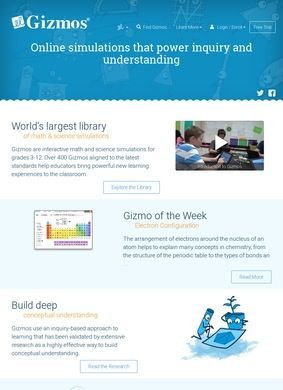
Four separate products sit under one roof here, each aimed at a different slice of the K-12 classroom, and that breadth is the first thing worth understanding about ExploreLearning. This is a US educational technology company building STEM software for schools, and instead of one all-purpose app ExploreLearning runs a small family of tools that teachers can pick from depending on what their students need. The pieces do not pretend to do each other's jobs, which feels refreshing after the usual one-size promises that crowd this category.
Four products for different grade levels
The flagship is Gizmos, a library of interactive virtual simulations for math and science spanning grades 3 through 12. The idea is that a student manipulates a model on screen, changes a variable, and watches the result, a method that suits concepts awkward to demonstrate with a textbook alone. Reflex handles something narrower and arguably harder to make stick: math fact fluency, using an adaptive engine that adjusts as a child practices. Frax takes the game route to teach fractions, pitched at grade 3 and up, where plenty of learners stall. Science4Us rounds it out at the youngest end, a K-2 science curriculum with thousands of activities that work both online and offline. That last detail matters in real classrooms where the wifi is not always cooperating.
Gizmos interactive simulations
Put together, the catalogue covers a genuine arc from early elementary science up through high school math and science, with two of the four products zeroed in on specific skills (facts, fractions) that teachers know cause trouble. That is a more thoughtful spread than a single platform claiming to teach everything, and it points to ExploreLearning paying attention to where students actually get stuck.
Reflex, Frax, Science4Us
The audience is squarely institutional: classroom teachers, school administrators, and the students they manage, not a parent shopping for after-school help. You can see it in the supporting material wrapped around the products. ExploreLearning offers professional development for educators, an educator support hub, research documentation, and a set of customer success stories. A district evaluating software wants proof it works and proof it will not create a compliance headache, and the site leans into both, foregrounding evidence-based outcomes and data privacy.
Built for schools, not parents
That framing shapes how you should read everything else. The emphasis on classroom integration, the research papers, the case studies from schools that adopted the tools: all of it is the language a procurement committee responds to. For an administrator weighing a purchase, that is exactly the right material. A parent landing here by accident would find less to grab onto, and that is fine, because ExploreLearning is not chasing them.
Professional development and educator support
The professional development angle deserves a separate mention. Plenty of classroom software gets bought and then sits unused because nobody showed teachers how to fold it into a lesson. By building training and an educator support hub into the offering, ExploreLearning at least acknowledges that the software is only half the equation. Whether the training is any good is something a school would need to test during a trial period, but the intent to support adoption is visible throughout the site.
Contact methods for districts
On contact, ExploreLearning keeps it straightforward. A toll-free number and a direct line are both posted, alongside accounts on LinkedIn, X, Facebook, YouTube, and Instagram. There is no street address on the homepage, which for a software vendor selling to districts by phone and rep is no real loss; schools deal with sales contacts and support lines, not walk-in visits.
Limited customer reviews available
Here the review picture is limited, and it is worth being honest about why. The Trustpilot page tied to explorelearning.com carries just three reviews with no aggregate score, which is too little to draw any conclusion from. Anyone hunting for a verdict from end users will not find a meaningful one at this point. There is a confusing wrinkle as well: a UK tutoring company shares the name Explore Learning and operates at a separate web address, and that business has thousands of Trustpilot reviews plus its own employer profile. Those numbers belong to a different company entirely. A quick search will surface the UK firm's tallies and it is easy to accidentally credit them to the US software outfit if you are not paying close attention.
Glassdoor ratings from staff
The one third-party data point that does point at this ExploreLearning comes from the employee side. On Glassdoor, roughly 86 percent of staff say they would recommend the company, with an overall rating sitting around 4.1 out of 5. That is an internal measure, not a customer one, so it tells you more about the workplace than about whether Gizmos lifts test scores. Still, a contented staff is not nothing, and it is the more reliable of what is available.
So the credibility case rests less on crowd reviews and more on what ExploreLearning publishes about itself: the research documentation and the school case studies. A buyer who wants independent verification will have to lean on those, or better, run a classroom pilot. The short review record is a feature of B2B education software in general, where purchasing happens through district procurement rather than public ratings platforms, so it does not disqualify ExploreLearning, but it does mean you are mostly taking the company's own word for things until you trial the product.
How ExploreLearning compares to IXL
ExploreLearning makes a strong impression as a focused, school-oriented operation with products that target real instructional pain points and a clear effort to support the teachers using them. The Gizmos simulation library in particular is the sort of thing that is genuinely hard to replicate well, and Reflex and Frax show a willingness to go deep on narrow skills instead of reaching for breadth. The weak spot is external validation aimed at customers, which is sparse in ways that ExploreLearning shares with most of its B2B peers.
Set against IXL, probably the most obvious competitor a school administrator would also be evaluating, the comparison sharpens. IXL casts a wider net across subjects and grade levels in a single subscription, which appeals to a district wanting one tool to cover a lot of ground. ExploreLearning answers with depth instead: the hands-on simulations and the skill-specific programs that broad practice platforms tend to gloss over. If a school wants one comprehensive workhorse, IXL has the edge on coverage. If the goal is making abstract science and math tangible, or cracking fact fluency and fractions specifically, the ExploreLearning products are built precisely for that, and a pilot run is the logical next step before any purchase decision is made.