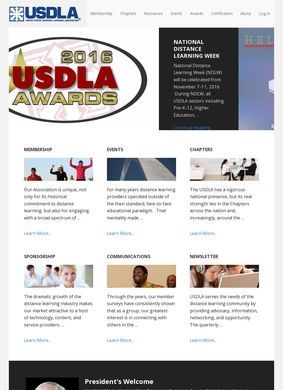
United States Distance Learning Association is a national nonprofit for the people who design and deliver education outside the traditional classroom. Its aim is plainly stated: lift the quality of distance and online learning, and give educators the training, tools and resources that effective online teaching demands. The website is built around that aim, and it works as an operating hub, pulling together the events, credentials and research that a working member comes back to.
Everything on the site hangs off a membership program built in tiers, so an individual instructor, a corporate training lead and an entire institution can each join at the level that suits them, with benefits that scale as the commitment grows. Members are the audience for almost every feature, and what that membership opens up is where the United States Distance Learning Association earns a serious look. For a working educator, the value is less any single perk than the standing bundle of events, credentials and research kept in one place.
Membership and its events calendar
Joining is less about a card and more about access. Two things dominate what a member gets in return: a place in a national network organised down to the regional level, and a year-round calendar of events built for a profession that meets both in person and on screen.
Neither is filler, and both reward people who stay involved beyond renewing once a year. The events in particular are the engine of the whole thing, the reason a lapsed member tends to drift back.
Membership tiers and chapter networks
The tiered structure is the practical entry point. The United States Distance Learning Association sets benefits by level, so a solo educator receives something different from what a large university or training company gets, and the value climbs with the tier. Beyond the individual membership, the United States Distance Learning Association runs chapter networks spread across the country, giving members a regional layer of contacts and smaller events without depending on a single national hub for everything.
In a field where a practitioner is often the only distance-learning specialist in their building, that peer network is one of the more practical things on offer, and it is the part that turns a subscription into a professional home.
Conferences, webinars and training
Events fill the busiest stretch of the calendar. There is an annual National Conference held in person, alongside virtual conferences for those who cannot travel, a fitting arrangement for a group that champions learning at a distance.
Between the flagship gatherings, the United States Distance Learning Association schedules webinars and smaller training sessions through the year, so professional development arrives as a steady stream rather than a single annual lump. A member has somewhere to learn most months, which in a fast-moving field is worth more than one intensive week followed by eleven quiet ones. The virtual formats also mean geography stops deciding who gets to take part.
Certification and research resources
The United States Distance Learning Association also works at the level of programs and knowledge, above the individual career. One track certifies whole online offerings; the other gathers the reading and research a practitioner needs to keep current, and the two reinforce each other.
That split between certifying programs and building a knowledge base runs through everything at this level, and it explains why the two sections below read so differently: one hands out a credential, the other stocks a library that keeps feeding the standards behind it.
Program certification for institutions
Certification is aimed at organisations, not individuals. The United States Distance Learning Association certifies distance-learning programs run by educational institutions, which hands a school or provider an external, association-backed mark that its online program meets a recognised standard.
For an institution trying to signal quality in a crowded online market, a credential from a long-standing professional body is harder to wave off than a self-declared claim. It also folds that institution into the same standards conversation the association exists to lead, which is arguably the larger benefit, because it keeps a school aligned with where the whole field is heading rather than judging itself alone.
Research, publications and the resource library
The knowledge side rewards a slow browse. The United States Distance Learning Association maintains research resources and publications, a distance-learning resources library that gathers reference material into one place, and a blog and news section that follows what is changing in the field. A newsletter pushes the same updates to an inbox for members who would rather be told than go digging. My read, working through these sections, is that they are pitched at working practitioners keeping current, and the depth matches that audience instead of a casual passer-by.
That research also feeds back into the certification standards, so the library is not a side project but the evidence base the credentials rest on.
Advocacy weeks and job listings
Two annual initiatives push the group out past its own membership. National Distance Learning Week is a promotional and educational drive around the field at large, aimed at raising the profile of online education generally. Public Policy Week points the United States Distance Learning Association at legislators and decision-makers, forming the advocacy arm of what is otherwise a member-services body. Together they mark an organisation that speaks for distance learning in public while serving the practitioners already inside it, and the second role is the one that separates a professional association from a simple membership club.
For members with a more immediate need, the United States Distance Learning Association runs a job-posting service dedicated to distance-learning roles, a narrow board that beats a general jobs site for anyone hiring or hunting inside this specialism. Sponsorship slots let partner companies attach their name to the events and the audience, the standard funding model for a body of this kind, and they also give vendors a legitimate way to reach the exact educators they build products for.
The whole apparatus points at a clearly defined crowd: educators, corporate training professionals, educational institutions, and any organisation involved in delivering or developing distance education. It is a focused audience, and the site does not pretend to serve anyone outside it.
On the calendar, National Distance Learning Week and Public Policy Week come round each year; the job board stays open to members in between; and the resources library, the conference registration and the certification track all sit within a click or two of the homepage, every one of them carrying the United States Distance Learning Association name.