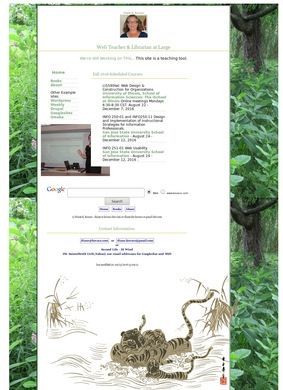
A working librarian who has been told to log continuing-education hours before the next appraisal, and who would sooner learn from a person than click through a recorded module at midnight, has a fairly narrow set of places to turn. Kovacs Consulting is built for exactly that reader. Run by Diane K. Kovacs, the site sells "Internet and Web Training" and teacher-led, web-based professional development aimed at librarians and other information professionals who need structured instruction to stay current in their work.
The pitch is specific about who it serves. This is continuing education for people already inside libraries and information roles, not a general adult-learning site that happens to mention research skills in passing. That narrow focus is the strongest thing Kovacs Consulting has going for it, because a course written for librarians by someone who has taught them tends to land closer to the day-to-day than a generic web class would.
What sits behind the Kovacs Consulting name
The teaching runs through a partnership with San Jose State University's School of Information, which gives the courses an academic home and a recognizable transcript line. That affiliation shapes the value of the course: it ties the training to an accredited iSchool, so the credit a student earns carries a name a supervisor or a licensing body will recognize without a second look, and that recognition is often the whole reason a busy librarian pays for a course instead of piecing training together from free webinars.
Two courses anchor the catalogue, and both are scheduled well ahead across several terms, Summer 2026, Fall 2026, and Spring 2027, so a prospective student can plan around a set calendar instead of waiting for a session to be announced. The rest of the offering is deliberately small, and Kovacs Consulting does not pretend otherwise.
Internet and web training, taught by an instructor
The description Kovacs Consulting leads with, teacher-led and web-based, is the thing that separates it from a self-paced video library. Courses are delivered live and online, so a librarian in one state can take instruction without travel while still having an instructor on the other end to answer a question in real time.
For continuing education tied to a job requirement, that live element is the selling point, and it is the reason someone would pick this over a cheaper recorded course. A student who wants to disappear into a set of videos on their own schedule will find the format a poor match. A student who wants to be taught, and to ask, will not. That difference separates the people this format serves well from the people it does not.
INFO250 and INFO251
The two named courses are INFO250, Design and Implementation of Instructional Strategies for Information Professionals, and INFO251, Web Usability. The first is squarely about teaching, useful for a librarian who runs patron workshops, teaches an information-literacy session, or trains junior staff and wants a framework for doing it well. The second, Web Usability, points at the practical work of keeping a library's website usable for the public who depend on it.
Both carry San Jose State course numbering, which tells a student precisely what the credit represents and where it will land. Two courses is a short list, though, so anyone hoping for a broad menu of subjects should know the range going in and treat Kovacs Consulting as a specialist stop rather than a one-stop school.
A Books section and a spare About page
Beyond the courses, Kovacs Consulting keeps a Books section referencing published materials by Diane Kovacs, which gives some sense of her background as an author in the field and adds a measure of credibility to the instruction. Someone deciding whether to spend money on an instructor tends to want evidence that the instructor has done the work, and a shelf of published titles supplies some of that.
The navigation is minimal: Home, Books, About. There is no sprawling menu to get lost in, and a first-time visitor can read the whole of Kovacs Consulting in a few minutes. The flip side is that the pages do not say much beyond that. A browser wanting course syllabi, a price, or a sense of class size will have to write in and ask.
How to reach Diane Kovacs
Contact is where Kovacs Consulting shows its age. The operator's name, Diane K. Kovacs, is stated plainly, which counts for something. An email is given, but only in obfuscated text form, spelled out as "diane at kovacs dot com" so a human can read it and a spam bot cannot. No phone number and no postal address appear on the fetched pages, and the navigation carries no contact tab, only Home, Books, and About.
The details are present; they are simply not put where a hurried visitor would look first. For a solo operation trying to keep the inbox clean, I can see the logic behind spelling the address out, though a would-be student in a rush may find the extra step a small irritation when they want to enroll now and not later.
Outside opinion is the real blank. A search for reviews of Kovacs Consulting turns up other businesses that happen to share the Kovacs surname, a motor dealer, a construction firm, an alarm company, a consulting group listed on Glassdoor, and none of them review the librarian training run at this address.
There is no Trustpilot score, no Google rating, no third-party testimonial to weigh. A prospective student is left judging the courses on the San Jose State affiliation and the course descriptions themselves, without a crowd of outside voices to lean on, and it is an absence worth knowing about going in.
In a field as small and closely networked as academic librarianship, word of mouth among colleagues may quietly fill the gap that a search engine cannot, but a first-time buyer sitting at the enrolment page has none of that private knowledge in front of them.
The two courses repeat across three coming terms, Summer 2026 through Spring 2027, each attached to a San Jose State course number. The email on the site is still written out as "diane at kovacs dot com," one word at a time.