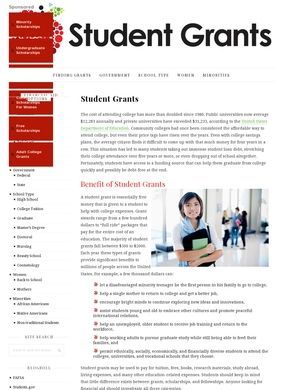
Where does a student start when the cost of a degree feels like a wall and the word "grant" gets thrown around without anyone explaining what it means? StudentGrants.org answers that by pulling the main funding paths into one free, readable place. It walks through the federal options most people have heard of in passing, Pell Grants, TEACH Grants, and FSEOG, and then keeps going into state programs and the quieter pools of money that come from employers and private organizations. Nothing here is locked behind a paywall, a login, or a sign-up form.
How grants are organized by student level
The structure is the most useful thing about it. Funding is sorted by where you are in your education, so a high school senior, an undergraduate, a graduate student, and someone finishing a doctoral program each have a path suited to their stage. That alone saves a lot of wasted reading, because a grant aimed at first-year students rarely helps someone three years into a PhD. StudentGrants.org treats those levels as genuinely separate, which matches how the real money is distributed.
Finding grants for your background or career
On top of education level, the content is also cut by who the student is. There are sections for minority students, women, veterans, students with disabilities, and international students, plus a breakdown by career field. That second axis matters because a large share of grant money is tied to demographics or a chosen profession, and a student often qualifies for far more than the obvious federal aid once they look through that lens. A veteran returning to school and an international student starting a master's are looking for very different things, and StudentGrants.org gives each of them a door rather than a single generic page.
Eligibility rules and application steps
For every grant type covered, the explanation follows the same practical pattern: who is eligible, and how you actually apply. That is the part students usually get wrong, missing a deadline or assuming they do not qualify when they do. Eligibility rules for grants can be fussy, and having them spelled out in plain language ahead of time is worth more than a glossy list of program names. For the application step itself, StudentGrants.org does the honest thing and points you outward to FAFSA.ed.gov and other official portals, because that is where submissions actually happen.
It is worth being clear about what StudentGrants.org is not. It does not hand out money, it does not award anything, and it does not run a single grant program of its own. It is a guide, an index, a starting map. Some visitors arrive expecting an application they can fill in on the spot, and that expectation will not be met here. Read correctly, though, the role is a reasonable one. Federal, state, and private grant information lives scattered across dozens of government and institutional sites, and a single place that organizes it by student type and explains the basics has a clear purpose.
That model also shapes what kind of relationship a student has with the site. Because StudentGrants.org collects and explains information instead of processing applications, there is little reason to need ongoing support from whoever runs it. You are not submitting documents or waiting on a decision from it. Still, the absence of any visible way to reach the operator is worth noting. The landing page and the navigation show no phone number, no mailing address, and no contact form. For a purely informational resource that points you elsewhere to apply, that gap is less alarming than it would be for a service handling your data, but it does leave open the question of who stands behind the content and how a reader would report an error or an outdated program listing.
A search for third-party opinion on StudentGrants.org did not surface notable reviews or ratings on any platform. What turned up were comments tied to other, similarly named grant sites, near-miss names easy to confuse, which say nothing about this one. There is no chorus of student feedback to lean on, positive or negative, and a visitor ends up judging the site on the quality and clarity of its pages rather than on accumulated outside opinion.
For free educational content, that is the right test anyway. A student pays nothing to read it, gives up no personal information, and risks nothing by checking whether a grant they had never heard of fits their situation. The downside of spending twenty minutes on StudentGrants.org is small, and the upside, finding a state program or a field-specific grant that the FAFSA process alone would never have flagged, can be real. StudentGrants.org does enough here to make that twenty minutes worthwhile, provided the reader keeps in mind that binding rules and deadlines always live on the official program pages.
Checking information against official sources
The thing to watch with any aggregator of grant information is freshness. Federal award amounts shift, state programs open and close, and eligibility wording changes from year to year. StudentGrants.org does not display a clear signal of how current its pages are, and with no contact route, a reader cannot easily ask. That puts the responsibility back on the visitor to confirm anything important against the source before counting on it. Treated as a place to discover options and learn the vocabulary, then cross-checked against FAFSA.ed.gov and the relevant state or institutional site, StudentGrants.org does an honest job of the narrow thing it sets out to do. The published content is clear enough and organized well enough that the site earns a straightforward recommendation as a first stop, not a last word.