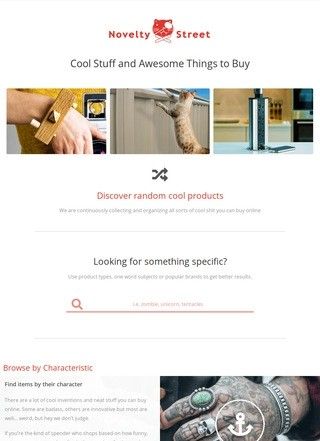
Where do you turn when you want to buy something odd, funny, or genuinely strange as a gift, and you have no idea where such a thing would even live online? Novelty Street is built for exactly that moment. It is a discovery layer that sits on top of the wider web of shops, pulling together products that are unusual, giftable, or just plain weird, and sorting them into something a person can browse without a clear search term in mind. You arrive not knowing what you want, and the whole point is to leave with an answer you would never have typed into a search box.
How the site works
Novelty Street does not run its own checkout. Nothing is sold here directly. Instead, the site collects items from other online retailers and links out to wherever the thing is actually for sale. That changes what you are looking at: this is a curation and browsing tool, a sort of index of curiosities, and any purchase happens somewhere else entirely. Understanding that up front saves confusion later, when you click a product and land on a third party store you have never heard of.
Browsing by filters and mood
The organising idea on Novelty Street is filters, and they are more thoughtful than the usual category grid. You can browse by who the gift is for, with guides aimed at men, women, kids, couples, and pets. You can browse by budget, with bands running from items under five dollars all the way past a thousand. And you can browse by feel: funny, cute, creepy, innovative, badass, elegant. Picking "creepy" and a low price ceiling is a far more natural way to shop for a gag gift than hunting through a generic store's catalogue, and that combination of axes is the strongest feature Novelty Street offers.
Stacking those filters together is what gives Novelty Street its character. A shopper does not arrive knowing the product they want. They arrive with a vague brief, something like a cheap funny thing for a coworker, and the layout maps to that brief. Most shopping sites assume you know the item. This one assumes you know the vibe and the recipient and not much else, which is honest about how gift hunting actually works.
Random discovery tool
There is also a random product discovery tool on Novelty Street, which fits the spirit of the project well. Hit it and you get something unexpected: the digital equivalent of poking through a shelf of oddities with no list in hand. For a site whose entire reason to exist is stumbling onto things, a deliberate "show me anything" button is a smart inclusion, and it rewards the kind of aimless browsing the rest of the design encourages.
Curated lists and departments
Beyond the filters, Novelty Street puts together themed roundups: collections of slippers, zombie dolls, Etsy finds, and similar narrow groupings. These curated lists are where a human editorial hand shows through, and they are the difference between a dumb feed of products and something that feels chosen. A roundup of zombie dolls is not an algorithm's idea of a category. Someone decided that was worth assembling, and that decision is the value.
The department-style browsing rounds things out for people who prefer to wander top down through broad sections instead of starting from a mood word. Between the filters, the lists, and the random button, there are three or four genuinely different ways to find the same catalogue, and they suit different states of mind. That redundancy is a feature, not clutter.
Social media presence
Novelty Street sums up its own job as continuously collecting and organising all sorts of cool stuff you can buy online, which is a fair plain-English description of what it does. There is a Tumblr presence too, where Novelty Street shares links to its product lists, extending the same discovery idea onto a platform built for casual scrolling. Tumblr audiences browse the way the main site wants people to browse, so it is a sensible fit.
Affiliate model limitations
The affiliate-style model deserves a clear eye. Because every product links out to an external retailer, the experience after the click is entirely out of Novelty Street's hands: the price you see, the stock status, whether the item still exists, the shipping, the returns, all of it belongs to whatever shop you land on. Curation sites like this can drift, with dead links and discontinued products lingering long after the source store moved on. Nothing in the published content says that has happened here, but it is the structural risk of any aggregator, and a buyer should treat the linked store, not this index, as the place that actually owes them a working transaction.
On contact, Novelty Street keeps a "Contact and Legal" link in its navigation, so there is a route to reach whoever runs it. That route is not front and centre. The homepage shows no phone number and no address, and you have to open a separate page to find the details, which is a minor friction point but a normal one for a site that links out to other shops rather than holding your money. Nobody is going to need to phone a curation index about a parcel, since the parcel is the retailer's problem.
Reputation is the real gap here. A search for outside reviews of Novelty Street turns up nothing that clearly belongs to this site. The results that do surface point at unrelated outfits sharing a similar name: a home services contractor, a real estate project in India, a sign shop, a restaurant. There is no body of independent feedback to lean on, no rating to cite, no chorus of users vouching for the curation. That absence does not condemn Novelty Street outright, but it does mean a visitor is judging the site on the experience itself, with nothing written down by anyone else to cross-reference.
Given all of that, Novelty Street is most useful to someone who enjoys the hunt more than the certainty of the purchase, or who needs ideas for an awkward gift and does not know where to start. The mood-plus-recipient-plus-budget filtering is genuinely better suited to that problem than typing keywords into a standard store. Where the site falls short is as any kind of transactional trust anchor: it does not sell, it links, and there is no outside reputation to calibrate how reliable the curation has been over time. Treat Novelty Street as the front door to other shops, not the shop itself, keep your expectations set on inspiration rather than purchase, and you will find it does that job well enough to be worth returning to next time a gift has you stuck.