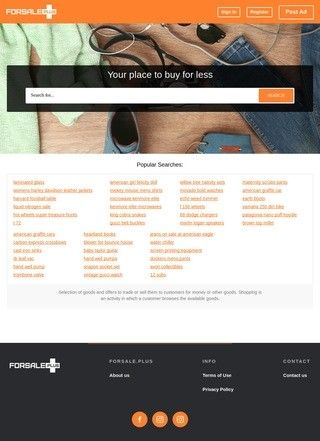
Standing in a store aisle with a full cart and a nagging sense that half of it will sit unused, most shoppers reach for their phone and search for a way to think it through before they pay. That gap, the moment between wanting something and buying it, is exactly where ForSale.plus tries to be useful. The site is not a shop and does not sell anything. It reads as a written guide to spending money better, aimed at people who suspect their buying habits could stand a little discipline.
The category label here says Shopping and E-commerce, and that framing sets an expectation the page then quietly declines to meet. There is no storefront, no marketplace, no listings, no cart of its own. What ForSale.plus offers instead is advice, organised into nine distinct topics that together read like a short course in becoming a more deliberate consumer. Someone arriving expecting to browse products will need a moment to reset, because the value on offer is guidance, not goods.
Nine topics for deliberate spending
The nine topics cover a lot of the actual mechanics of spending. The first and most familiar is the split between needs and wants, the question you are supposed to ask before the wallet comes out. From there it moves into budget management, then into researching products and comparing prices so you are not paying more than you have to for the same item. Timing gets its own treatment, the idea that when you buy can matter as much as what you buy, since prices swing across the calendar. There is a section weighing online purchasing against going into a physical store, which is a genuinely practical comparison for anyone who defaults to one habit without thinking about the trade-offs.
Needs versus wants and budget management
The back half of the material widens the lens. One topic looks at technology tools that help people save, the apps and trackers and comparison utilities that do the legwork a person would otherwise skip. Another turns to eco-conscious buying, the environmental cost sitting behind a purchase that the price tag never shows. Evaluating quality gets a section too, so a buyer can tell durable from disposable ahead of the purchase. And the last one is the most interesting choice on the list: emotional awareness while shopping, the recognition that a lot of bad purchases are driven by mood, boredom, or the small rush of buying rather than any real requirement.
Tools for saving money
Put together, those nine pieces form a reasonably complete map of where money leaks out of a household. ForSale.plus states plainly that it is written for two audiences at once: seasoned shoppers who want to sharpen an approach they already have, and casual or occasional buyers who have never really examined how they spend. That is a sensible pairing, because the advice sits at a level that works for both. None of it is advanced enough to bore an expert into leaving, and none of it is so specialised that a newcomer would feel shut out.
Quality, environment, emotional awareness
What the site does well is coverage. The topics do not overlap much, and each one addresses a real decision a shopper faces. Needs against wants, a budget to stay inside, research before buying, the right moment to buy, where to buy, what tools to lean on, the environmental angle, the quality check, and the emotional pull. Read straight through, it is a checklist a careful buyer would recognise. The strongest thing about ForSale.plus is that it names the parts of shopping people usually run on autopilot, and the emotional-awareness piece in particular is the sort of thing plenty of budgeting sites leave out entirely.
Who wrote this and how to contact them?
What surrounds the words is a different story. The content is the whole of ForSale.plus. There is nothing on the page to tell a visitor who wrote this, what the site is trying to become, or whether anyone stands behind the guidance. No phone number appears, no email, no postal address, and there is no contact page to click through to. A reader who finished the material and wanted to ask a question or point out an error would have nowhere obvious to go. For a site whose entire product is advice, that absence of any visible author or point of contact puts a ceiling on how much trust it can build; readers tend to weigh advice differently once they know who is giving it.
No author or contact information
The reputation side is quiet in a way that is worth being honest about. A search for outside reviews of ForSale.plus turns up nothing that actually belongs to it. The results that surface are for ForSaleByOwner.com, a real estate service with no connection to this site, and folding those ratings in would be misleading. Scamadviser has an entry for the domain, but it carries no user reviews at all, and its trust label is generated by an algorithm reading technical signals, not a verdict from anyone who used the site. So there is no body of real feedback to draw on here, positive or negative. That is not a mark against the content itself, but it does mean a first-time visitor is judging ForSale.plus on the writing alone.
Outside reviews and track record
Weigh that fairly and it lands as a modest, useful resource operating in a spot where a lot of overlap already exists. Personal-finance and smart-shopping advice is not scarce, and a page competing in that space with no named author, no contact route, and no track record of reader response has to win on the quality and clarity of what it says. On the evidence of the nine topics, the substance is sound and the selection is thoughtful. Whether it is deep enough to send someone back a second time depends on how much detail sits under each heading once you start reading, and the outline alone cannot answer that.
From outline to actual depth
For its intended reader, the occasional buyer trying to stop impulse purchases or the regular shopper wanting a framework, ForSale.plus does have something to say. It treats shopping as a set of decisions that can be improved with a little structure, and it walks through those decisions in an order that makes sense. A person looking for this listing in a business directory expecting to buy something will be in the wrong place; a person looking to shop more carefully will find a starting point. The reasonable use of ForSale.plus is as a quick read to sharpen your own habits before the next purchase, not as a destination you return to often.
The gap between the label and the reality is the detail that lingers, and it is a description more than a complaint. Filed under e-commerce, ForSale.plus sells no goods and processes no transactions. It is a guide wearing a shopping badge, and once that is clear the material stands on its own terms. The nine topics are there, the writing addresses both novices and veterans, and the advice is practical enough to act on. What is missing is any window into who assembled it. A visitor gets the counsel and none of the credentials, and closes the tab knowing more about spending than about the people telling them how.
Business address
ForSale.plus
13-280 West Beaver Creek Rd Unit #250,
Richmond Hill,
Ontario
L4B 3Z1
Canada