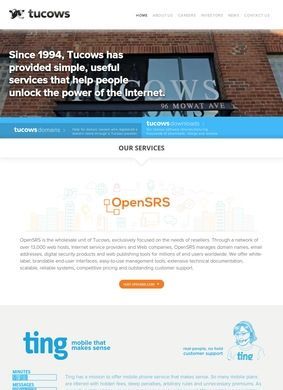
OpenSRS, Enom, Ascio and Hover are, underneath the branding, four faces of a single operation: Tucows Domains, which the corporate site bills as the world's second-largest domain registrar. That one fact reframes what Tucows is. A lot of people who have registered a domain in the last two decades have done business with Tucows without ever seeing the name, because the company sells wholesale through resellers as readily as it sells retail through Hover.
Tucows Inc. is a publicly traded internet infrastructure company, and its own website is written for several audiences at once: business customers, individual buyers, investors, and prospective employees. The homepage does not try to sell you a single product. It maps out a group of distinct businesses and lets you find the one that concerns you, which is either refreshingly honest or slightly disorienting depending on why you arrived.
Three businesses under one corporate name
The structure of Tucows is the structure of the site. There are three core operations, and the pages are organised around them rather than around a marketing funnel. Once you understand that, the whole thing reads more clearly, because a person shopping for a domain and a telecom operator evaluating billing software have almost nothing in common except the parent company.
The About Us area fills in the corporate frame: company overview, leadership, history and the group's inclusion initiatives. Investors get a properly stocked section of their own, with financials, news, stock information and SEC filings, which is what you would expect from a listed company and a useful signal that the numbers are open to inspection. Careers lists roles across the divisions, and Tucows recruits tech professionals well beyond any single country.
Domains, from wholesale to Hover
The domain side is the oldest and the deepest part of Tucows. OpenSRS and Enom are the wholesale engines, the plumbing that thousands of resellers and hosting companies quietly run on. Ascio serves the corporate and enterprise end. Hover is the retail storefront, the one an individual actually visits to buy a domain and an email address without being upsold a dozen things they will never use.
Splitting the same capability into four brands aimed at four buyers is a deliberate design, and it works because each brand can speak to its own customer without confusing the others. A reseller does not want the Hover experience, and a first-time buyer does not want a wholesale control panel. Tucows runs both, and that breadth is the clearest argument for taking the domain arm seriously.
Domains is also the part with the longest memory. Resellers build whole hosting businesses on top of OpenSRS and Enom and then stay for years, because moving a book of domain names is painful and risky, so the wholesale side holds its customers through inertia as much as merit. For a buyer sizing up the registrar, that stickiness cuts two ways. It signals a dependable backend, and it also means a complaint can take a long time to turn into lost business.
The retail face, Hover, has to win people the harder way, one clean checkout at a time, which is probably why it has the friendliest reputation of the four.
Ting fibre and the Wavelo platform
Ting is the part of Tucows that pours concrete. It is a fibre-optic internet provider steadily expanding across American communities, which puts a physical, infrastructure-heavy business next to the software and registrar operations. Fibre is slow, expensive, capital-hungry work, and a company willing to dig trenches is making a very different bet than one that only pushes bits around.
The community angle is the interesting wrinkle. Ting does not blanket the map; it arrives town by town, wiring up the specific American communities where the economics and the local appetite line up, which makes it as much a local utility story as a national technology one. For a household in one of those towns, the corporate structure overhead is beside the point. What matters is whether the fibre reaches their street, and the Ting pages answer that far more directly than any parent-company overview could.
Wavelo is the newest angle, a software platform aimed at telecom operators who need to manage subscribers, billing and provisioning. It points Tucows at other carriers as customers, selling the tooling rather than the connection. Between Ting laying fibre and Wavelo running the back office, Tucows is trying to occupy two rungs of the same ladder, and whether those pieces reinforce each other or simply coexist is the sort of thing an investor reading the Investors section will want to judge for themselves.
Wavelo is also the clearest signal of where Tucows thinks the value is heading. Selling the operational software other carriers run on is a higher-margin, stickier game than reselling connectivity, and pointing years of telecom know-how at that market is a deliberate move. Whether enough operators adopt the platform to justify the spend is the open question, the kind of bet that reads as either prescient or premature only with hindsight.
What the site does honestly is refuse to pretend these are one smooth, unified story. Domains, fibre and telecom software are genuinely separate businesses with separate customers, and Tucows presents them as such instead of wrapping them in a single grand narrative. That candour is worth something. It also means the homepage cannot be all things to one visitor; you have to know which door you came in through.
The Careers pages deserve a mention of their own. A group recruiting engineers and operators across several countries is, in effect, advertising the size of the machine behind the three brands. A job board is an unglamorous thing to read, and yet the spread of open roles across domains, fibre and software quietly confirms these are real, staffed operations and not marketing lines dropped onto a slide.
For a reseller or a developer, the domain group is the reason to be here, and the four-brand spread of Tucows covers most needs from wholesale to retail. For a household in one of the towns where fibre has arrived, Ting is the only one of the three worth thinking about. For a carrier shopping for operational software, Wavelo is the pitch. None of these three readers has much reason to care about the other two, which is the honest and slightly awkward truth of a business assembled from parts that share a parent and not a great deal else.
The company's history and its listing give it a track record a newer entrant simply cannot claim, and the openness of the financial pages lets a sceptic check the story instead of trusting it. Longevity in internet infrastructure counts for more than it looks, because the graveyard of registrars and access providers that quietly folded is a long one, and still being here is itself a kind of credential.
Which leaves the one thing the site cannot decide for a visitor. Tucows is three businesses stapled to one name, deep in each but diffuse across all of them, and whether it is worth attention depends almost entirely on which of the three brought someone here in the first place.