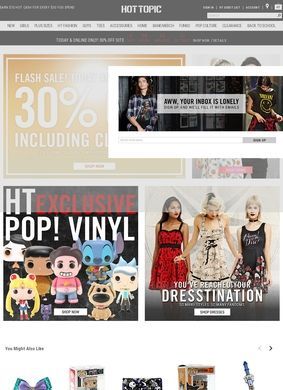
Pop-culture licensing and alternative fashion built Hot Topic into what it is today: a specialty retailer aimed at teenagers and young adults who shop by fandom first and price second. The site carries what you would expect from its mall stores, plus a deeper online inventory covering t-shirts, hoodies, jeans, dresses, pajamas, swimwear, outerwear, and a plus-size range threaded through most of those categories instead of tucked into a token corner. Apparel is the spine, but nowhere near the whole of it.
Accessories and home goods across fandom categories
The accessories side is where the breadth gets interesting. Backpacks include the Loungefly line, which has its own following among collectors, alongside wallets, jewelry, body jewelry, hats, socks, and hair pieces. There is a beauty and cosmetics section, tech accessories, and footwear. Home and lifestyle goods fill out the rest: bedding, mugs, tumblers, collectible figures, manga, notebooks, and assorted decorative items. A shopper at Hot Topic could outfit a bedroom, a backpack, and a wardrobe in the same visit without leaving the fandom they came in for.
That reach across categories is the thing to understand before judging the place by any one product. A teen who walks in for a band tee can leave with body jewelry, a notebook, and a tumbler in the same bag, and none of it feels bolted on. The merchandising treats apparel, accessories, and home goods as one continuous catalog tied to the same set of interests, which is a coherent idea for the audience Hot Topic chases.
Organizing 600 licensed properties without chaos
The number that defines this retailer is 600-plus licensed properties. That is the real product, more than any single hoodie. The roster spans Disney, Marvel, DC Comics, Star Wars, Pokemon, and Studio Ghibli, alongside a wide pull of anime franchises, horror titles, and music artists. The implication for a shopper is simple: whatever niche obsession a teenager has landed on this month, there is a reasonable chance Hot Topic stocks a shirt, a figure, or a Loungefly bag tied to it. Few retailers chase that many properties, and fewer still aim them at one age bracket the way Hot Topic does.
Music and anime as distinguishing categories
Organizing that many licenses without the catalog collapsing into noise is the harder problem. Hot Topic leans on gender-segmented sections for women, men, and plus-size customers to give browsing some structure. The music-artist and anime overlap is the part that distinguishes the place from a generic apparel store, because those two categories rarely sit side by side anywhere else at this scale. A music-merch buyer and an anime collector are not usually served by the same storefront, yet here they are.
Depth within each franchise matters more than breadth
The horror and music corners in particular read as deliberate rather than padding. A store can claim a music selection and stock three safe arena acts; 600-plus properties implies something closer to genuine depth, reaching into franchises and artists that a mass retailer would skip. For a teenager building an identity around a band or a series, that specificity is the draw. What keeps the licensing model from feeling like a pure novelty play is the depth within each property: a franchise is not represented by a lone t-shirt but stretched across apparel, accessories, and home goods, so a Pokemon fan can move past the shirt rack into bedding, mugs, and figures.
Loyalty rewards and clearance pricing strategy
On the commerce side, Hot Topic runs a "Hot Cash" loyalty rewards program, an earn-and-redeem setup that nudges repeat visits from a customer base that tends to come back often anyway. Clearance sales reach up to 60 percent off, fitting an audience that watches prices closely and where a markdown rack can be the whole reason for the trip. Pairing a points program with steep clearance is a sensible read of who shops at Hot Topic and how often.
Free shipping threshold and in-store pickup options
Shipping and fulfillment are spelled out plainly. Free shipping applies on orders over $75, a threshold that sits a little high for a single shirt but lands naturally once accessories or a figure join the cart. In-store pickup bridges the online catalog and the physical footprint, letting a shopper reserve online and collect at a nearby location. For a young shopper without a credit card, that pickup option quietly solves a real problem: plenty of teens browse online and pay in person.
How does the website extend the physical store?
That dual setup, real stores plus a complete online operation, is worth pausing on. Plenty of mall brands have let one channel wither; Hot Topic treats the website as a genuine extension of the store, given the inventory it carries online beyond what any single location could shelve. The website holds the larger half of the operation.
Plus-size inventory integrated into main apparel sections
The plus-size handling deserves a second mention because of how it is structured. Instead of a separate microsite or a token handful of items, plus options run through the apparel categories themselves, swimwear and outerwear included. For a shopper accustomed to being told their size lives in a separate section, finding it folded into the main range across Hot Topic's apparel is a practical difference.
One thing worth setting expectations around is volatility. A catalog driven by 600-plus licenses and frequent clearance is, by nature, a moving target. The Studio Ghibli piece or the specific band tee in stock today may not be there next month, which cuts both ways: it rewards the regular visitor and frustrates anyone hoping to return for one exact item. The Hot Cash program and recurring markdowns are designed precisely for the first type of shopper, the one who treats the catalog as something to check regularly and never expects to finish. Hot Topic is a fandom store first and a clothing store second, and the inventory makes that order of priorities plain.