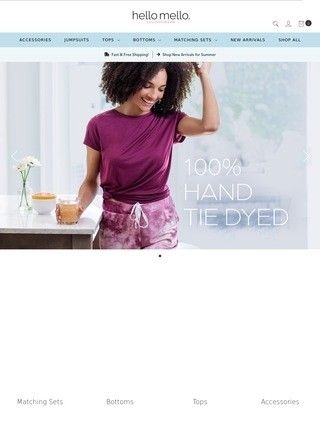
What does a loungewear brand actually sell once you strip away the mood photography? In Hello Mello's case, the answer is a coordinated top-and-bottom set, treated as the anchor that everything else hangs off. From that center the catalogue fans out into separates: lounge pants and shorts on elastic waistbands, sleep shirts, sweaters, cardigans, basic tees, and a scatter of smaller pieces meant to fill a drawer without making anyone think hard. Socks, slippers, and wraps sit at the edges. Several of the sets arrive tucked inside drawstring storage pouches, a touch that recurs in the product copy often enough to read as a deliberate choice rather than a one-off.
How do ratings compare across platforms?
Loungewear is a category where the product photos rarely tell you what you need, because the whole proposition rides on how the fabric feels after three washes. That is exactly where Hello Mello has an advantage most direct-to-consumer apparel labels never build: it is carried on Amazon and Walmart, so the verdict sits on platforms the brand cannot edit. On Amazon, 2,273 reviews settle at roughly 4.6 out of 5. A Walmart listing lands at the same 4.6, drawn from 71 reviews. Knoji aggregates 18 reviews at about 4.2. Smart.reviews scores a related store domain at 4.1. A Cherry Picks profile shows a 5.0 across 11 clothing items, though 11 is a small enough base that the number should be read lightly.
The useful part is not any single figure but the agreement among unrelated sources. When a 4.6 on a base of over two thousand lines up with a 4.6 on a separate retailer and a 4.2 elsewhere, you are looking at buyers reporting back from real purchases on their own initiative, not a tidy in-house testimonial wall. Two thousand reviews also tells you something quieter about the business: brands with shallow catalogues and one-time customers do not accumulate that volume. Hello Mello has been trading long enough, and selling steadily enough, to leave that kind of trail.
Weighing the negative reviews
The dissenting voices deserve their hearing. Thingtesting carries a single review at 2.0, with specific complaints about fabric that felt thinner than expected and a return policy the reviewer found inflexible. That is one account against a large base of satisfied buyers, so it should not be read as typical. The fabric note, though, is worth holding onto for the right reason: Hello Mello's whole pitch is soft and lightweight, and those two words mean precisely what they say. Anyone expecting weight or structure from Hello Mello is shopping in the wrong aisle. Tenereteam shows a 4.0 from just two reviews, too small a sample to move the needle either way.
Common features across product listings
Three features turn up across Hello Mello listings without fail: elastic waistbands, drawstring ties, and pockets. None of that is a revelation for loungewear, but Hello Mello puts the details up front in the product descriptions instead of leaving a shopper to dig, which is a small courtesy that saves real time. The collections are built to mix and match, a sensible structure here because people wear these pieces in combinations, not as sealed outfits. Prints carry most of the visual personality. The fabrics are sold as super soft and lightweight, and the cross-platform feedback broadly backs that up.
Focus on women's loungewear only
Hello Mello is womenswear, and that is the entire story: no menswear, no children's line. The navigation does nothing to disguise it, so anyone hunting those categories knows in seconds to look elsewhere. Inside its lane the selection runs reasonably deep, with genuine variety among the sets, prints, and separates, and the line stretches from pajama basics up to pieces casual enough to wear out the door. The narrowness is a design decision, not a shortfall. There is no outerwear, nothing structured, nothing with hardware. Everything is soft, elasticated, and built for the house. That clarity helps a buyer who knows what she wants and stops anyone who needs something tailored before she wastes a click.
Checking the contact options
The contact setup on Hello Mello's own site is genuinely poor. No phone number, no email, no physical or mailing address shows on the homepage, and the URL that ought to hold a contact form, a /pages/contact path, returns a 404. Hello Mello pushes customer communication through its social accounts instead, trading as hellomellowear on both Facebook and Instagram, and those channels are active, with regular Instagram posting. Plenty of small apparel labels run support through social and do it well, but a broken contact page is a rough edge, and a buyer who wants a written support exchange tied to an email thread will not find a clean way to get one here.
Comparing marketplace return policies
The marketplace presence reshapes that worry. Amazon and Walmart both handle returns and disputes on their own terms, independent of Hello Mello's website, so a buyer who hits trouble on an order placed through either retailer has recourse that owes nothing to the brand's missing contact infrastructure. Most small labels live or die on a single storefront where the brand's own responsiveness is the only net. Hello Mello, sitting on the shelves of two of the largest US retailers, is in a different structural position, and the dead contact page costs far less when the checkout never belonged to the brand in the first place.
So the verdict does not hinge on a leap of faith or a customer-service gamble. The numbers are already on the table: 4.6 from more than two thousand Amazon buyers, echoed across other platforms, against one critical voice and a contact page that does not load. Set Hello Mello beside Soma, the established loungewear name with its own retail footprint and a polished direct support operation, and the trade-off is clear enough. Soma gives you a brand you can phone; Hello Mello gives you a deeper bench of prints and sets at marketplace prices, with the marketplace itself standing in for the support desk. For a soft, elasticated, home-bound wardrobe judged on outside reviews, that is a fair exchange, and the matching sets are where it starts.