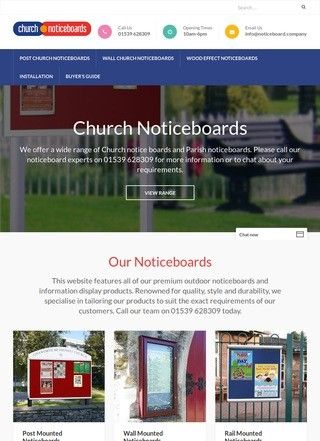
Take the triple-door post-mounted board with an oak frame and a personalised header panel: it is the sort of product that tells you who this company is aimed at. Church Noticeboards, the trading name of Noticeboard Company Cumbria Ltd, builds outdoor display boards for churches and parish organisations, and the catalogue stays narrow on purpose. Post-mounted boards come in single, double and triple-door configurations, there are wall-mounted versions, and the company also produces church signs. Prices run from roughly 619 to 2,695 pounds excluding VAT, with the best-sellers clustered between 1,981 and 2,395 pounds. That is not impulse-buy territory, and having the pricing on the page at all says something about the confidence behind it.
Materials, guarantees, installation
Most of these boards are bought once a generation, so materials matter. The construction options are aluminium or timber, with oak as the named hardwood, and customers can specify ornate posts, bespoke sizing and a header panel carrying the church name. The up-to-15-year guarantee is the figure worth circling back to, because a parish ordering a 2,000-pound board needs to know it will still be readable after a decade of British weather, and a guarantee of that length commits the maker to standing behind the build. Installation is offered too, which closes the obvious gap for a buyer who does not fancy concreting posts into a churchyard.
15-year warranty on timber boards
Church Noticeboards does more than list products. There is a photo gallery of finished installations, which for a made-to-order item is the most useful thing a prospective buyer can see, since a rendering never tells you how the timber ages or how the lettering sits at distance. Church Noticeboards also runs a blog with planning and design guidance, the kind of content a parish council member needs when they are tasked with a purchase they have never made before and do not know which size suits a porch versus a roadside frontage.
Design guidance and project gallery
Free delivery to mainland UK is part of the offer, with some Scottish exclusions noted honestly instead of buried, and there is an online quote-request facility so a buyer can get a figure for a custom spec without a phone call. For a product this configurable, a quote tool beats a fixed price list, because the variables (door count, material, post style, dimensions) genuinely change the final number. Church Noticeboards does not appear in a general business directory of sign makers, which is consistent with operating as a specialist rather than a broad trade supplier.
Delivery, quotes, specialist positioning
One feature that reads a little carefully is the set of location-specific supplier pages built for nationwide coverage. A Kendal manufacturer claiming to serve the whole country is reasonable for boards shipped flat and installed on visit, though a buyer in, say, Kent should confirm during the quote whether installation travels that far or whether delivery alone is what is on offer for distant orders.
From Kendal to nationwide coverage
On transparency, Church Noticeboards is straightforward. A phone number, two email addresses and a full registered address in Kendal, Cumbria are all present, and the company lists its VAT number and Companies House registration. For a high-value purchase made by volunteers spending church funds, that paper trail counts: a treasurer can verify the company is a properly registered entity and the presence of a physical Cumbrian address gives the operation a fixed location rather than a faceless web storefront.
Company registration and contact details
The weaker spot is outside validation. A search for this specific domain turned up no notable third-party reviews. A Trustpilot listing does appear in results, but it belongs to a separate business (Noticeboards Online, operating from a different domain), so it tells a prospective buyer nothing reliable about this manufacturer and should not be mistaken for one. That leaves the gallery of completed projects doing the work that customer ratings normally would. Photographs of installed boards at named churches are persuasive evidence, but they are not the same as independent feedback, and a careful buyer would be within their rights to ask for a reference or two before placing an order.
Lack of third-party reviews
That absence is worth stating plainly. It does not point to anything wrong; specialist manufacturers in low-volume niches frequently have little or no presence on consumer review platforms, simply because few parishes think to leave a star rating after buying a noticeboard. Church Noticeboards is a registered company with a traceable address, published pricing and a photographic record of completed installations, and that combination tells a treasurer more about what they are buying than a handful of online ratings from anonymous accounts ever would.
Why low volume means no ratings
So who is Church Noticeboards for, and how does it stack up against the obvious substitute? A parish could go to a general signage firm or a high-street print shop and have a board knocked up cheaper, but those routes rarely offer oak construction, a 15-year guarantee, or design guidance written specifically for churchyards and porches. Against a generalist sign maker, Church Noticeboards trades a lower headline price for genuine specialism: heavier materials, longer warranty, and a quote process built around the exact variables a church purchase involves.
Specialism versus cheaper alternatives
For a congregation that wants a board to look right outside a historic building and survive years of rain, the focus Church Noticeboards brings to this one niche is the clearest argument in its favour. The main caveat (no independent reviews yet) is genuine but not disqualifying: the registered-company details are verifiable, the guarantee is explicit, and Church Noticeboards has been doing this long enough to have a gallery full of completed installations. A direct conversation with them before ordering is still the sensible step.