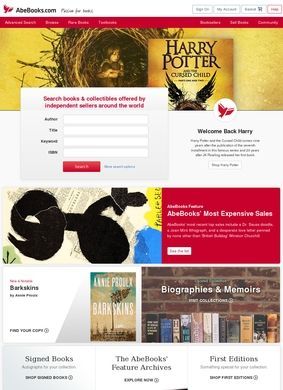
You need a 1962 hardback your library discarded, or a signed copy of a novel that went out of print before you were born, and the usual retail shops give you nothing. That gap is the whole reason AbeBooks exists. It is an online marketplace built around new, used, rare, and out-of-print titles, pulling together independent booksellers from around the world into one searchable catalogue. Type in an author, a title, a publisher, even a year, and the advanced search will narrow results down to a specific edition or binding. Two copies of the same book can differ by a hundred dollars depending on condition and printing, so that level of filtering is genuinely useful rather than decorative.
How the marketplace connects buyers to sellers
The site splits its inventory into a few clear lanes. There is a Rare Books section for first editions and collectible signed copies, an Art and Collectibles area that stretches into fine art and ephemera, and a Textbooks channel aimed squarely at students hunting for cheaper course books. Featured Catalogs lean on specialist sellers who curate their own lists, so a buyer chasing a niche, say antiquarian maps or early science fiction, can browse a dealer's expertise instead of wading through everything at once. For anyone sitting on inventory of their own, AbeBooks runs a Start Selling program that lets booksellers list stock and reach that same global pool of buyers.
Inventory categories and seller programs
What distinguishes AbeBooks from a single online store is structural: it does not own most of the books. Thousands of separate sellers do, and the platform is the connective layer that lets you find them. That reach is wide. International storefronts run under AbeBooks.co.uk, AbeBooks.de, .fr, .it, and .ca, with IberLibro.com covering Spanish and Portuguese readers and ZVAB.com serving the German antiquarian trade. If you are after a French first edition, the French storefront and its sellers are likelier to have it than a generic global search. The company has been running since 1996 and was acquired by Amazon in 2008, which explains both its scale and the Amazon-style mechanics under the hood.
International storefronts and global reach
That marketplace model is also where the honest cautions live, and they are worth spelling out before anyone clicks buy. Because the books come from many independent sellers, the experience is only as good as the individual dealer you happen to order from, and the aggregate reputation data reflects that unevenness sharply. On Trustpilot, the .com storefront sits near 1.6 out of 5 across roughly 799 reviews, with the UK storefront carrying over a thousand reviews at a similarly low rating. The pattern repeats elsewhere: SmartCustomer shows about 1.6 from 715 reviews, PissedConsumer lands near 1.7 across 456, ResellerRatings drops to 1.3 over 250, and Reviews.io comes in around 2 stars from 182. These are not flattering numbers, and they deserve attention.
Reputation data across review platforms
Dig into what people complain about and a consistent shape emerges. Shipping costs draw fire, especially on international orders where postage can rival or exceed the book's price. Delayed and missing orders come up repeatedly. And the one that stings most for collectors is inconsistent condition grading: a book described as "very good" arriving with markings, foxing, or a cracked spine the listing never mentioned. None of this is surprising for a platform that delegates fulfilment and description to third parties, but it does mean the burden of vetting falls on the buyer.
Common complaints from buyers
Read the seller's own rating, read the condition note in full, and message the dealer before ordering anything expensive. I tend to trust the catalogue dealers with detailed, idiosyncratic descriptions more than the bulk listings, because someone who writes three careful sentences about a dust jacket usually packs the book with the same care.
Customer support through web forms only
Support on AbeBooks is handled entirely online. There is no published phone number; help routes through support.abebooks.com and a web-based customer service request form. For a marketplace of this size that is a defensible choice, since most disputes are seller-specific and need a paper trail anyway, but buyers who want a human voice on the line when an order goes sideways will not find one here. The form is the channel, and resolution can hinge on how responsive your particular seller turns out to be.
So where does that leave the place? For tracking down a specific edition, an obscure out-of-print title, or a textbook at a fraction of campus-bookstore prices, the breadth of AbeBooks is hard to match. The catalogue is deep, the international reach is substantial, and a careful buyer who reads listings closely and sticks to well-rated sellers can do very well. The low aggregate ratings are not noise, though; they describe a real risk that lands squarely on you when a seller underperforms. AbeBooks gives you the inventory and the tools, then mostly steps back. Whether that trade suits you depends entirely on your patience for doing the homework each listing demands.