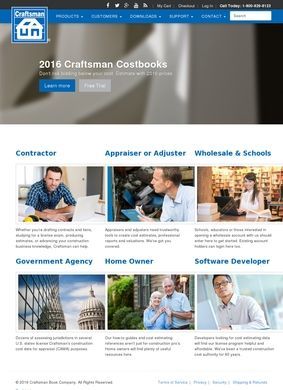
The National Estimator Cloud sits at the center of what Craftsman Book Company sells: a subscription version of the estimating costbooks that contractors have leaned on to price jobs for decades. Craftsman Book Company has been at this a long time. Its tagline, Helping Builders Since 1952, doubles as a founding date and a statement of purpose, and the catalogue behind it is built almost entirely around one problem, working out what a construction job should cost before anyone swings a hammer.
That focus is narrow in the best sense. The company publishes for the people who estimate, bid, build, appraise, and adjust claims, and the products track those jobs closely instead of drifting into general business software. A publisher that has spent this long on a single trade tends to know it well, and the shape of the catalogue reflects that.
What fills the catalogue
The range splits cleanly into software and print, with a few hybrids in between. A carpenter, an electrician, a plumber, or a roofer will find titles aimed squarely at their trade, and so will the contractors, builders, estimators, appraisers, and insurance adjusters who work alongside them. Craftsman Book Company also names schools and training institutes among its customers, which fits a publisher whose books read like reference manuals a class can work straight through.
The breadth is less about sheer volume than about covering every seat around a construction project. An estimator pricing a bid, an adjuster valuing a loss, and an instructor teaching the next crew can all pull from the same publisher, which is unusual for a house this specialized. Most reference publishers pick one lane; this one follows the money through the whole build.
Software that does the estimating and the paperwork
The software line is the most current-feeling part of the Craftsman Book Company catalogue. National Estimator Cloud handles cost estimating, pulling the printed costbook data into a tool a bidder can run without keying figures by hand. Construction Contract Writer turns the tedious task of drafting a compliant construction contract into a guided process, which matters in a trade where a badly worded contract is how disputes start. National Appraisal Estimator serves the appraisal and insurance-adjustment side, aimed at the people who have to put a defensible number on damage or value.
Each of the three answers a different daily headache, and each is priced construction data with a workflow built around it rather than a generic spreadsheet a user has to fill in from scratch.
There is also data licensing, which lets outside developers build the company's cost figures into their own software. That last option is a quiet tell that the underlying cost data, more than the apps wrapped around it, is the real asset here. Decades of collected pricing is the thing other people want to license, and Craftsman Book Company sells access to it directly.
Books, guides, and the money-back promise
The print and eBook side of Craftsman Book Company runs deeper. Estimating costbooks anchor it, joined by exam preparation guides for trade licensing, office manuals for running a contracting business, and technical references meant to sit on a shelf and get pulled down in the middle of a job. The exam prep in particular points at a specific reader: someone studying to pass a contractor's licensing test, who needs the material organized for that exact purpose.
Craftsman Book Company backs the whole line with a 100 percent money-back guarantee and free technical support, and it runs a blog of construction-industry articles that works as a low-key argument for buying the books. For a working contractor deciding whether a costbook pays for itself, the guarantee is the piece that takes the risk out of finding out.
Free technical support does similar work for the software titles, since estimating tools are only useful if someone can walk you through the parts that do not behave. A publisher that answers the phone about its own products is treating them as tools people depend on, not one-time sales.
Reputation is where the picture gets more uneven than the long history would suggest. Craftsman Book Company keeps a Better Business Bureau profile in Carlsbad, filed under Computer Software Developers, though it is not BBB accredited and no numeric grade came through, which sits awkwardly against the site's own claim of an A+ BBB rating, a discrepancy I would want cleared up before repeating that grade to anyone. A self-reported A+ and an unaccredited profile with no visible score are not the same claim, and the difference is the sort of thing a careful buyer notices.
Elsewhere the trail is light. G2 carries two user reviews of Craftsman Book Company products, both generally positive about the pricing and labor-cost tools. Goodreads lists an author page crediting 23 works but holding only three ratings, which average 3.33, a sample far too small to lean on. Yelp carries a business directory listing for the Carlsbad address with no visible rating, and a thread on the r/Construction subreddit asks the community what people make of Craftsman for estimating, drawing informal replies.
For a firm as old as Craftsman Book Company, that is a modest online footprint, and it means most of the confidence a buyer builds here comes from the products and the guarantee, not from a stack of outside reviews.
What holds the whole thing together is the age of the data. A costbook is only as good as its numbers, and Craftsman Book Company has been compiling and revising construction pricing for more than seventy years, which is the strongest argument in its favor. That modest review trail matters less when the product is a reference a contractor checks against their own experience, correcting as they go, because the buyer is trusting a maintained dataset more than a stranger's star rating.
Contact is the opposite of hard. The company lists a toll-free phone number, an email address, and a street address in Carlsbad, plus the exact window in which its technical support answers, a short stretch of weekday afternoons. Anyone who wants to reach a person can, which counts for something from a business that sells guarantees and support next to its books. The narrow support hours are the one small friction, since a contractor with an evening question has to wait for the desk to open.
The costbooks are updated on a yearly cycle, the support desk keeps short and specific hours, and the cost data underneath the whole operation is licensed out to developers who would sooner buy it than build it. Craftsman Book Company has been selling that same core, priced construction work, since 1952.