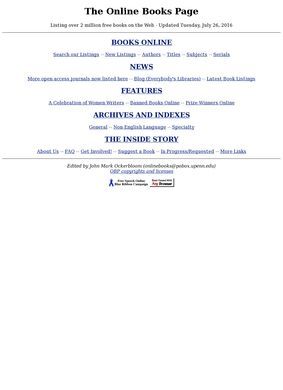
You want a full, legal copy of an old book, and a search engine hands you a wall of shops selling reprints instead. The Online Books Page exists to cut straight through that. It is a curated index, edited by John Mark Ockerbloom and hosted by the University of Pennsylvania, that points to more than three million free books available in full text on the web. The promise is simple: skip the storefronts, and go where the real, free copy already lives.
That framing matters, because the problem it solves is not scarcity but noise. Enormous free libraries are online already, at Project Gutenberg, the Internet Archive, and university collections around the world, but finding one specific title across all of them is the hard part. The Online Books Page is the finding layer, the catalogue that sits above the archives and tells you which one holds what you are after.
How the listings are put together
The heart of the resource is the section marked Books Online, and it is built for two kinds of visitor: the one who knows exactly what they want, and the one who is browsing with no fixed target. Both are handled without fuss. The Online Books Page gives you a search box for the first case and a set of ordered lists for the second, so neither visitor is forced through the other's workflow.
What sits behind those lists matters, because indexing three million titles is only useful if the paths in are clean. Here they are. Authors, Titles, Subjects, and Serials each open a different way into the same catalogue, so a reader chasing everything by one writer takes a different route than one hunting a single periodical, and neither has to wade through the other's results.
It is a plain interface, and that plainness is a feature. Nothing on The Online Books Page is trying to sell, upsell, or steer a reader toward a purchase, so the design gets out of the way of the one thing a visitor came to do, which is find a book and go read it. That restraint is rare enough on the modern web that it reads almost as a statement of purpose, and it is one reason the index has aged so well.
Authors, titles, subjects, and serials
The four index routes are the workhorses. The Authors listing gathers a writer's freely available works in one place; Titles goes straight to a known book; Subjects lets a researcher graze a topic without a specific title in mind; and Serials covers periodicals and journals, which are easy to lose track of when their runs are scattered across archives.
That last one is a quiet strength, since serials are exactly the material a casual web search tends to miss, and a scholar tracking a nineteenth-century magazine across incomplete runs is precisely the reader The Online Books Page was built to help.
Search and the new listings feed
For anyone who arrives with a specific target, Search our Listings is the fastest door in. The New Listings feed does the opposite job, showing what has recently been added, which is how a regular visitor keeps up with a catalogue that keeps growing.
Between the two, The Online Books Page serves both the one-off lookup and the returning browser, and it does so without dressing the interface up in anything it does not need. A reader who checks New Listings now and then is effectively subscribing to the growth of the collection.
The features that steer the browsing
Past the raw index, The Online Books Page curates. This is where a librarian's hand shows, because a pile of three million links is daunting until someone starts organizing it by theme and interest. The Features section does that organizing, pulling particular slices of the collection into lists a reader can actually work through instead of staring at a search box with no idea where to begin.
These are not vanity pages. Each one solves the problem of where to start when the full catalogue is too large to browse cold, and together they reflect a clear editorial point of view about what free online literature is good for and who it should reach.
A celebration of women writers and read banned books
Two of the standing features tell you a lot about the project's character. A Celebration of Women Writers gathers works by women whose writing might otherwise be scattered or overlooked, and Read Banned Books collects titles that have faced suppression, which is a pointed thing for a free-books index to spotlight.
Prize Winners Online rounds out the set by tracking award-winning literature that has become freely available. On The Online Books Page these curated lists turn an archive into something closer to a reading list with a spine, and I find them the most inviting way into a collection this size.
Archives, indexes, and the blog
The Archives and Indexes section widens the map further, sorted into General, Non-English Language, and Specialty collections, each a curated pathway into external book archives that a reader might never find alone. The Non-English section alone answers a real gap, since so much free-book coverage skews toward English by default. Sorting the archives by general, specialty, and language turns a flat directory into something a researcher can navigate by discipline, which is how serious reference work actually gets done.
The News side keeps the project talking. A blog called Everybody's Libraries, a feature titled Meet the People Behind the Books, and a running feed of the latest listings all signal a maintained resource with a person thinking out loud behind it, not a database left to rot. That living quality is part of why The Online Books Page has stayed useful while countless link collections from the same era went dark.
Who keeps it running and who it serves
The Online Books Page does not host most of the books it lists. It aggregates and indexes full texts held elsewhere, at Project Gutenberg, the Internet Archive, and various university digital collections, and points you to them. That design is the whole trick: instead of trying to store everything itself, The Online Books Page becomes the map to everything already stored across the open web, which is a more durable job than hoarding files other institutions are already preserving.
Its audience follows from that role. Researchers, students, librarians, and general readers who need free, legally available full-text books and serials all land in the same place for the same reason, because verifying that a copy is both free and genuinely legitimate is tedious work the index has already done. The editorial care that comes with a named editor and a university host is the difference between a trustworthy pointer and a random link dump, and it is why librarians in particular send people to The Online Books Page without hesitation.
For a student who needs a primary source by tonight, or a librarian fielding that same request, the vetting is the whole value, because it converts hours of checking into a single dependable link.
The participatory corners fill out the picture. An Inside Story section holds About Us and an FAQ, while Get Involved, Suggest a Book, and In Progress or Requested invite readers to propose titles, flag gaps, and follow what is being prepared for listing. That two-way design keeps The Online Books Page current, since its own users help decide what gets tracked down next. Suggest a Book and In Progress in particular make the catalogue feel less like a finished product and more like an ongoing collaboration between the editor and the people who lean on it.
What The Online Books Page finally offers is confidence. A link from here is far likelier to lead to a complete, legal, readable text than the top result of a blind search, and the curated features give a reader a reason to wander past the title they came for. With more than three million titles indexed and clean routes by author, title, subject, and serial, The Online Books Page has already done the hard part of finding and vetting.
What is left for a reader to decide is not whether a copy exists, but which of those millions of free books to sit down and read first.