Estee Lauder Skin Care is the online storefront and brand hub of one of the largest prestige beauty companies in the world, run through the parent group The Estee Lauder Companies. The site pulls together product catalogs, buying tools, and brand content into a single shopping destination aimed at consumers who want higher-end skincare and beauty goods. It is a commerce site first, so most of the space goes to selling and to helping a shopper find the right item.
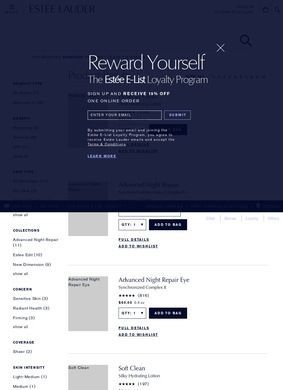
The skincare category is where the site puts its heaviest weight. Product lines are grouped so a visitor can move through them by concern or by range, and the flagship names are given their own dedicated space: Advanced Night Repair, Revitalizing Supreme+, Perfectionist, and Resilience Multi-Effect all sit as distinct lines with their own pages. The Estee Lauder Skin Care catalog is deep enough that without clear grouping, a shopper would drown in serums and creams that look nearly identical on a thumbnail.
Presentation here is polished in the way a company of this scale can afford. Photography is consistent, product descriptions carry ingredient and benefit claims, and the routes from a landing page to a specific serum are short. That polish is a baseline expectation for prestige beauty, so it earns no special credit, but its absence would have been a red flag and there is none of that here.
What the storefront stocks and how it guides a shopper
Skincare is only one pillar. The catalog spans makeup and fragrance as well, and the parent group folds in a roster of owned brands, so the wider ecosystem touches Clinique, MAC, La Mer, and Jo Malone alongside the namesake line. On the Estee Lauder Skin Care pages themselves, the focus stays narrow: cleansers, serums, moisturizers, eye treatments, and the multi-step regimens the brand is known for pushing.
Gift sets get their own treatment, which makes sense for a company whose products move heavily around holidays and special occasions. There is a loyalty and rewards program layered over the shopping experience, the sort that returns points and perks to repeat buyers. For a brand that counts on customers replenishing the same serum every few months, that program is doing quiet work in the background of every Estee Lauder Skin Care visit.
The commerce backbone is what you would expect from a company of this size: an online store with published shipping and returns terms, region-specific storefronts, and localized shipping so the site behaves differently depending on where a visitor lands. That regional splitting is a real feature and a real friction at once. It means pricing and availability reflect a shopper's own market, but it also means the experience is not uniform across countries.
Diagnostic and consultation tools
Beyond the raw catalog, Estee Lauder Skin Care leans on skin diagnostic and consultation tools meant to steer a shopper toward products suited to their skin. For a category where buyers often have no idea which of a dozen serums applies to them, a guided path from a stated concern to a specific recommendation carries genuine practical value. It also, unavoidably, funnels people toward the brand's own answers, so the advice and the sales pitch are the same motion. A shopper should read it with that in mind.
Still, the presence of a consultation flow puts Estee Lauder Skin Care ahead of the many beauty sites that hand a visitor a grid and leave them to guess. Answering a few questions about skin type and concern beats scrolling blindly, even when the destination is always a house product.
The tools are useful for narrowing a very broad shelf. They are not a substitute for independent skin advice, and the site never pretends otherwise.
Beauty content and the store locator
There is a beauty advice and blog layer, the kind of editorial content that explains routines, ingredients, and application. Content like this does double duty: it answers real questions and it keeps shoppers on the site longer. Whether it reads as helpful or as soft marketing depends on the individual article, and the honest answer is that it swings between both.
A store locator rounds out the practical side, pointing shoppers to department store counters and physical retail where the products are sold in person. That bridge to offline buying is worth noting, because a fair share of prestige skincare purchases still happen at a counter where someone can test a texture or a shade. The locator acknowledges that habit instead of fighting it, and it makes the online catalog feel like part of a wider retail presence instead of a closed loop.
Who it serves and where it leaves a visitor
The audience is clear. Estee Lauder Skin Care is built for retail consumers shopping for prestige skincare and beauty, and the whole design assumes a buyer with some willingness to spend at the higher end of the market. Nothing here targets bargain hunters, and the site does not pretend to.
The global reach is part of the appeal. Estee Lauder Skin Care operates region-specific storefronts, so a shopper in one country sees prices, stock, and shipping that fit their own market instead of a foreign default. That localization is more work than a single global page, and it pays off in trust: a buyer sees terms that will actually apply to their order.
Because the same domain also carries investor relations and corporate information as part of a publicly traded NYSE-listed company, a visitor occasionally bumps into the seam between a shopping site and a corporate one. Most consumers will never touch the investor pages, but their presence signals the scale of what sits behind the storefront.
A search turned up no independent third-party reviews or star ratings specific to the Estee Lauder Skin Care storefront itself, separate from the countless product reviews the brand's own pages host. That is not unusual for a retail arm of a company this size, where reputation gets measured brand by brand and product by product rather than as one storefront score.
The strongest parts of Estee Lauder Skin Care are the depth of the skincare range and the tooling built to make that depth navigable. The diagnostic path, the clear separation of flagship lines, and the tie to physical counters all reduce the guesswork that usually comes with buying skincare online. That is a real advantage over a plain catalog dump.
The weaker parts are the ones baked into the model. The editorial advice and the diagnostic recommendations both point back to the brand's own products, so a shopper looking for a neutral comparison will not find it here, and should not expect to. Regional fragmentation means the experience a friend describes in one country may not match what loads for you in another. Estee Lauder Skin Care also assumes a certain price tolerance, and a visitor who does not have it will feel the mismatch quickly.
The verdict lands in the middle, and honestly so. Estee Lauder Skin Care does the job it sets out to do, presenting a large prestige catalog with enough structure and enough guiding tools to make it shoppable, and backing it with real retail infrastructure. What it is not, and never claims to be, is a place for objective product evaluation.
Anyone already interested in the brand's lines will find a capable, well-organized store. Anyone weighing Estee Lauder Skin Care against rival houses will need to do that comparison somewhere else, because this site exists to sell its own shelf and does that competently, no more and no less.