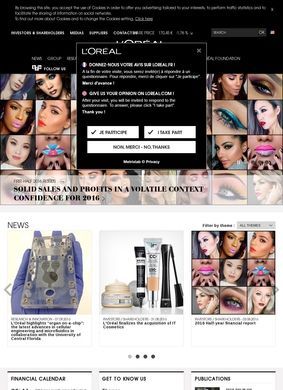
Nothing on this site is for sale. For a company whose products sit in half the bathrooms in the world, L'Oreal runs a corporate home with no shop, no cart and no price on anything. It is a company portal, built to explain the group and route very different visitors to very different destinations, and once that clicks the whole layout makes sense.
What holds it together is scale. This is the official site of L'Oreal Groupe, and its job is to present a beauty company that works through dozens of brands sorted into four divisions, then hand each type of visitor the door meant for them. Nobody is expected to browse the way they would on a retail site; they are expected to find their lane and follow it.
A corporate portal, division by division
The four brand divisions
The Brands section is the heart of it, and the four-division split is the clearest way in. Consumer Products is the mass-market tier, holding names like L'Oreal Paris, Garnier, Maybelline, NYX and Essie. Luxe is the premium shelf, with Lancome, Yves Saint Laurent, Armani, Kiehl's, Prada and Urban Decay among others. Professional Products aims at salons and stylists, gathering L'Oreal Professionnel, Redken, Kerastase and Matrix. Dermatological Beauty covers the pharmacy-and-clinic end, with La Roche-Posay, Vichy, CeraVe and SkinCeuticals.
Laid out this way, the portfolio explains itself. A shopper who owns a drugstore mascara and a dermatologist-recommended moisturizer can see, perhaps for the first time, that both trace back to the same parent. That is the real function of the section: not to sell any single item but to map how the whole house is arranged, and the map is genuinely clarifying once you see how much of a bathroom cabinet one company quietly accounts for.
The four-division structure also maps onto how beauty actually reaches people. Consumer Products lives in supermarkets and pharmacies, Luxe on department-store counters and in dedicated boutiques, Professional Products in salons through stylists, and Dermatological Beauty in pharmacies and clinics on the strength of skin-care credibility. Seen that way, the split is less a filing system than a picture of every route a L'Oreal product can travel to reach a customer.
Groupe, and what the company says about itself
The Groupe section is where L'Oreal talks about L'Oreal. It covers company information, the stated purpose, governance, culture and heritage. This is corporate self-presentation, so a reader should take the framing for what it is, but the governance and structural material is exactly what an investor, a business student or a journalist needs, and collecting it in one place saves a lot of scattered searching.
Heritage sits alongside all of that, giving the group a long backstory to lean on. Whether a visitor cares about the founding narrative or only wants the governance chart, both are here, which is a fair balance for a page that has to speak to admirers and skeptics at once.
Commitments and beauty science
Two sections speak to how L'Oreal wants to be judged beyond sales. Commitments sets out initiatives across three fronts: the environment and the planet, social and people-focused programs, and product responsibility. Beauty Science and Technology covers research, innovation and technology development, the laboratory side of a business that spends heavily on formulation.
The Beauty Science and Technology area is more substantial than a corporate site strictly needs. Giving research, innovation and technology development its own dedicated space is a claim about identity: it says the company wants to be read as a laboratory-driven business and not solely a marketing operation. Whether that holds up is for a reader to test, but the material is there to be examined instead of merely asserted without evidence. For a science journalist or a competitor's analyst, having the innovation story stated plainly in one place is a convenience the site did not have to provide.
Both are, unavoidably, the company describing its own record, and a careful reader will weigh them as such. Even so, for anyone assessing L'Oreal on sustainability or research claims, the site at least commits those positions to writing in the company's own words, which is where any real scrutiny has to start. A vague page here would be a red flag; a detailed one is at minimum something a critic can hold the company to later.
Doorways for journalists, suppliers and investors
The portal shows its structure most clearly in how it separates audiences. There is a mediaroom for journalist inquiries, a dedicated suppliers section for firms hoping to do business with the group, a careers portal for job seekers, and a separate investor-relations site kept on its own domain. Links out to Facebook, Twitter, Instagram, LinkedIn and YouTube extend the reach into social feeds.
Careers is a full section in its own right, and for an employer of this size the jobs portal is a serious destination, feeding recruitment across research, retail, supply and corporate roles. For a graduate deciding whether to apply, the site doubles as a first impression of the company as a workplace, which is part of why the Groupe and Commitments pages read the way they do. A prospective hire can weigh the stated values against the roles on offer before ever sending a CV.
This is the giveaway that L'Oreal built the site as a hub and not a storefront. A reporter, a supplier, an investor and a would-be employee each arrive wanting something completely different, and each gets sent down a purpose-built path instead of dumped into one generic catch-all. For a company this large it is the correct design, even if it means an ordinary customer is never really the guest of honor. The whole architecture assumes you already know which of L'Oreal's many audiences you belong to.
The honest limit is that none of this helps a shopper standing in an aisle choosing between two foundations. The site is built for the people who study, supply, fund, cover or join the company, and a consumer looking for shade matches, ingredient lists or where to buy will bounce off it fast and end up on an individual brand's own page instead.
Step back, though, and the sheer breadth is the story the site tells almost by accident. Four divisions, dozens of brands, and separate front doors for investors, journalists, suppliers and staff describe a company operating at a scale most visitors never picture when they pick up a single mascara. The L'Oreal portal, more than anything it states outright, makes that scale legible.
That is the real tension in the site. It is thorough, cleanly sorted and honest about what it is: a window onto how a beauty conglomerate organizes itself, not a place to buy lipstick. Coming to understand the company behind the brands gets rewarded with real depth. Coming to shop the brands themselves gets nothing, and means leaving for an individual brand's own page to find it.