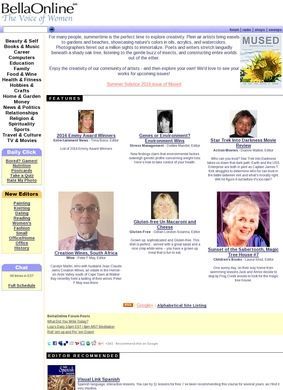
Someone looking for a beauty article that was written by a person who knows the subject, and not spun out of a content mill, lands in a strange spot online these days. That is the itch Bella Online sets out to scratch. The site files its beauty coverage under a wider channel called Beauty & Self, one of eighteen lifestyle channels that together hold more than 400 topics. Each topic has a human editor behind it, a volunteer who picks the subjects, writes the pieces, and answers in the forums. The site states plainly that nothing on it is AI-generated, which is worth something at a moment when most of the open web cannot say the same.
Eighteen lifestyle channels and 400 topics
The beauty material sits next to a wide spread of related subjects: Health & Fitness, Food & Wine, Home & Garden, Family, Relationships, Career, Money, Travel & Culture, plus lighter corners for Books & Music, Hobbies & Crafts, Sports, TV & Movies, and even Computers. So a reader who arrives for a skincare tutorial can drift into a gardening guide or a piece on personal finance without leaving the site. The articles on Bella Online come in several shapes: how-to tutorials, product reviews, longer guides, and shorter columns.
How articles take shape
The breadth is the obvious draw, and it is also the obvious risk, because a network this wide depends entirely on whether each individual editor is any good, and that varies from topic to topic. A site that tries to cover skincare, sweepstakes, theology, and computer hardware under one roof is making a bet that readers value variety enough to forgive the inconsistency that comes with it.
Community features beyond articles
Around the articles, Bella Online stacks a fair amount of community machinery. There are discussion forums tied to the topics, free newsletters, downloadable eBooks, online courses, book clubs, quizzes, games, and even sweepstakes. There is online radio programming too. The most distinctive piece is Mused, the site's own quarterly literary review, which runs prose, poetry, photography, and art. A literary magazine is not what most people expect to find attached to a women's lifestyle portal, and its presence tells you Bella Online has ambitions beyond churning out search-bait. Whether all of these features get equal attention is another matter; sprawling volunteer projects tend to have lively rooms and quiet ones living side by side.
Volunteer writers model
The editorial model is the part worth understanding before you trust anything here. Bella Online runs on volunteer writers, and the site openly recruits them, offering free training, promotion, and the publishing tools to get their work online. That arrangement is the engine and the weakness at once. On the upside, articles are written by people who chose their subject because they care about it, which often reads warmer and more specific than agency copy.
Quality varies by topic
On the downside, an unpaid roster means uneven output, topics that go dormant when an editor moves on, and quality that swings depending on who holds the byline. A reader should judge each topic on its own merits instead of assuming a house standard across all 400. The flip side is that the writers are not chasing a quota or an editor's deadline, so when a topic is active the columns often carry the small, lived-in detail that paid generalist copy tends to skip. It is the difference between someone who has tried the product and someone assigned to write 800 words about it by Friday.
Limited public reviews and social presence
Public opinion on Bella Online is hard to read because there is so little of it. On SmartCustomer there is a single review sitting at 1.0 out of 5, hardly a sample anyone should lean on either way, but not a positive note either. Indeed carries reviews from people who have written or worked for the site, and those tend to frame it as a genuine volunteer writing community with real training resources, which lines up with how the site describes itself. Nothing turned up on Google, Trustpilot, Yelp, or the BBB.
For a portal that has been publishing for many years, that quiet footprint is itself a data point: Bella Online has not generated the kind of complaint pile a scammy operation collects, but it has not built a loud fan base either. The scattered reviews do not add up to a clear consensus, so the safest read is to treat the site's own track record of staying online and unpaywalled as the strongest evidence on offer.
The Facebook page shows roughly 3,851 followers, a modest number that fits a niche community more than a mass-market destination. Taken together, the reputation evidence points to a small, sincere project that people who contribute to it generally speak about with some affection, while the wider public has mostly not weighed in. That is a reasonable basis for cautious trust, not blind faith.
Finding contact information
Contact is the softer spot. The landing page carries no phone number and no physical address, and for a general reader who wants to reach someone the path is not obvious. What you do get are social links in the footer for Facebook, Twitter, YouTube, and LinkedIn, an About BellaOnline page, and information aimed at recruiting editors. So the routes that exist lean toward prospective writers more than toward a visitor with a question or a correction.
If transparency of contact matters to you, set expectations accordingly: Bella Online is reachable through social channels and the About page, but it does not put a direct line front and centre. For a content site that is not selling a transaction, that is a smaller mark against it than it would be for a shop, though it still means a casual visitor has to hunt.
The charity-oriented framing fits the rest of the picture. Bella Online presents itself as a community effort under the banner "The Voice of Women," and the volunteer recruitment, the free training, and the no-paywall content all match that self-description. It is not a polished commercial brand selling a product; it is a long-lived publishing collective that happens to cover beauty among hundreds of other subjects. Read it that way and the gaps in polish make sense.
Bella Online versus Byrdie
For beauty specifically, the comparison most readers will reach for is Byrdie, the dedicated beauty site with editorial staff, dermatologist sourcing, and a tight focus on skincare, makeup, and hair. Byrdie is the cleaner, more authoritative pick if beauty is the only thing you came for, since its depth and consistency in that lane are simply greater. Where Bella Online wins is range and tone: a real person writing about a topic they chose, sitting beside four hundred others, with forums and a literary magazine in the mix. If you want one trustworthy beauty reference, go to the specialist. If you want a sprawling, human-written community where beauty is one room among many, Bella Online is a fair place to wander, provided you weigh each editor's work on its own.