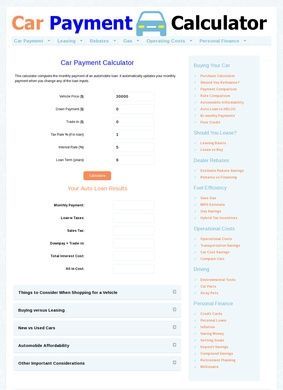
Most automotive calculator sites give you a payment field and a submit button. CarPaymentCalculator.net goes considerably further, and the lease-versus-buy tool is the clearest proof of that. It asks for residual value, money factor, the negotiated price, and how long the driver plans to keep the car. Those inputs are what move the answer, and because the tool collects them instead of defaulting to rough assumptions, it lands ahead of most free alternatives. A refinancing comparison and a loan-term tool spanning three to eight years sit alongside it, and together they read as tools built by someone who has spent time in a finance office and wanted to check the numbers for themselves.
Payment calculators for multiple vehicle types
The core of the site is exactly what the name promises. There are payment calculators for cars and trucks, with the same logic extended to motorcycles, RVs, and boats. That extension is a useful one because those loans differ in term and rate from a standard new-car note and deserve their own inputs. A biweekly payment calculator lets users see what splitting the monthly amount in half and paying every two weeks shaves off total interest, a trick most lenders will not volunteer. Then there is the rebate-versus-low-APR comparison, the single most practically useful tool on CarPaymentCalculator.net, since dealers routinely present those two incentives as though reasoning about them is difficult.
Clicking through the site, what comes across is that the tools were built to answer specific buyer questions rather than to fill out a feature list. The loan-term comparison is a good example. It puts a three-year note and an eight-year note side by side so the buyer can see the trade in plain figures: the longer term drops the monthly payment and quietly adds thousands in interest, and the tool does not soften that. A boat or RV buyer gets the same treatment, with terms and rate assumptions tuned to those categories rather than lifted wholesale from car loan logic. That consistency across vehicle types takes real work to maintain.
Tools for ownership costs beyond the purchase price
Around the financing tools sits a layer for the cost of running the vehicle. A depreciation estimator, a gas budget and MPG pair, and an operating-cost calculator all push past the purchase price toward what the thing costs to own over a few years. That framing is the right one and rarer than it should be. A lot of buyers fixate on the monthly payment and ignore the fuel bill and the value cliff in years two and three.
CarPaymentCalculator.net at least gives them the means to look. The MPG and gas-budget tools feel almost dated given how easily fuel-economy figures are found elsewhere, but pairing them with the depreciation estimator inside one workflow is where they earn their usefulness. A buyer who runs the same vehicle through all three gets a rough total-cost picture in one session, which is more than a standalone payment widget produces.
Lender rates and APR comparisons
CarPaymentCalculator.net also runs an auto lender review guide that publishes current rates from large nationwide lenders, citing examples such as PenFed starting at 1.39 percent APR for a 36-month new-car loan for borrowers with excellent credit. Rate tables age fast, and a teaser APR quoted for top-tier credit on a short term is the best case a lender advertises. The gap between that headline and what a typical applicant is offered can be wide. The number is useful as a starting reference, less useful as something to plan around, and any visitor should click through to the lender directly before treating it as reliable.
Educational content on financing decisions
The educational writing is broader than the calculators alone. It covers new against used, the case for and against leasing, ways to keep insurance costs down, negotiation tactics, when in the year to buy, and how to repair credit before applying for financing. None of it is original research, but it reads as practical consumer guidance written to be acted on, the sort a buyer keeps open in another tab, and it gives the tools a context that a bare calculator page would lack. The personal-finance calculators added at the edges, home loan, credit card, debt management, retirement, and a savings-goal tool, stretch the scope past automotive. They work, but they dilute the focus; the auto tools are clearly where the care went.
Site longevity since 2012
One detail in the site's favour is age. CarPaymentCalculator.net has been running since 2012, which is a long stretch for a single-purpose calculator hub to stay live and maintained. Longevity is not proof of accuracy, but a tool that has survived more than a decade of changing rates and shifting ad models has cleared a bar that most affiliate calculator sites never reach. Someone keeps the lights on and the math current, and that continuity is worth something.
Lack of contact information or user reviews
The gap that is harder to dismiss is the absence of any way to reach whoever runs it. The footer has an About Us link and a copyright line, and that is the whole of it. No phone number, no postal address, no contact form, no email. For a site that hands people formulas they will use to make a five-figure borrowing decision, that silence is a real problem. If a calculation on CarPaymentCalculator.net looks off, or a rate in the lender guide has gone stale, there is no door to knock on. A form alone would have gone a long way.
A search for what other people say about CarPaymentCalculator.net turns up almost nothing. No Trustpilot profile, no body of Google reviews, no Better Business Bureau entry surfaced, only the site's own pages and a single directory reference. For a free utility that asks nobody to register or pay, the lack of a review trail is less damning than it would be for a shop taking money, since there is little for a user to complain about beyond a wrong number. Still, it means the site's credibility rests entirely on whether its outputs hold up, and no outside source confirms that they do.
Weighed up, CarPaymentCalculator.net is a genuinely useful set of tools for anyone trying to understand a car loan before they write a check. The rebate comparison, the biweekly calculator, and the lease-versus-buy tool give a buyer concrete answers to bring into a dealership. The ownership-cost calculators round it out sensibly, and the educational content backs the math with plain advice. The personal-finance extras are a reasonable addition even if they pull at the focus. The doubt that lingers is the one impossible to resolve from outside: a rate table quoting best-case APR with no visible date, a math engine that has to be taken on faith, and no one to contact if any of it is wrong. CarPaymentCalculator.net gives users the numbers to question a dealer, then offers no way for them to question its own.