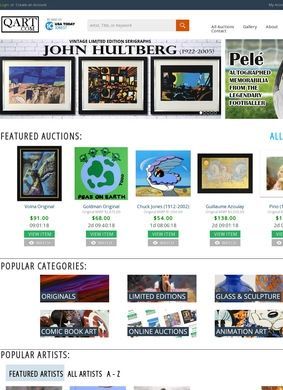
An online auction featuring a Bob Dylan piece alongside work by Wyland and Peter Max tells you fairly quickly what kind of operation Q Art runs. This is a Los Angeles marketplace, trading as Quality Art Auctions, Inc., that has been selling fine art over the web since 2006. The catalog leans toward names a casual collector might recognize, and the inventory spreads across more media than most single-category sellers bother with: original paintings, limited edition prints, serigraphs, lithographs, giclee prints, hand-blown glass, sculpture, animation art, and comic book art.
How Q Art's auction format works
The buying experience on Q Art splits into a few clear paths. Browse Art holds the for-sale listings and the live auctions, New Arrivals does what its name says, and Featured Artists groups work by the bigger draws. Anyone who registers can keep watchlists, build saved searches, and track lots they care about, which are the practical tools a buyer needs when an auction format means timing matters and you cannot always sit at the screen. Mark Kostabi turns up among the featured names too, so the roster reaches past the obvious crowd-pleasers into territory that contemporary collectors will appreciate.
Media types and collector appeal
The breadth of media deserves a second look, because it shapes who this site actually suits. A serigraph buyer and a hand-blown glass collector rarely shop the same place, yet both have a section here, and the inclusion of animation art and comic book art widens the audience again toward pop-culture collectors who do not always show up at traditional fine-art venues. That mix is unusual for a single seller, and it means the catalog rewards browsing more than a narrow specialist site would. The flip side is that depth in any one category depends on what is currently consigned, so the right approach is to search for the artist or medium you want and judge the stock that comes back.
Artist-protective bidding system
One detail sets the auction side apart from a generic bidding board. Q Art runs standard auctions but also uses a proprietary bidding format built to protect artists and curb predatory bidding. That is a thoughtful answer to a real problem in art auctions, where lowball sniping can devalue an artist's market, and it shows the people behind Q Art have thought about the seller's side instead of only chasing buyer volume. For artists and dealers there is a consignment route, the "Sell Your Art" service, which gives the platform a two-sided purpose instead of a shopfront alone. A site that courts sellers as deliberately as buyers tends to keep fresh inventory moving, and the New Arrivals section is the visible result of that.
Reviews across multiple platforms
The picture is mixed, and a buyer spending real money on art should read it honestly. Birdeye carries 22 reviews at a 5-star average, which is strong, and Scamadviser shows a single 5-star entry. Houzz lists 26 reviews, though the snippet does not surface an aggregate score, so the raw count is more telling than any number attached to it. Knoji sits lower at 3.8 out of 5 across 11 reviews, a more middling result.
Customer service and business standing
The wrinkle shows up on Five.Reviews, where individual write-ups run mixed and a couple of recurring complaints surface: high prices and poor customer service. Neither is unusual for a fine-art seller working with collectible names, and high prices in this corner of the market often track the work itself. Still, the customer-service notes are worth weighing if you expect quick hand-holding through a purchase. The Better Business Bureau lists the company in Los Angeles, confirms the 2006 start, and counts 19 years in business, but currently marks it "Not Rated" because there is not enough information to assign a grade. That is a neutral mark, not a black one, and the long operating history counts for something on its own.
Contact options and social presence
Contact is straightforward. A phone number and an email are both visible on the site, and a FAQ page handles the routine questions buyers tend to ask before bidding. For a platform asking people to commit to high-value, sometimes one-of-a-kind items, that openness is more reassuring than a bare storefront. Q Art also keeps an active presence on Facebook, Instagram, and Pinterest, which fits a business built around images and gives a buyer another way to gauge how current and responsive the operation is.
Strengths and pricing cautions
Where does that leave a prospective buyer? The strengths are genuine: a real mix of media, recognizable artists, a bidding system designed with artists in mind, and nearly two decades of continuous trading. The cautions are equally real: pricing that some buyers find steep and a service record that draws occasional criticism. Q Art reads as a credible operator with a clear niche, not a fly-by-night listing, and the volume of positive reviews on Birdeye and Houzz backs that up.
Comparing Q Art to larger platforms
The obvious comparison is a marketplace like Artsy, which aggregates galleries and auction houses worldwide and gives a buyer a wider price reference and more provenance depth for blue-chip names. Artsy will almost always offer more breadth and a thicker paper trail. What Q Art gives in return is a tighter, curated roster, a long single-operator history, and that artist-protective auction format, which a collector buying Wyland or Peter Max specifically may value over a sprawling aggregator. If a particular artist from the featured list is already on your radar, Q Art is the place to start; if the search is still wide open, the larger platform will likely serve better.