A dining table cut from a single slab of Burr Oak, six foot nine long and three foot wide, resting on metal legs: that is the piece that tells you what Roni Roberts Artistic Woodcraft is really about. The oak came from Dryslwyn in Carmarthenshire, and it was not felled to order. Like the rest of the work here, it started as a tree that came down on its own. That sourcing rule sits at the centre of everything the business makes, and it changes how you read the smaller items too.
This is a one-woman operation in Cardigan, Ceredigion. Roni Roberts Artistic Woodcraft turns and hand-works wood from local Welsh trees that have fallen naturally, a far narrower supply than a workshop buying in seasoned timber has to work with. It means no two bowls are quite alike and the range is dictated by what the woodland gives up.
What the wood becomes
The bread and butter is turned pieces. Wooden bowls, plates, and cawl bowls (the Welsh soup bowl, which is a nice touch of local specificity) make up the bulk of what appears in the gallery. Alongside those sit larger commissions like the oak table, so the catalogue at Roni Roberts Artistic Woodcraft stretches from a small hand-held bowl up to a piece of dining furniture without feeling like two unrelated businesses stapled together.
Finishing gets more attention than you might expect from a maker this size. The standard treatment is an oil and wax mixture followed by a wax polish. Food-safe finishes are available when a buyer asks, an option worth checking before ordering anything meant to hold food. There is a blog covering finishing techniques, and reading through it you get the sense of someone who genuinely enjoys the process and likes explaining how it works.
Turned bowls and the natural edge
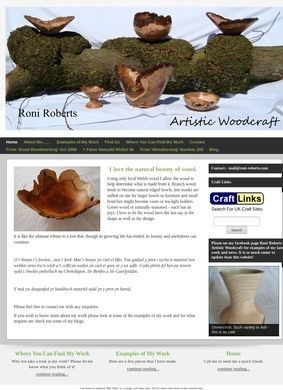
Woodturning is the core skill on display at Roni Roberts Artistic Woodcraft, and the bowls are where it shows. Because the timber is naturally fallen, natural-edge work fits the material well: pieces that keep part of the original outer wood at the rim. It is a style that depends entirely on the character of the individual log, so the gallery functions less as a fixed product line and more as a record of what has been made.
I find that honesty appealing, because it sets a realistic expectation. You are buying into a maker's hands and a specific piece of Welsh wood, not ordering from a standard range with guaranteed stock. If you want six matching bowls in a particular timber, this is not the fastest route, and the site does not pretend otherwise.
The maker behind it
The "About Me" section does real work. The woman behind Roni Roberts Artistic Woodcraft grew up in a medieval farmhouse in the Gwaun valley in North Pembrokeshire, in a self-sufficient household, and she draws a direct line from that upbringing to the craft philosophy behind the business. Whether that biography moves you or not, it explains the insistence on sustainable, locally fallen timber rather than reading as a marketing afterthought bolted on later.
That context is the thing that lifts Roni Roberts Artistic Woodcraft above a plain product page. The story and the sourcing rule reinforce each other, and the writing on the site fills in the detail behind both.
Standing and how to reach her
On outside footing, the picture is modest but genuine. Roni Roberts Artistic Woodcraft is a member of Ceredigion Craft Makers, and her work is stocked as a featured maker at Origin Arts and Crafts, a makers' co-operative shop in Carmarthen that also draws from Carmarthenshire, Pembrokeshire, Swansea, and Ceredigion. Being carried by a co-operative like that is a form of vetting, since other makers have to rate the work worth shelf space.
Beyond that, there is not much to go on. A Facebook page has around 450 likes, and there is a "Meet the Maker" interview feature from a few years back. Searching Google, Trustpilot and Yelp turned up no star-rating reviews at all. For a small artisan maker that is not unusual, but a first-time buyer is trusting the gallery images and the co-operative association rather than a wall of testimonials.
Reaching her directly is the softer spot. The main website would not load during this check, so I cannot vouch for how clearly a phone number, address, or contact form sits on her own pages. What is confirmed comes through third parties: the Facebook page and the physical presence at the Origin Arts and Crafts shop, where the pieces can be seen and bought in person. A buyer who prefers to handle a bowl before paying has a real route through the Carmarthen shop, which is arguably better than any online form for work like this.
So where does that leave a prospective customer? If you want mass-produced homeware or a guaranteed matching set delivered fast, look elsewhere. If you want a turned bowl or a table with a traceable Welsh origin and a maker who can tell you which valley the wood came from, Roni Roberts Artistic Woodcraft has a clear and unusually well-documented offer.
My reservation is purely practical: the shallow public review trail and the unverified on-site contact details mean I would go through Origin Arts and Crafts or the Facebook page to make first contact, then judge the piece with my own eyes. On the craft itself, the evidence points the right way. On the ease of buying, do a little legwork first.
Business address
Roni Roberts
Waunblaen,
Felinwynt,
Dyfed
SA43 1RW
United Kingdom