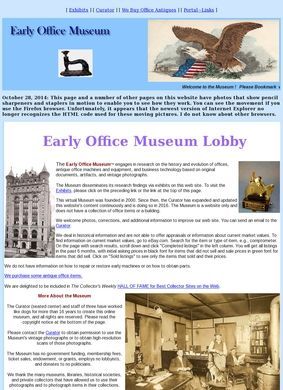
officemuseum.com is home to the Early Office Museum, a one-person online archive that researches and documents the history of office technology made before about 1920. Everything lives on the web; there is no building to walk into. A single curator has run the Early Office Museum for more than fifteen years, and that shows in both the depth of the material and the slightly homemade feel of the presentation.
Small office objects get sustained attention
What the Early Office Museum actually holds is a wide spread of pre-1920 office antiques, each given its own exhibit rather than a passing mention. Paperweights, writing ink, paper fasteners, seal pressers, tabulating and copying machines, pencil sharpeners, hole punches: these are the sorts of small objects that almost no general museum bothers to catalogue, and at the Early Office Museum they get sustained attention. The exhibits lean on vintage photographs and scans of original documents, so a reader is looking at period advertisements, patent illustrations and trade material instead of modern reconstructions. For anyone trying to date an old desk gadget or understand how a particular mechanism worked, that primary-source grounding is the part that pays off.
Who uses this archive
The audience is broader than the niche subject might lead you to expect. The Early Office Museum is built for collectors, but it also fields interest from movie producers chasing period-accurate props, museum staff, exhibitors and researchers who simply want to know how a tool of the era functioned. The Early Office Museum's curator answers research questions from these groups directly, which turns a static archive into something closer to a reference desk staffed by one knowledgeable person. That is unusual, and it is worth weighing if you are stuck on an identification that ordinary search engines cannot settle.
Buying and pricing antique items
A couple of practical functions sit alongside the exhibits. The Early Office Museum buys select antique office items, so collectors with something to sell have a route to a buyer who actually knows the field. And for people trying to put a price on what they own, the Early Office Museum does not pretend to be an appraiser: it points them toward eBay's completed listings, where real sale prices live. That is honest advice. Completed listings are the closest thing to a market value an amateur can check, and steering people there instead of inventing valuations says something good about how the place is run. There is also a portal section of links pointing to other collector resources, which extends its usefulness beyond what one curator could ever document alone.
Recognition from institutions
On the question of whether it can be trusted, the Early Office Museum has accumulated recognition that, in this corner of the internet, outweighs any number of star ratings. Harvard Business School's Working Knowledge archive has featured the Early Office Museum, and Collectors Weekly lists it in its Antique and Vintage Hall of Fame, an editorial nod rather than a scored review. The Foundation History of Design in Barcelona and other institutional references have cited it as well.
None of these come with a numeric rating, and that is the right way to read them: editorial recommendations from organizations that have no reason to flatter a hobby site mean more than an anonymous pile of starred reviews. No Google, Yelp, Trustpilot or Tripadvisor review counts turned up, which is exactly what you would expect from a research archive, not a consumer business. Their absence is not a mark against it.
Inside the contact system
Reaching anyone here takes some effort. There is no phone number and no physical address, which makes sense for a virtual museum but does limit how you can get in touch with the person behind it. The only route to the Early Office Museum's curator is via an email link, and the address itself is never printed in plain text anywhere on the site.
For a site whose chief offer is answering research inquiries, a single contact channel is a little narrow, and a first-time visitor may need to look around before spotting the link and realizing it is the way in. That said, the link does the job a contact form would, and omitting a plain-text address is a reasonable defence against spam, so it is not worth dwelling on. The bigger limitation is simply that you are relying on one person's time and goodwill, with no fallback if that person is unavailable.
Design reflects a personal project
The design of the Early Office Museum is dated, and there is no point pretending otherwise. This is a long-running personal project, not a polished institutional platform, and the layout reflects an earlier era of the web. For some visitors that will be a friction point. For the subject at hand it is almost fitting, and the substance underneath easily survives the plain wrapper. Anyone who judges a site by its visual gloss will be unimpressed; anyone who came for the content will stop noticing the styling within a few minutes.
So what is the Early Office Museum actually for, and is it worth the trip? It rewards a specific kind of visitor: the collector, the props researcher, the curious person who has found an odd old office tool and wants to know what it is. If that describes you, the depth here is hard to find anywhere else, and the institutional citations give you good reason to take the information seriously. If you are casually browsing antiques with no particular interest in office history, the narrow focus and old-fashioned presentation may not hold you for long.
The Early Office Museum does not try to be everything, and it should not be judged as though it does. Within its lane it is a genuinely valuable resource, run by someone who clearly cares about getting the history right and is willing to answer questions to prove it.
The honest verdict lands a notch below glowing, and only because of the constraints that come with a solo operation: one contact channel, no quick way to reach a human if the curator is busy, and a presentation that asks for some patience. None of that touches the quality of the Early Office Museum's research, which is the reason it exists and the reason serious people keep citing it. Worth bookmarking if office history or antique tool identification is on your list; worth a quick visit if you have stumbled across an old desk gadget and want a name for it. That split is the fair way to score the Early Office Museum: a specialist archive that does its narrow job unusually well, and makes no apology for being narrow.