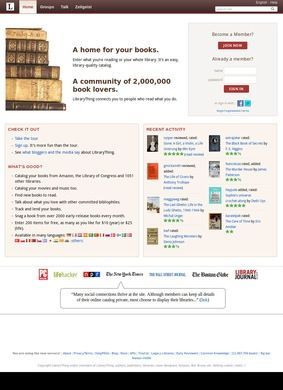
LibraryThing is a free online catalog for the books, movies, and music a person owns, run out of the United States and used by readers worldwide. Adding a title means pulling its record from one of the sources the site draws on: Amazon, the Library of Congress, and by the platform's own tally around 4,941 other libraries. Match the edition, and the fields fill themselves in. From there a member can track reading progress, give a star rating, and write a review that sits on the same page as the shelf.
The premise is old-fashioned in a way that ages well. A personal library, in LibraryThing, is treated as something worth logging with care, not a throwaway list you abandon after a week.
Most people arrive for the catalog, so that is where a fair look starts.
Building a catalog from many sources
The three source feeds do different jobs. Amazon and the Library of Congress cover the mainstream and the well-documented, while the several thousand additional library connections are what let a collector match a foreign printing, an older hardback, or a small-press run that a single retail feed would never surface. For anyone whose shelves hold more than bestsellers, that breadth is the reason to use LibraryThing over a plain spreadsheet.
Rating and reviewing sit near the center of the experience, and they are what separate a catalog from a plain inventory. A member marks a book with stars, writes out what worked and what fell flat, and leaves that verdict public for other readers browsing the same title. Across a full shelf those small judgements add up into a record of taste that is genuinely yours, and because a single title carries reviews from many members, someone deciding whether to start a book has several opinions to draw on beyond one lone guess.
There is a practical payoff to entering everything rather than a curated selection. Duplicate copies, books lent out and never returned, and the title you nearly bought a second time all become visible once the catalog is complete. Progress markers, star ratings, and personal notes accumulate, and over months the catalog starts to describe your habits back to you. Music and film records can live in the same LibraryThing account, so a household's media ends up in one place instead of scattered across three.
None of this is flashy, and that counts in its favour. The system rewards patience: the more you enter, the more the LibraryThing catalog is worth to you.
The Early Reviewers program
One of the more distinctive offerings is Early Reviewers, which connects authors and publishers with readers willing to review a book before it reaches shelves. For a self-published writer that is a route to early feedback and a few honest reactions at the point where they matter most, and LibraryThing is one of the few general reading sites to run a program of this kind at all.
The mechanics are straightforward on paper. Publishers and authors list pre-release titles, members request the ones they want, and copies go out in exchange for an honest write-up once the reader has finished. For a small press or a debut novelist without a marketing budget, that puts a book in front of committed readers who already log what they read, a different audience from a general online giveaway.
Whether it pays off for an author is a reasonable thing to weigh, and readers have weighed it. A thread on Reddit's r/selfpublish debates whether the Early Reviewers route is trustworthy for writers chasing reviews, and no numeric rating came out of that conversation. The fact that authors are asking the question in the open is useful context, and anyone weighing the program would do well to read how those writers describe their results before sending a manuscript into it.
Reviews Enhancement for library catalogs
LibraryThing also sells to institutions, which is easy to miss from the hobbyist side of things. Its Reviews Enhancement product feeds patron reviews and ratings directly into a library's own catalog, with sharing out to Twitter and Facebook, so a public library can display reader opinion beside a title without building that machinery itself.
For a library the appeal is concrete. Patrons see familiar star ratings and short reviews at the moment they decide whether to borrow, librarians gain an engagement feature without a development project, and the social sharing pushes titles out to networks where a catalog page would otherwise sit unseen. This is quiet infrastructure, the kind a patron uses without ever knowing whose software sits underneath, and it points to a company that earns part of its keep from libraries and not from individual members alone.
Forums, the app, and how it reads on trust
Beyond the catalog sits a community layer that does real work. Topic and forum pages, including long-running welcome threads under headings like "Welcome to LibraryThing!", let members post questions and get answers from other users, which counts for a lot on a platform where much of the value is knowing how to drive the cataloging tools well. A companion blog at blog.librarything.com carries site news and announcements alongside the LibraryThing forums.
The community answers tend to be practical rather than chatty. Someone stuck on importing a list, merging two duplicate editions, or fixing a cover that matched the wrong printing can usually find that another member solved it long ago, and the long welcome threads work as a soft on-ramp for newcomers who might otherwise bounce off the density of the site. That self-reliance is not incidental: much of LibraryThing runs on member knowledge instead of a staffed help desk.
The mobile side is practical too. An iOS app on the App Store handles the errand of scanning a book's barcode straight into a catalog and searching a collection from a phone, which is what turns LibraryThing from a desk activity into something you can do standing in a bookshop or in front of your own shelves. Scan, match, done.
Put together, the pieces serve three fairly different groups: individual collectors and readers, self-published authors after reviews, and libraries buying the catalog enhancement. Spanning hobbyist, author, and institution is unusual for a site this unassuming, and it is part of why LibraryThing has stayed useful where flashier reading apps have come and gone. That range is a point in its favour, and a fair reason the tool has outlasted a few trend cycles.
What outside reviewers say
Independent opinion is scarce here. On Sitejabber, LibraryThing carries a 3.0 star rating drawn from six reviews, a middling score on a very small sample. What is worth stating plainly is that six reviews is too slim a base to support a firm verdict either way; it tells you a handful of people came away lukewarm, and little more than that. No rating turned up on Google, Trustpilot, Yelp, Facebook, or Tripadvisor for the site, so that Sitejabber figure and the Reddit discussion are close to the entire independent record on LibraryThing.
Contact is harder to assess, because the site would not load on a direct visit, which leaves the usual signals, a phone number, a mailing address, a contact route, unconfirmed on this pass. Read that as a caveat and not a mark against it. A platform with paying library clients plainly runs support channels; they simply could not be verified here. The stronger evidence is what the product does, and by that measure the software is deep, specific, and clearly still maintained.
The outside reputation is small and mixed, but the catalog underneath keeps doing serious work: matching editions across thousands of library sources and giving readers a place to log an honest opinion instead of a lone number pulled from nowhere. That, more than any outside score, is what LibraryThing has going for it.