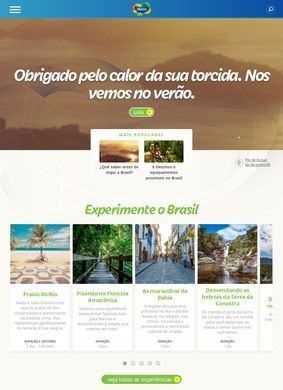
Visit Brazil is the official international tourism platform of EMBRATUR, the Brazilian Institute of Tourism, a federal agency founded in 1966 and tied to the country's Ministry of Tourism. Its job is narrow and clearly stated: promote Brazilian destinations to travelers, tour operators, and media outside Brazil. That government backing shapes everything on the site, from the choice of stories to the way regions get framed for an audience that has probably never set foot in the country.
Editorial approach and cultural storytelling
The content sits somewhere between a travel magazine and a marketing arm. There is a blog with destination guides, city and regional write-ups, and longer cultural pieces that reach past the usual beach-and-carnival shorthand. One thread covers Amazonian indigenous legends; another digs into the boi-bumba festival, the folk performance from the north that turns rival groups and a mythical ox into days of song and staged drama. That editorial choice tells you something about the ambition behind Visit Brazil. Instead of reducing the country to Rio and a few postcard views, the site reaches for the interior and the northeast.
Regional guides over postcard shortcuts
The strongest material on Visit Brazil is the storytelling. Regional guides and traveler experience pieces give a sense of place that a plain listicle rarely manages, and the cultural narratives read as though someone wanted a foreign visitor to understand why a festival or a stretch of rainforest matters to the people who live there. For a country this large, that framing does real work. A traveler weighing the Amazon against the Pantanal, or the coast against the highlands, gets context rather than a flat menu of names.
Inspiration versus practical planning details
What is harder to judge is how far the writing carries you toward an actual trip. Promotional content and practical planning are different animals. A guide can make Manaus sound irresistible and still leave you without the boat schedules, the permit rules, or the rough costs that decide whether a plan survives contact with reality. Visit Brazil is built to inspire the first, and the evidence points to it doing that part well. The second part, the logistics a booker actually needs, is less clear from what the platform advertises about itself.
Publishing rhythm and content freshness
The blog format also means freshness matters. A promotional site lives or dies on whether its stories keep coming and stay current, since a festival calendar or a regional feature ages fast once dates and details drift. There is no way to gauge the publishing rhythm from the outside here, and that uncertainty sits under any praise for the writing.
Audience and institutional perspective
Behind Visit Brazil is an agency with a wider brief than the blog suggests. EMBRATUR markets Brazil to both the leisure and the business travel markets, courts the travel trade, and supports journalists and media covering the country. That last function explains a lot about the tone. When a platform is partly built to feed correspondents and tour operators, the polish and the sweep of the coverage make sense, and so does the occasional distance between the copy and the granular needs of an individual planning a two-week holiday.
Sustainability, diversity, climate action framing
The agency also frames its work around economic and social development, sustainability, diversity, and climate action. Those priorities are stated as part of the mandate, and they line up with how a national tourism body positions itself to the international market today. How much of that filters into the day-to-day content of Visit Brazil, versus living mostly in policy language, is the sort of thing a reader can only test by spending time in the guides themselves. The mandate is broad; the proof is on the blog.
State promotion without independent critique
Because Visit Brazil is a state-run promotional brand, the perspective is worth naming plainly. It is not a neutral guidebook, and it does not pretend to be one. It is Brazil selling Brazil, which is exactly what an official tourism platform is supposed to do. The upside is authority and reach: the country's own agency can open doors and gather material that an independent blogger cannot.
The trade-off is that a visitor will not find the candid downsides, the safety caveats, or the honest "skip this" that a traveler sometimes wants. Read it for the pitch, then cross-check the practicalities elsewhere. A search for outside reviews of Visit Brazil itself, separate from EMBRATUR's broader press coverage, does not turn up an independent review count on Trustpilot or a comparable platform, so any judgment here rests on the content rather than on outside feedback.
Value for travel operators, media professionals
For the travel trade and media, the value proposition is cleaner. An operator building Brazil itineraries or a journalist assembling a feature has a single, official starting point with regional depth and cultural angles already worked out. That audience is arguably better served than the solo tourist, since Visit Brazil speaks their language: destinations packaged, narratives ready, the national story told with one coherent voice. The platform clearly knows who it is talking to on that side of the ledger.
The general traveler gets a genuine reason to browse Visit Brazil. The cultural pieces alone justify a visit, and the reach beyond the obvious circuits is the site's real distinction. A first-timer who thinks Brazil means Copacabana and nothing else will come away with a longer list and a better sense of what each place actually offers. Whether that browsing turns into a booked flight depends on how much Visit Brazil is willing to hand over past the inspiration stage.
And that is where the honest doubt settles. As a brand, Visit Brazil is unambiguous about its identity and its authority, and the sample of content points to writing that is thoughtful, not generic. What I cannot resolve from here is the gap between a beautifully told story about the boi-bumba or an Amazon legend and the moment a traveler needs a date, a route, and a price to move forward. A tourism board can inspire the desire to go and still leave the hardest, most practical questions to someone else, and it is not clear on the evidence which side of that line this platform lands on.