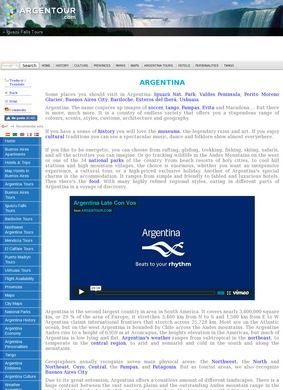
Covering every one of Argentina's 23 provinces on a single site is a wide brief for any travel resource to carry, and Argentour takes that brief on directly. That ambition explains both the strengths and the occasional gaps in what is actually on the page. The site is two things at once: a sprawling reference library about the country, and the shop window for a private tour operation based in Buenos Aires.
Start with the reference half. Someone planning a first trip to Argentina usually has a fuzzy mental map, a couple of famous names (Iguazu, Patagonia, maybe a steak dinner), and no real sense of how the pieces fit together. Argentour arranges the country into regions such as Patagonia, Cuyo and Mesopotamia, then drills down into cities like Mendoza, Bariloche, Salta and the capital. That regional framing is useful, and it happens to be how Argentines themselves talk about their own geography, which saves a traveler from treating a place the size of India as one blur.
Where the guides take you
The content runs deeper than the usual top-ten listicle. It is also unevenly distributed across the site, which reads less like a flaw and more like an honest reflection of where the writing effort actually went. Some sections are clearly labors of interest. Others feel like placeholders waiting for someone to fill them in.
National parks get real attention. There are dedicated pages for Iguazu, Los Glaciares and Perito Moreno, the glacier that most people picture when they picture Argentine Patagonia. Historical sites in Buenos Aires get the same treatment, with entries on Plaza de Mayo, the Cabildo and the Teatro Colon. These are the anchors a trip is usually built around, so putting them front and center is the right call.
Maps and provincial coverage
The map section is a small surprise. Instead of one generic country outline, Argentour offers physical, political, satellite and tourist maps side by side. That distinction matters to different readers for different reasons: a hiker cares about terrain, while someone sorting out domestic flights cares about political boundaries and where the provincial capitals sit. Bundling several map types together is a practical touch a lot of glossier travel sites skip, and it reads as a sign that whoever built Argentour has actually planned trips there.
The promise to cover all 23 provinces is the boldest claim on the site, and it is also where a reader should keep expectations honest. Covering the famous provinces well and the obscure ones at all are different jobs, and a site this broad almost certainly manages the former better than the latter. Still, having any entry point for a lesser-visited northern province beats the silence on most English-language guides, which stop at Buenos Aires and Bariloche and call it a country.
Culture, history and the softer material
Beyond logistics, Argentour reaches into cultural writing on national history, indigenous peoples, food and even sport. This is the material that turns a checklist trip into something a traveler actually understands. Reading a little about the country's indigenous history before standing in the northwest, or knowing why a parrilla is run a certain way before sitting down at one, changes the experience on the ground.
Whether every page is thorough is hard to judge from the outside, but the intent to go past hotels and opening hours is plain, and it is the kind of writing that separates a site built by people who care about the place from one assembled to catch search traffic.
One caution on the cultural pages: writing about indigenous peoples and national history is easy to get glib, and the honest test is whether a page names specifics or drifts into vague respectfulness. A visitor cannot audit every entry from the outside, so these pages read best as a starting point rather than the final word. Used that way, they add genuine value to trip planning.
Travel packages and suggested itineraries sit alongside the free content, and that is the natural bridge to the commercial side of the operation.
The tour operator behind the reference site
A separate strand, Argentour Day Tours, runs private tours out of Buenos Aires with some reach into Chile. The pitch is boutique and upscale: small-group or private guiding and gourmet itineraries, aimed at travelers who would rather pay for a curated day than herd onto a coach. That is a specific market. It will not suit a backpacker counting pesos, and it does not appear to be trying.
Pairing a deep free-content library with a paid tour service is a sensible model, and it holds together better than it might sound. A visitor can read the Argentour guides, decide the country is worth the trip, and then, if a guided day in the capital appeals, there is a booking route rather than a dead end. The reference material does the persuading; the tours are where the money comes in.
Reputation is the harder part to pin down. Argentour Day Tours has a TripAdvisor page with an active reviews section, which is the platform where guided-tour operators tend to live or die, so its presence there counts for something. A specific rating or review tally could not be confirmed from the outside, and inventing a number that was never actually seen would be worse than saying nothing.
Searches beyond TripAdvisor turned up nothing on Trustpilot, Google, Yelp or the other usual rating sites, and several similarly named companies (Argento, Argent and the like) make casual searching harder than it should be. Anyone weighing whether to book should read the TripAdvisor comments directly, since that is where the actual substance about specific guides and specific days sits.
Contact details are straightforward, and that counts in the operation's favor. Two email addresses, a Buenos Aires phone number, and links out to Facebook, Instagram and TripAdvisor are all there, with nothing buried behind a single obscure form. For a traveler booking from another continent who wants to ask a real question before parting with money, that kind of reachability is reassuring on a type of site where it is often missing.
Living with the dual identity
A word of realism about the two roles this one site plays. The line between free encyclopedia and paid tour shop is not always sharp, and a reader should keep track of which hat the page is wearing at any given moment. The guides are informational; the packages and day tours are a product. That split is not really a criticism, more a reminder to read with clear eyes, which is fair advice for any operator that both informs and sells.
Who fits this best? An independent traveler doing homework, someone who wants to understand Argentina's regions before booking flights and would happily hand one or two days in Buenos Aires to a private guide, gets the most out of the reference depth. The gourmet, upscale tour angle also suits a couple or small group treating the trip as something of a splurge. It is a weaker match for the bargain traveler, and for anyone who wants a big established brand with thousands of visible reviews sitting behind every booking.
Plenty of sites offer a Buenos Aires walking tour. Plenty of others publish free country guides. Argentour does both, and the guides give its own tours a context a standalone booking page could never provide on its own. The breadth across provinces, parks and cultural writing is genuine, even where it grows sparser in the corners, and the map section shows a level of care that is not always present elsewhere.
The caveat is just as real: for the tours specifically, the public track record sits on one platform and was not quantified in anything found here, so the reading has to happen on TripAdvisor itself before money changes hands. Argentour earns credit for the depth and honesty of its country guides. What a booking with Argentour Day Tours is actually like still rests on a handful of reviews on someone else's site, not on Argentour's own page.