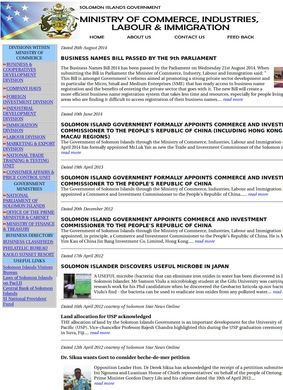
Where does someone in the Solomon Islands go to register a business name, apply for a work permit, or secure a foreign investment certificate? The Department of Commerce, Solomon Islands is where those errands land. Its site is the official web presence of the Ministry of Commerce, Industry, Labour and Immigration, and it pulls a wide span of government functions together in one place.
That breadth is the first thing worth understanding about the Department of Commerce, Solomon Islands.
Services that reach business and border alike
Start with the everyday transactions. The Department of Commerce, Solomon Islands handles visa facilitation for both short-term and long-term visas, processes work permits, issues passports, registers business names, and grants foreign investment certificates. That is an unusual combination to find under one roof, immigration paperwork sitting beside company formation, and it reflects a ministry whose remit was drawn to cover commerce and the movement of people at once.
Most governments split these jobs across two or three departments. Here they run together, which is either a quirk of a small state or a deliberate efficiency, and either way it changes how a user approaches the site: one place to check with the Department of Commerce, Solomon Islands, not several. For a citizen or a foreign applicant, that cuts down the number of offices to chase, though it also concentrates a great deal of responsibility in a single ministry.
Registering a business and investing from abroad
For anyone starting or expanding a company, this is the practical core. Business name registration runs through a unit the ministry calls Company Haus, and foreign investors deal with the Foreign Investment Division for the certificate that lets them operate. The Business and Cooperatives Development division sits alongside, aimed at the ground-level work of getting enterprises and cooperatives going.
The Department of Commerce, Solomon Islands effectively acts as the front door for setting up in the country, whether the applicant is a local trader or an overseas firm testing the market. Having the divisions named, so a would-be investor knows the Foreign Investment Division is the right desk, saves the kind of wandering that plagues government paperwork everywhere. In practice the Department of Commerce, Solomon Islands is doing double duty here, standing as registrar and as promoter of new enterprise at the same time.
Visas, permits and passports
The immigration side is just as substantial. An Immigration Division manages the visa and permit workload, and the Department of Commerce, Solomon Islands frames these as facilitation: short-term visas for visitors, long-term ones for people staying to work or invest, with work permit processing and passport issuance handled in the same stream.
For an employer bringing in overseas staff, or a family sorting travel documents, the value is in having the process and the forms set out on an official source. It removes a layer of guesswork about who to ask and what to file, and I found the plain naming of each function more reassuring than any amount of polish would have been.
Passport issuance in particular is a service most citizens will need at some point, and finding it grouped with the commercial functions under the Department of Commerce, Solomon Islands is a fair measure of how consolidated this ministry really is.
The divisions behind the counter
Behind those front-line services sits a longer roster of divisions, and reading it gives a clear picture of how much this ministry carries. The Department of Commerce, Solomon Islands is organised into a set of specialised arms: Corporate Services and Headquarters keeps the institution running, while the substantive work is split across units for investment, industry, labour, consumer protection and trade.
It is a lot of mandate for one department. The Department of Commerce, Solomon Islands does the useful job of naming each division, so a visitor can aim at the right one instead of the switchboard.
Watching prices and settling disputes
Two of these deserve singling out, because they touch ordinary people directly. Consumer Affairs and Price Control, shortened to CAPC, is the arm concerned with what businesses charge and how consumers are treated, and it is tied to the penalty information and price rules that bite in a small economy. A Trade Dispute Panel handles disagreements that need a formal hearing. For a consumer who suspects overcharging, knowing the CAPC exists at all is half the battle, and a trader on the wrong end of a dispute has a named body to turn to.
The Department of Commerce, Solomon Islands puts both of these in plain view, and price control and formal dispute resolution are exactly the functions people need to know exist before the moment they need them; burying them would defeat the purpose.
Growing industry and export
The development side is broad. An Industry Development Division works on growing local industry, the Marketing and Export Promotion Division looks outward at getting Solomon Islands products in front of foreign buyers, and an E-Commerce Implementation Unit signals an effort to move some of this online. A Labour Division rounds it out, covering worker protection and the rules around employment.
The Department of Commerce, Solomon Islands is plainly trying to do development and regulation at the same time, promoting trade with one hand and policing it with the other. Whether one ministry can carry both well is an open question anywhere it is attempted, but the intent is legible in how the Department of Commerce, Solomon Islands lays out its arms.
What lifts the site above a list of division names is what it hosts. The Department of Commerce, Solomon Islands publishes legislation and policy documents, application forms, fee schedules with penalty information, awareness and education materials, and its annual work plans and strategic documents. For a researcher, an investor's lawyer, or a business owner working out what a licence will cost, that document library is the real draw, the difference between a page that tells a visitor a division exists and one that hands over the actual form and fee.
A library like that is why the site of the Department of Commerce, Solomon Islands is worth bookmarking even by someone with no immediate transaction to make, since it doubles as a reference on how the country regulates trade and labour. The awareness and education materials in particular suggest the ministry treats part of its job as explaining the rules and enforcing them, which is a healthier posture for a regulator than pure gatekeeping.
The doubt that lingers is currency. A government portal spanning this many functions is only as trustworthy as its most out-of-date page, and a fee schedule or a form that has quietly been superseded is worse than none at all, because it looks authoritative while being wrong. Whether every document on the Department of Commerce, Solomon Islands is the current version is something a visitor cannot judge from the page alone, and for anything carrying a fee or a legal consequence, that is the question to settle before trusting what gets downloaded.