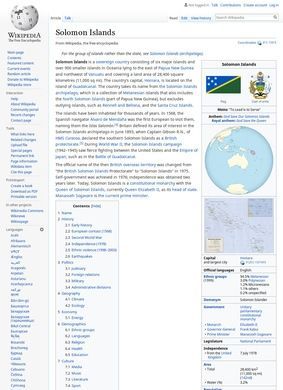
Someone planning a trip to Honiara, or trying to make sense of a news report about a Pacific security pact, usually needs a single page that pulls the whole country into focus before chasing specialist sources. That is the job Wikipedia: Solomon Islands does well. The article gathers geography, history, government, population, economy and culture into one place, with the infobox alone answering the quick questions: a 28,896 square kilometre archipelago of six major islands and more than 900 smaller ones, capital at Honiara on Guadalcanal, roughly 829,000 people by the 2025 estimate.
Tracing history from first contact to independence
The history coverage is where Wikipedia: Solomon Islands pays off for a curious reader. It pushes human settlement back to somewhere around 30,000 to 28,800 BC, notes the first European contact when the Spanish navigator Alvaro de Mendana arrived in 1568, then traces the British protectorate declared in 1893 and the heavy fighting of the Second World War, the Guadalcanal Campaign included. From there it carries through independence on 7 July 1978, the ethnic conflict known locally as the Tensions between 1998 and 2003, the RAMSI intervention that settled it, and the 2022 security agreement with China. A reader can follow the thread from prehistory to current affairs without leaving the page.
Government system and population details
Government and demographics are handled with the same density. Wikipedia: Solomon Islands lays out the constitutional monarchy under King Charles III, the Westminster-style parliament and the prime minister as head of government. On population it goes past raw numbers into composition: about 95.3 percent Melanesian, roughly 97.4 percent Christian, English as the official language with Solomon Islands Pijin as the everyday lingua franca, and somewhere between 60 and 70 indigenous languages still spoken. That last figure tells you more about the place than any travel brochure could.
Economy built on logging and fishing
It covers the country as a starting map, not as the final word. The economy section is a fair example. Wikipedia: Solomon Islands gives a GDP per capita near $2,205 for 2024 and names the load-bearing sectors plainly: logging, commercial fishing, smallholder agriculture and tourism, with a frank note about how much the country leans on timber exports and foreign aid. Those are the facts a journalist or student needs to frame a story, and they are stated without spin.
The culture material is thinner by comparison, with sections on indigenous traditions, music, arts and sport that sketch the subject more than they fill it in. That is the trade-off in any single encyclopedic page. Breadth comes first, and depth lives one click away. What makes the depth reachable is the reference apparatus: inline citations, external links to government and international bodies, maps and navigation that connect Wikipedia: Solomon Islands to related Pacific and Commonwealth topics.
For most readers, the value is in not having to go further at all. Wikipedia: Solomon Islands answers the common questions in a few minutes: where the country sits, how it became independent, who governs it, what the economy runs on, what languages people speak. The figures are specific enough to cite and broad enough to orient a newcomer. It is the kind of reference you check first and trust to point you somewhere reliable next.
Is the population data reliable?
One caution belongs here. The article is the product of open editing, so the freshest claims, a population estimate or a recent political development, can shift as editors update them. The 2025 population figure and the 2024 GDP number are estimates, and the page presents them as such. A careful reader treats the most current statistics as snapshots and follows the citations when a number matters to their work. That is not a weakness of Wikipedia: Solomon Islands specifically so much as the nature of the format, and the citations make the checking straightforward.
Where the page consistently delivers is on the settled history and the structural facts. The dates of European contact, protectorate, wartime campaigns and independence are well anchored. The geographic and demographic breakdown is detailed and internally consistent. A student writing a country profile, a traveller building background before a flight, a reader trying to understand the China security deal in context: each finds what they came for without wading through material meant for the others.
Inside the deep settlement history
The depth on indigenous languages and the unusually old settlement dates are the details that reward a slower read. Sixty to seventy living languages in a population under a million is a remarkable fact, and Wikipedia: Solomon Islands treats it as a plain entry rather than a curiosity. The same goes for the prehistoric settlement window, which quietly reframes the country as one of the older inhabited places in the Pacific. These are the moments where the article stops being a summary and starts teaching.
Against a printed reference such as the Encyclopaedia Britannica entry on the same country, Wikipedia: Solomon Islands wins on currency and on the sheer reach of linked sources, while Britannica holds an edge in editorial consistency and the assurance of a named expert behind the text. For a reader who wants the 2022 security agreement and the latest population estimate alongside the deep history, Wikipedia: Solomon Islands is the more practical first stop. The citations are thorough enough that anyone can verify the parts that count before relying on them.