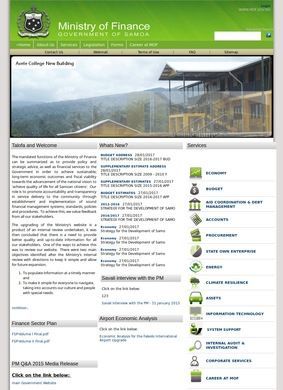
Samoa's Ministry of Finance publishes the Quarterly Debt Bulletin on a regular schedule alongside Quarterly Economic Reviews and Quarterly Financial Reports. That cadence of public reporting is the spine of the whole resource. If you want to know how the independent state of Samoa raises, allocates, and tracks public money, this is where the primary numbers live, straight from the body responsible for them.
Quarterly reports and public data
The structure of the organisation comes through clearly in how the work is split. On one side sits Policy Management, which gathers Aid Coordination and Management, Budget and Fiscal Policy, Economic Policy and Planning, and Debt Management. On the other is Operational Management, covering Accounts and Financial Reporting, Assets Management, Corporate and Strategic Services, IT and System Support, and Procurement Monitoring. Three further divisions sit apart from that split: Internal Audit and Investigation, Legal Services, and Public Finance Management. Reading the division list is itself useful, because it maps who inside the Ministry of Finance owns which piece of the country's fiscal machinery, and it explains why a single document might cite both a budget unit and a debt unit.
Policy and operational divisions
What lifts this above a static org chart is the published output. Annual budget documents and Fiscal Strategy Statements are here, which is the material most researchers, journalists, and donors come looking for. The interactive data visualizations are a genuinely practical touch: they break out development programs, budget allocations, public accounts, procurement, and public debt in a form you can read without downloading a spreadsheet and squinting at it. I spent longer than I expected on the procurement and debt views, partly because they answer questions a press release never would. For a small-state finance authority to put that granularity online is more than many larger governments manage.
Budget documents and fiscal strategy
Procurement gets real attention beyond the charts. The site carries tender advertisements and contract awards, useful to any business weighing whether to bid for government work in Apia, and it gives outsiders a way to see where contracts actually land. Job vacancies are posted too, so the Ministry of Finance doubles as a recruitment channel for its own divisions. Around all of that sit the usual streams of news, events, and press releases, plus sector and corporate plans that set out medium-term direction rather than just reporting last quarter's figures.
Interactive data visualizations
One document deserves singling out: the Pathway for Development of Samoa, the national planning framework. It frames the budget numbers inside a longer-term direction for the country, and having it sit next to the quarterly reporting means a reader can move from strategy down to specific allocations without leaving the site. That vertical connection, from a national plan through fiscal strategy to public accounts, is what makes the Ministry of Finance resource coherent rather than a pile of unrelated PDFs.
Tender notices, contracts, job postings
The intended audiences are easy to read off the content. Government agencies use the Ministry of Finance site for official financial data and policy reference. Citizens get a route to public accounts and budget information. Businesses track tenders and contract awards. Donors and development partners find the aid coordination material, debt bulletins, and economic reviews they need to assess the country's position. Each group is served by a distinct slice of the site, and the material is organised closely enough to how the ministry itself is structured that you can usually guess which division produced a given report.
National development pathway
There are limits worth being honest about. A finance ministry site lives or dies on how current its publications are, and a visitor's experience depends entirely on whether the latest quarter has actually been posted by the time they arrive. The interactive tools are a strong idea, though their value rests on the underlying data being refreshed in step with the reports. None of that is a knock on the design; it is the standing condition of any government reporting portal, where the substance has to keep pace with the calendar to stay worth visiting.
Who uses this resource
Set against the alternatives, going straight to the source is the more direct route. A reader could reach for the Central Bank of Samoa for monetary statistics, or pull country-level summaries from the Asian Development Bank, which works closely with Pacific states on exactly this kind of data.
Currency of publications matters
Those have their place, and the ADB is useful for cross-country comparison. For the primary budget documents, the tender notices, the debt bulletins, and the national development pathway, the Ministry of Finance is the originating authority, and the others largely draw from or sit beside it. Researchers who need Samoa's official fiscal record, as opposed to a secondhand reading of it, will get there fastest by starting with the Ministry of Finance itself. That is where the primary data originates, and secondary sources are only as good as what the Ministry of Finance publishes.