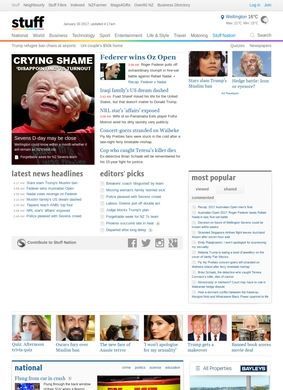
New Zealand's largest digital news publisher lives at stuff.co.nz, and that scale matters before anything else. Stuff covers the country from a position most rivals cannot match for sheer reach, pulling together breaking news, national politics, business, sport, entertainment, lifestyle and property pages into one place. The audience is overwhelmingly domestic, and the editorial output is built around that. If you want to know what happened in New Zealand today, Stuff is one of the obvious places to check. It has been doing this long enough, and at enough volume, that it occupies a different tier from smaller regional titles or topic-focused outlets.
News coverage across politics sport and lifestyle
The coverage runs wider than the homepage might suggest at a glance. Politics and business sit alongside heavy sport, with rugby getting the kind of attention you would expect from a national outlet writing for a rugby-mad readership. Travel and property each get dedicated sections. Stuff also runs a standing Opinion section, and that detail counts for something: it tells you the site is doing more than rewriting wire copy, because someone is being paid to argue a position and readers can take or leave those arguments. Video runs throughout the news offering as well, so Stuff is not a purely text operation. The combination makes it a reasonable first stop for general news consumption rather than a niche source you would check alongside several others.
Extending reach through app and magazines
Stuff reaches past the website itself. It runs a mobile app for people who prefer reading on a phone, and it distributes magazine titles including NZ House and Garden through subscription. The operation therefore spans a daily news site, an app, and print-adjacent magazine products. That is a fuller publishing footprint than a single news homepage would lead you to expect, and it helps explain how Stuff funds itself: advertising sits against the free news tier, and paid subscription options are layered on top for readers who want to go deeper into particular topics or support the journalism more directly.
Free content versus paid subscription options
The free-versus-paid division works in the ordinary way for a publisher this size. A large amount of content is readable without paying, advertising carries the revenue there, and subscription products are offered to anyone who wants extras or wants to support the journalism financially. Nothing about that model is unusual among publishers of comparable scale. What it does mean is that a casual reader can get a great deal from Stuff without ever reaching for a credit card, which is not always true of the bigger international mastheads. Stuff has kept breaking news and most domestic coverage open, and that choice makes the site genuinely useful to a general audience not a paywall destination from the first click.
Reading the Trustpilot complaints
Here the picture grows more complicated, and smoothing it over would be dishonest. On Trustpilot, Stuff has gathered around 102 reviews, and the tone leans negative. The recurring complaints are less about the journalism than about the machinery around it: the app performing poorly, and subscriptions not being fulfilled the way buyers expected. Those are exactly the friction points that turn loyal readers sour, because they hit people who have already decided to pay and then felt the arrangement did not hold up its end.
Weighing the Scamadviser rating
Scamadviser is the other data point, and it needs reading with some care. It lists roughly 112 reviews at an average near 1.9 stars, which looks alarming until you examine what that pool contains. Scamadviser aggregates scam reports, and a chunk of those reports concern things entirely unrelated to Stuff as a news operation: fraud using the name or domain in ways the publisher did not create. The platform itself rates the site as legitimate and safe. So the low star figure reflects the noise of a scam-reporting forum more than any verdict on Stuff as a newsroom. The two should not be read as interchangeable.
Balancing reputation against user complaints
Put together, those data points say different things, and a fair reading holds both. Stuff is a genuine, well-established publishing operation, and no serious observer disputes that. At the same time, a meaningful slice of people who interact commercially with it, subscribers and app users, have had a rough enough experience to go online and complain about it. The complaints are specific enough to be worth taking at face value, even accounting for the fact that unhappy customers are always overrepresented in public review pools.
Unconfirmed contact details from the homepage
An automated fetch of the homepage came back blocked, so the usual footer information could not be confirmed from the outside. For an outlet of this stature that is almost certainly a scraping quirk and not a genuine absence: a publisher running paid subscriptions and a magazine arm will have help and contact routes in place. They were simply not visible in what could be retrieved, so that detail should be treated as unconfirmed, not a gap worth holding against the outlet.
Recommendation for casual and paid readers
As a source of New Zealand news, Stuff is a solid and genuinely central option. The free tier alone covers most of what a daily reader wants across news, sport and lifestyle. The hesitation has nothing to do with editorial quality. It sits on the paid side: the volume of complaints about app stability and subscription handling is consistent enough across two separate platforms that anyone thinking about paid access is right to take note. For free reading, Stuff is easy to recommend without reservation. For a paid subscription or heavy app use, the outside reviews are specific and numerous enough to suggest going in carefully. The complaints are too consistent to dismiss as outliers, and too focused on the commercial layer to reflect on the journalism itself.