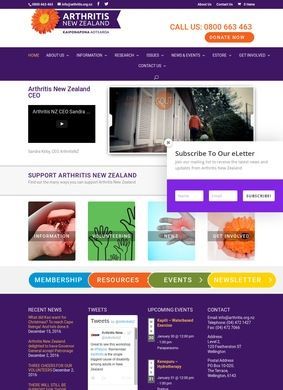
Arthritis New Zealand describes its reach around the figure of more than 850,000 New Zealanders living with arthritis, and the site is built to match that scope. The organisation describes itself in te reo as Mateponapona Aotearoa and positions itself as the country's main patient-facing arthritis body. As a national charity, Arthritis New Zealand has taken on the role of turning that claim into something a person can use, and the range of services on offer is notably wider than the static fact-sheet approach many comparable organisations settle for. The site reads like an organisation that has thought carefully about what someone in pain needs at each stage of the condition.
Arthritis Assist coaching service
The part of the site that does the most to justify a visit is the Arthritis Assist program, a one-on-one coaching service that walks a person through symptom management, medication questions, nutrition, and the practical difficulty of getting through an ordinary day when joints are not cooperating. Alongside that sit two digital tools aimed at specific conditions: the MyRA app for rheumatoid arthritis self-management and the MyJointPain website for osteoarthritis. That division tells you something about how Arthritis New Zealand approaches the subject. Arthritis is not one disease, so the support splits by what a person is dealing with, not lumped under a single banner.
Apps for rheumatoid arthritis and osteoarthritis
The written content is organised into sections that follow the arc of the condition. There is a symptom-checking and diagnosis area for people who suspect something is wrong but have not yet been told what. A separate newly-diagnosed section picks up where that leaves off, which is a sensible division, because the questions a person asks in week one are not the questions they ask in year three. From there the material branches into living with arthritis, pain management, exercise programs, nutrition, mental health, and workplace guidance.
Content organized by condition stages
That last category is worth pausing on. Workplace guidance is the kind of topic many health charities skip entirely. Including it shows an understanding that arthritis follows people to their jobs and shapes whether they can keep them. The mental health thread does similar work. Chronic pain and the loss of physical capacity wear on a person psychologically, and treating that as a genuine part of the picture rather than an afterthought gives the content more credibility than a purely clinical resource would manage.
Workplace guidance and mental health support
What lifts the library above a static set of leaflets is the way it connects to live support. A reader who finds the pain-management pages can move toward Arthritis Assist coaching or a peer group, so the information is a doorway rather than an endpoint. The peer support runs both ways, in person where local groups exist and online for people who cannot get to a room full of others. Arthritis New Zealand has clearly thought about the fact that not every user is in Auckland or Wellington, though the in-person layer will inevitably reach some towns and miss others.
How does peer support work?
Beyond direct support, Arthritis New Zealand runs the activities you would expect of an established charity found in any business directory of health organisations: advocacy on behalf of people with the condition, research funding, and the usual fundraising, volunteering, sponsorship, and bequest channels. None of that is unusual, but it fills out the picture of an organisation working on the policy and funding side as well as the front line, and that breadth counts for a body claiming to speak for a very large patient population.
Advocacy, research, fundraising channels
The clinical-advice content is the part a visitor should approach with the right expectations. A charity website is not a substitute for a rheumatologist, and the smarter framing is that the material helps a person arrive at appointments better informed and points them toward the right service. The health-system navigation help may be the quiet strength of the whole offering. Knowing which door to knock on is often the hardest part for someone newly facing a chronic diagnosis, and Arthritis New Zealand handles that orientation reasonably well.
From clinical advice to health navigation
A search turns up no substantial independent review record for Arthritis New Zealand in the usual consumer-rating channels, which is expected for a non-commercial health charity. The credibility here rests on the organisation's established presence, the detail visible in the published programs, and the fact that condition-specific tools like MyRA are not the kind of thing a poorly resourced operation puts together. Arthritis New Zealand has been around long enough that the absence of star ratings is not a gap worth dwelling on.
Digital tools close geographic gaps
The verdict lands on the favourable side without being uncritical. Arthritis New Zealand offers a genuinely broad and well-structured set of services, and the combination of human coaching, peer support, condition-specific apps, and a staged content library is more substantial than a typical charity homepage. The limit is the inherent one of any national resource: support intensity depends on whether local groups and coaching capacity reach a given person's town. The digital tools partly close that gap, since MyRA and MyJointPain work anywhere there is a phone or browser. Get the most out of the site by going beyond the pages and booking into the actual services; the written content is solid, but the human layer is where Arthritis New Zealand delivers its real value.