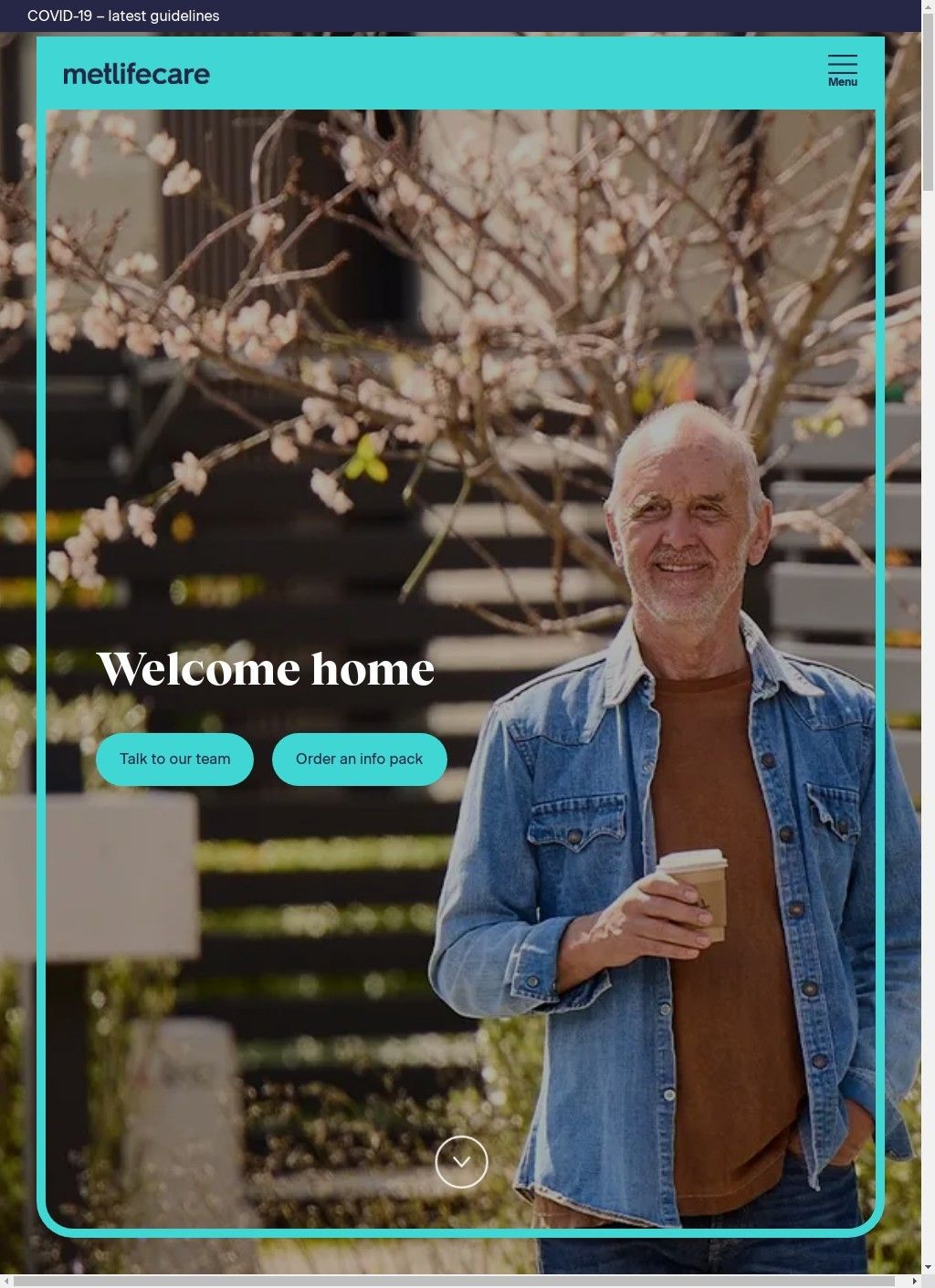
Choosing where a parent, or eventually yourself, might live for the next decade or two comes down to what a national retirement village operator actually puts on the table. Metlifecare answers that with a practical set of choices. Three living arrangements are laid out: independent living for retirees who still run their own days, serviced apartments for people who want some help with meals and daily tasks, and full aged care in residential care homes for those who need clinical support. The presentation stays plain instead of leaning on mood photography, and Metlifecare puts the spectrum of need up front, which is the right instinct for a category where families are often making the decision under pressure.
Three living arrangements across New Zealand
The geographic reach is one of the more concrete things on offer. Communities run from Northland down to Otago, spanning both the North and South Islands, and a village locator tool lets you filter by region instead of scrolling a flat list. Retirement village choice is almost always tied to staying near family or in a familiar area, so a map-and-filter approach respects how people actually search. A new Metlifecare care home, Gulf Rise (also referenced as Weiti) in Northland, is flagged as under construction, so the network is still growing.
Finding villages by region and location
Beyond the property side, Metlifecare leans into the research phase of the decision. There is a retirement guide and an FAQ resource library, sensible given how many people approach this topic with no idea how the occupation-right model works, how fees are structured, or what separates independent living from serviced apartments in practice. Village event listings and a tour-booking path round out the experience, letting prospective residents see a place in person before they decide. A MetProtect program also appears under the Metlifecare banner, though the homepage does not spell out its terms, so anyone interested would need to dig into a village page or ask directly. For a sector where the fine print genuinely shapes the cost of living, that lack of detail at the top level is a minor letdown.
Research resources for the decision phase
One unusual feature here, compared with a typical care provider, is that Metlifecare is a listed company on the New Zealand Stock Exchange, and the site carries investor relations material alongside the consumer-facing content. For a family doing due diligence that is genuinely useful: a publicly accountable operator publishes financials, governance details and announcements that a privately held village simply would not. It is a form of transparency that does not announce itself as a selling point, but it gives the more cautious reader something solid to check. I tend to trust an operator more when its numbers are out in the open like this, because it raises the cost of cutting corners.
Financial transparency through stock exchange listing
The news section and the linked social channels (Facebook, Instagram, LinkedIn and YouTube) extend that picture and show how active Metlifecare is and how it presents day-to-day village life. There is also a current promotion: the first ten buyers at selected villages are offered a $100,000 Welcome Package. That is a sizeable incentive, worth reading carefully, since headline offers in this sector usually come attached to specific villages and specific terms. The figure appears on the site; the conditions behind it are where the detail lives.
News, promotions and social media presence
On the question of who Metlifecare is built for, the answer is clear enough from the structure. Active retirees looking to downsize into a managed community sit at one end. People who need graduated support, and ultimately residential care, sit at the other. The strength of an operator running all three tiers is continuity: a resident can move from independent living through to aged care without leaving the village they have settled into, which spares families the upheaval of finding a new provider when needs change. Few competitors cover that full span as plainly as Metlifecare does here.
Continuity of care across all three tiers
Public customer reviews are harder to find than you might expect for a company of this size. A search did not surface a body of resident or family reviews on Google, Trustpilot or comparable platforms, which is a little surprising for an organisation of Metlifecare's scale, though retirement villages tend to attract fewer public reviews than restaurants or shops. What does exist sits on the employer side. On Glassdoor the New Zealand profile shows 3.6 out of 5 across 19 reviews, while the international Glassdoor profile shows 3.9 out of 5 across 17, with somewhere between 72 and 77 percent of employees saying they would recommend working there. Indeed carries employee reviews too, though a clean rating was not pulled from what surfaced.
Staff ratings on Glassdoor and Indeed
Those are staff opinions rather than resident opinions, so they should be read for what they are. Still, in aged care and retirement living, staff sentiment is far from irrelevant. The quality of daily life in a Metlifecare village rests heavily on the people delivering meals, care and maintenance, and a workforce broadly willing to recommend its own employer is a reasonable, if indirect, indicator. A mid-to-high recommendation rate alongside ratings in the high-3s points to a workplace that is decent without being remarkable, which is honest information to have when the marketing naturally accents the positive.
The absence of resident-side feedback in the public domain is the sharpest gap. With so little external commentary to go on, an in-person visit and a conversation with people already living in a Metlifecare community would fill in what the website cannot provide, and the site's prominent tour offer is the natural way to get there.
Limited public resident feedback available
The weakest area is contact. There is no phone number and no email shown directly on the Metlifecare homepage. Everything routes through a "Get in touch" navigation path and through the tour-booking and information-pack request forms. The likely explanation is structural: with villages spread across the country, each location carries its own details, so routing people to the relevant Metlifecare village makes more sense than a single national number that would not serve most enquiries well.
That said, a prominent general phone line would reassure visitors who want to speak to a person before filling in a form, and its absence is a small friction point on an otherwise well-organised site. The forms cover the practical bases, and an information pack is a low-commitment way to start, so contact is workable even if it is not immediate.
Taken together, Metlifecare presents as a substantial, established operator with wide reach, a full continuum of care, and the public accountability that comes from exchange listing. The research tools and tour pathway reflect an understanding that this decision takes months. Where the site is less complete is in the unexplained MetProtect terms, the undisclosed conditions on the $100,000 promotion, and the near-absence of independent resident feedback. Those gaps sit precisely where scrutiny belongs: in the details that shape what living in a Metlifecare village actually costs and what daily life there looks like.

Business address
20 Kent Street
Newmarket,
Auckland,
Auckland
1023
New Zealand
Contact details
Phone: 09 539 8000