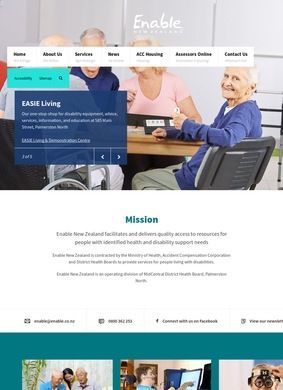
EASIE Living is the retail shop run by Enable New Zealand, and it is a good place to start, because it turns an organisation that could read as purely bureaucratic into something concrete: a store where a disabled or injured person can walk in, or click in, and buy the equipment that makes an ordinary day workable. That practical streak runs through everything Enable New Zealand does, and it is the reason the operation is easier to judge than a lot of agencies working in this space.
The wider remit is far bigger than a shop, though. Enable New Zealand provides assistive technology, equipment, home and vehicle modifications, professional assessments and plain-language advice, all pointed at one goal: helping disabled and injured people across Aotearoa New Zealand get on with everyday life. It works as a contracted national provider alongside government agencies, chiefly ACC and the broader health and disability sector, without being a government department in its own right.
That distinction sets the tone. This reads as a delivery organisation, the kind you end up judging on whether the wheelchair arrives and the bathroom rail actually gets fitted.
Two very different audiences share the same website, and Enable New Zealand has to serve both of them well without confusing either one.
Who the site is built to serve
On one side are the disabled and injured New Zealanders the whole service exists for. On the other is a professional network: the assessors who decide what equipment a person qualifies for, and the subcontractors and suppliers who deliver and fit it.
Enable New Zealand builds a separate path through the site for each group, which is why the navigation can look crowded at first and why it makes sense once you work out which door is yours.
Access support for individuals and families
The Access Support section is the front door for people seeking help directly. It covers equipment provision, a specific strand for children's support, and clear guidance on how an assessment works and who carries it out. The Enable New Zealand pages here are written to be read by people in the middle of a stressful stretch, not by insiders trading acronyms, which is the right instinct for a service like this.
For a family trying to arrange equipment for a disabled child, that dedicated children's support strand is the sort of targeted help that is easy to underrate until the day you actually need it.
Equipment provision is the practical core of the section, and the path from assessment to delivery is laid out plainly instead of left mysterious.
Home and vehicle modifications sit alongside the equipment, and they are where the organisation moves from handing over a product to changing how a person's house or car works. A ramp, a bathroom conversion or hand controls in a vehicle are bigger commitments than a walking frame, and Enable New Zealand treats them as a managed process with assessment behind it. EASIE Living then covers the simpler end, letting people buy everyday assistive items outright without waiting on a funding decision.
Tools for EMS, ACC and hearing assessors
The other half of the site is a stack of professional portals, and this is where the true scale of Enable New Zealand shows. There are dedicated areas for EMS assessors handling disability support equipment, for ACC assessors working through accident-related equipment and housing modifications, and for the spectacle and hearing aid assessors who occupy their own part of the system. A Subcontractors section serves the providers who carry out the physical work in people's homes.
The split between EMS and ACC is more than filing. A person whose need comes from an accident is usually funded through ACC, while someone living with a longer-term disability is handled on the EMS side, and the equipment, the paperwork and the eligibility rules differ between the two. By running distinct portals for each, Enable New Zealand keeps an assessor from wading through options that do not apply to their client.
It is a dry piece of design, but for the professionals using it every day, that separation is the difference between a clean approval and a wrong turn that costs a client weeks.
Behind those portals sit the Online Apps, the digital systems assessors use to manage cases, plus an Education Centre and a Resources library stocked with documents, forms and equipment lists. Clicking through the assessor tools, I braced for the usual public-sector tangle and instead found them clearly labelled and sensibly split by role. None of this backstage machinery is glamorous, yet it is precisely the part that decides whether a person's equipment request moves forward or stalls in a queue, and Enable New Zealand has plainly put work into getting it right.
Contact details and a name it shares with others
Getting hold of Enable New Zealand is refreshingly straightforward. The site publishes a freephone number, an email address and a physical base in Palmerston North, and there is a proper Contact Us page that also sets out a feedback and complaints process. For an organisation dealing with people who may already be frustrated or unwell, a visible complaints route, plainly signposted, is a small mark of good faith. You are not left digging for a way to reach a human, which is more than some far larger services manage.
The one real soft spot has nothing to do with the service and everything to do with its name. A search for reviews of Enable New Zealand does not surface a clear body of third-party feedback. What comes up instead is a crowd of similarly named but unrelated outfits: enable.me, a financial-coaching and budgeting business run by Hannah McQueen, together with software products such as enableHR and Enabler, and a Glassdoor page for some 'Enable' that cannot be tied to this organisation at all.
None of that reputation belongs to Enable New Zealand, and it would be a mistake to lend it any. The honest position is that no notable independent customer reviews specific to this assistive-equipment provider turned up in search, so the record of Enable New Zealand here has to rest on what the service itself puts on show.
For a New Zealander weighing where to turn, the nearest comparison is Accessable, the other agency contracted to arrange government-funded equipment for part of the country. Which of the two a person deals with is mostly settled by where they live and which funding stream applies, so this is less a free choice than a map with the lines already drawn.
Within its own patch, Enable New Zealand comes across as organised, genuinely contactable and practical, strong on the assessor and subcontractor machinery that gets equipment out the door, and honest enough in its public information that Enable New Zealand is worth trusting even without a wall of outside reviews behind it.
The scant third-party footprint is a fair caution to note, but it looks far more like a name-shadowed public service working quietly than any real doubt about the work it does.