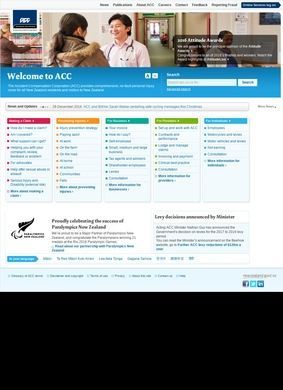
Injured in New Zealand, you generally cannot sue anyone for it. The Accident Compensation Corporation is the reason why. This is the body that runs the country's no-fault injury cover, a statutory scheme set up under the Accident Compensation Act that pays out regardless of who caused the harm. In exchange, the right to take a personal injury claim to court was removed. That trade-off shapes everything the site does, because the Accident Compensation Corporation is not one option among several. For most injuries on New Zealand soil, it is the whole system.
How the no-fault scheme covers injuries
The cover is unusually broad in who it reaches. It applies to every New Zealand resident, and it applies to visitors who get hurt while in the country. It also follows New Zealanders who are injured abroad. So the audience is not a narrow slice of the population but effectively anyone who sets foot in the place and has an accident, which makes the website's job partly that of a national reference desk for what happens after you are hurt.
Weekly compensation and treatment costs
Work through what an injured person can actually claim and the scope becomes clear. The Accident Compensation Corporation pays weekly compensation, which replaces a portion of lost earnings when an injury keeps someone off the job. There is coverage of treatment costs. Beyond the medical bill itself, the scheme extends into rehabilitation, home help for people who cannot manage daily tasks while recovering, aids and equipment, and counselling. For the most serious cases there are permanent injury benefits. Read as a list it sounds dry, but the practical effect is that the same organisation handles the physiotherapy session, the income while you are off work, and the grab rail installed at home, all under one claim.
Three portals for different user groups
The site is built around the fact that three very different groups need to use it, and each gets its own route in. Injured individuals are one. Businesses are the second: employers and the self-employed who pay levies into the scheme. They are pointed at the MyACC for Business portal, where they manage those levies, look at Experience Rating programs that adjust what they pay based on their claims history, and reach workplace safety material. The levy side is where the funding comes from, so it gets real tooling and not a single static information page.
Provider claims and workplace safety rules
Health providers are the third group, and arguably the one with the most technical needs. GPs, specialists, physiotherapists and hospitals lodge claims through ProviderHub, the digital platform aimed at them. There they manage contracts, request prior approvals before certain treatments, and read the treatment guidelines that govern what the scheme will fund. Splitting the provider workflow off into its own system makes sense, because a hospital lodging hundreds of claims is doing something fundamentally different from a person filing one after a fall.
What ties the three together is that they are all facing the same set of rules. The patient claiming weekly compensation, the employer paying the levy that funds it, and the physio submitting the treatment cost are three views of one pool of money and one piece of legislation. The Accident Compensation Corporation site reflects that by keeping the audiences separate on the surface while the underlying scheme stays singular.
Work injuries, tourist injuries, overseas coverage
The distinction between injury types matters too, and the cover is drawn widely here. Work-related injuries are in. So are non-work injuries, the slip on the stairs at home or the rugby tackle gone wrong, which in many other countries would fall outside any compensation body and into private insurance or the courts. Injuries to New Zealanders overseas are covered, and so are injuries to international visitors who get hurt while in the country. A tourist who breaks an ankle hiking is inside the same scheme as a local factory worker.
Statutory authority and mandatory participation
Because the scheme is compulsory and government-administered, the website has an authority a private insurer's site does not. There is no shopping around, no comparison of competing policies, no question of whether you are covered by this provider or that one. If the accident happened in New Zealand, the Accident Compensation Corporation is the answer by default, which puts a particular kind of pressure on the information being clear and correct. People arrive here at a bad moment, often hurt and unsure what they are entitled to, and the structure of the site has to do the work of explaining a fairly complex statutory arrangement to someone who has never had reason to learn it before.
That is also where the value of going to it directly lies. Plenty of third-party explainers describe the New Zealand no-fault system in general terms, but the specifics, what counts as a treatment cost, how weekly compensation is calculated, when a permanent injury benefit applies, are governed by the Accident Compensation Corporation's own rules and contracts. For a provider checking whether a procedure needs prior approval, or an employer trying to understand an Experience Rating result, the primary source is the only one that will be current and binding. A search of major review platforms turns up no public ratings for acc.co.nz as an entry in any business directory, which is unsurprising given its role as a statutory body rather than a commercial service.
Worth being honest about what the Accident Compensation Corporation site is not. It is not a place to evaluate a service and decide whether to buy. The scheme is mandatory, so the question is never whether to use it but how to navigate it. The material on offer reads accordingly: practical, procedural, organised around tasks like lodging a claim, paying a levy, or finding what rehabilitation support exists. For anyone dealing with an injury in New Zealand, or running a business that pays into the system, or treating patients within it, this is the operative reference, and there is no alternative version of it to compare.