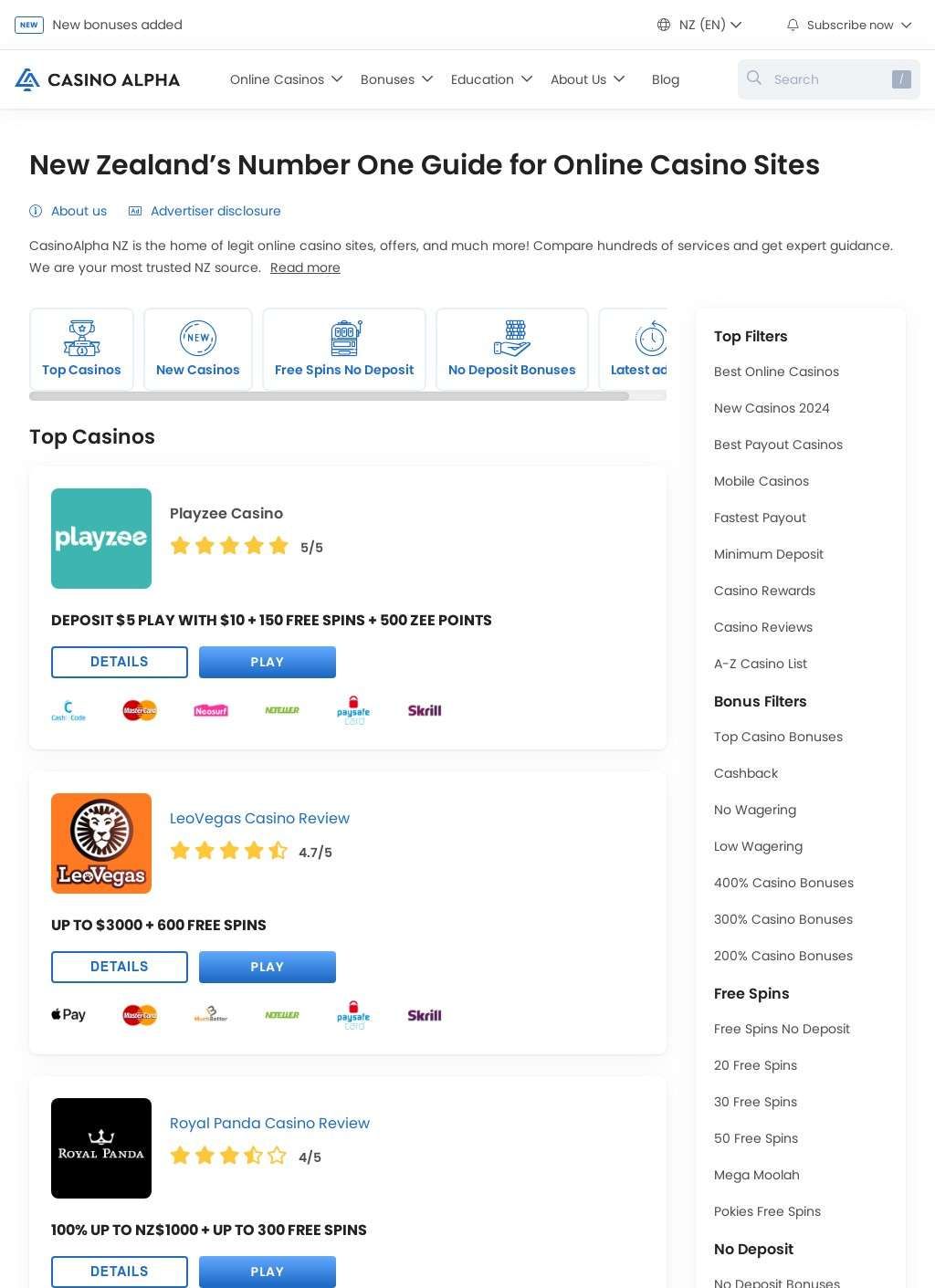
A grade of 7.8 on Casinoalpha.co.nz comes with the label Fair. So does a 7.4. That is the scoring habit across the site's casino reviews for New Zealand players: numeric, and tight with praise.
The list those grades sit on is long. Review pages exist for 721 online casinos, the pokies index runs to 719 titles, and the bonus database holds 724 separate offers. Behind the rankings on Casinoalpha.co.nz sit an About Us page, a How We Review page, an Editorial Policy, an Advertiser Disclosure, an Authors page with team bios, a blog, and a Contact page. Scale like that raises the obvious question of who does all the grading, and on whose money.
How a 7.8 ends up labelled Fair
Each casino review on Casinoalpha.co.nz follows a set anatomy: a rating, a pros and cons list, bonus terms, minimum deposit and maximum cashout figures, expected payout time, counts of slots and live dealer games, VIP program details, and the payment methods on file. The format lets a reader settle narrow questions fast. How quickly a casino claims to pay out, what the cashout ceiling on a bonus is, how many live tables an operator carries: those answers sit on one page.
And the two scores visible on those pages, a 7.8 and a 7.4, are both filed under Fair, which says the top of the scale is guarded.
Two of the corporate pages stand out. How We Review describes the testing approach behind the scores, and the Editorial Policy sets rules for the writing itself. Educational material rounds the section out: player guides, legal guides, and a run of pages on gambling addiction.
Thirty specialists, ten hours a review
The staffing claims are specific. Casinoalpha.co.nz states that more than thirty gambling specialists work on its reviews, that each carries over ten years of industry experience, and that a single review takes upwards of ten hours of research. The Authors page puts individual names and bios against those claims. None of the figures can be verified from the outside; what can be verified is the output, hundreds of distinct and heavily structured pages, and that much is evidence of sustained work by a real team, maintained at item level across the whole catalogue.
Claimed credentials and visible effort are different measures, and only the second is on display.
The advertiser disclosure says who pays
The most consequential corporate page on Casinoalpha.co.nz is the Advertiser Disclosure. It discloses paid partnerships with the casino operators featured on the site, and affiliate commissions that flow back from them. Every ranking therefore lives inside a standing conflict of interest: the companies being graded help fund the grader.
Printing that in plain language is to the site's credit, and affiliate commissions are the normal economics of casino comparison publishing. The disclosure does not dissolve the conflict, though. It gives the reader fair warning, and a reason to treat each Fair label as a claim to check against the operator's own terms before any money moves.
One detail cuts against the harshest reading. A site chasing nothing but sign-ups has little use for a stingy grading curve, yet the visible scores sit in the mid sevens under a lukewarm word. Restraint of that sort is at least consistent with the methodology the site says it follows. The printed specifics fit that reading too: bonus terms, cashout ceilings, and payout windows appear casino by casino, which hands a depositor something concrete to hold an operator to.
A catalogue that runs to 721 casinos
Breadth is the core product. Casinoalpha.co.nz ranks online casinos as a class, live casinos separately, and newly launched sites in a section of their own, and it keeps a running list of minimum-deposit casinos where the buy-in sits between $1 and $10. A player on a small bankroll gets a filter built for exactly that. The live casino rankings serve a different reader, the one who cares about dealer tables and wants that side judged on its own.
The pokies side nearly matches the casino count: 719 slot titles indexed for New Zealand play. Individual reviews on Casinoalpha.co.nz then record how many slots and how many live dealer games each operator carries, so game volume and overall grade can be weighed side by side. Figures this granular go stale fast in the gambling market, and no outside audit confirms any of them. The categories, though, track the way players search: by deposit size and by game type.
Free spins, bonus codes, and low wagering
The bonus inventory on Casinoalpha.co.nz is itemised down to the niche: 724 bonus offers, 221 free spins deals, 106 no-deposit bonuses, plus separate collections for bonus codes and for deals with no wagering or low wagering attached. That last shelf is the telling one. Wagering requirements are where headline bonuses usually die, and a filter for low-wagering deals assumes an audience that reads terms before depositing.
The no-deposit list works from the opposite end, gathering more than a hundred ways to trial a casino without funding an account first. Between those two poles, most bonus-hunting styles are covered.
A-Z lists down to payment methods
The reference layer is the least flashy part of the operation and may prove the most durable. An A-Z list covers 722 New Zealand casinos, and three parallel directories slice the market by casino group, by game provider, and by payment method, each sorted the same way.
Those pages reverse the usual search. A reader who trusts one payment method can start from it and land on a shortlist of casinos that accept it; the same route works from a favourite game provider, and Casinoalpha.co.nz keeps an index for each. The casino-groups directory answers a quieter question: which company stands behind the brand on the screen.
One Trustpilot review and an empty scorecard
Outside opinion is where things thin out. Trustpilot lists a single review for the parent CasinoAlpha domain, with no aggregate star rating showing, and the snippet that surfaces is hostile: it calls the site's information fake. The MyWOT scorecard for Casinoalpha.co.nz sits empty. Google Reviews, Yelp, Facebook, Tripadvisor, Glassdoor, and the BBB return nothing at all.
For an operation claiming thirty specialists and grading more than seven hundred casinos, the silence around Casinoalpha.co.nz is loud. It cuts both ways. One angry review proves nothing by itself, and comparison publishers rarely draw feedback the way shops and restaurants do, so a blank slate is not automatically damning. The stark part is the sum: no independent party anywhere has vouched for the accuracy of these write-ups, and the lone outside voice on record disputes them. That reviewer could be mistaken; the point is that no counterweight exists.
The corporate trail is easier to follow. The wider CasinoAlpha operation is owned by Extremoo Marketing, was founded by Tudor Turiceanu, and runs sister editions for Ireland, the United Kingdom, and Spanish-language markets. The New Zealand site is one branch of a multi-country affiliate publisher, then, with a named founder and a named corporate owner, and that much stays traceable while the review platforms stay silent.
The sister editions matter mostly as context here: the New Zealand pages are one instance of a template the publisher runs in several markets, so the depth is systematic, and so is the funding model.
Contact runs one click deep. The main menu on Casinoalpha.co.nz carries a Contact item labelled "Reach our Experts", so a route to the team exists, but the front page itself shows no phone number or street address; those details wait behind the click. For a web-only publisher this is ordinary. The blank outside record is the bigger issue.
What remains is a strange object: a large, openly affiliate-funded index of nearly everything a New Zealand online gambler could ask about, resting on a reputation nobody outside the company has confirmed. The corporate pages push one way, with a published methodology, named authors, and a disclosure that admits where the money comes from.
The outside evidence pushes the other way, or would, if there were more than one data point of it. The directories on Casinoalpha.co.nz answer factual questions well, which casino takes a $1 deposit, who owns it, which providers stock its games, how fast it claims to pay; the grades ask for more trust than the record currently supports. A visitor can use one half of the site without buying the other.
Every visitor ends up holding the same decision. Use the catalogue as a map and verify each 7.8 somewhere independent before depositing, or take the Fair labels at face value. On a site funded by the casinos it scores, with outside opinion this quiet, the first of those readings is the safer bet.