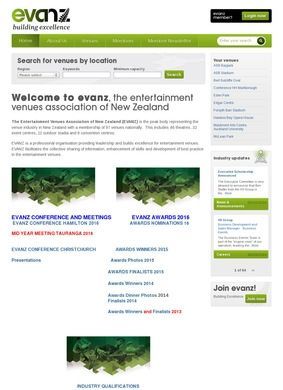
Venue managers in Dunedin or Hamilton who take over a theatre or convention centre quickly find themselves without a peer group, a training pipeline, or a ready source of industry standards for a building type almost no one else in town operates. The Entertainment Venues Association exists to fill exactly that gap. It is the peak industry body for entertainment venues across New Zealand, pulling together what would otherwise be a scattered handful of isolated operators into a single professional network with shared resources behind it.
Network for 120 venues nationwide
The scale is worth laying out plainly. The Entertainment Venues Association represents more than 120 venues nationwide, and the list it covers is broad: theatres, stadia, arenas, and convention centres all sit under the same membership umbrella. Alongside the venue operators there are roughly 50 associate members, organisations that supply goods and services into the sector, from equipment to specialist consulting. Add those two groups together and the Entertainment Venues Association counts around 2,500 industry professionals in its orbit. For a country the size of New Zealand, that is most of the working population of the live-venue business in one place.
The more telling detail than the headcount is the spread of what membership buys you. The body runs in two directions at once. For the venues themselves, there is a set of services aimed at the people who keep arenas and theatres open and running. For the suppliers, there is a separate associate track with partnership and sponsorship routes into the same audience. A trade association that only served one side of that relationship would be half-built. Here both operators and the firms selling to them have a formal seat, and the back-and-forth between them is part of the point.
Training and mentoring programs
That is the fair question to ask of any trade body, because plenty of them collect a subscription and offer little past a directory entry. The Entertainment Venues Association answers it mostly through training. It runs programs for venue professionals, and the investment goes beyond one-off sessions: there are scholarships and mentoring initiatives sitting alongside the formal courses. Mentoring in particular is the kind of commitment you see in a body that cares about bringing newer staff up through the ranks, a serious gap in a field where expertise tends to live in the heads of long-serving operators and walks out the door when they retire.
The development side is reinforced by the calendar. The Entertainment Venues Association hosts an annual End of Year Conference and Awards Gala, with the next edition set for Christchurch. A conference plus an awards night gives a scattered profession a reason to gather in one room once a year, compare notes, and recognise good work publicly. For operators who rarely meet their counterparts face to face, that single event can be the most useful thing a membership delivers, and the recurring commitment distinguishes a working body from a nameplate.
Beyond the headline event, the practical machinery is steady rather than flashy. There is a job portal aimed at the venue sector, a genuinely useful thing given how specialised these roles are: a stadium operations hire is not something a general recruitment site handles well. There is a news and newsletter hub to keep members current, and an events calendar that extends past the annual gala. None of these are glamorous, but they are the day-to-day reasons a member logs back in, and their presence tells you the Entertainment Venues Association is being run as an active service with work going on through the year.
From ticketing codes to planning resources
The published material is where the Entertainment Venues Association's character comes through most clearly. It maintains a Ticketing Code of Practice, a piece of sector self-regulation covering fees, resale, refunds, and access. Ticketing is the area where venues and the public collide most often and most painfully, and a body that has bothered to write down a code on it is doing the unglamorous work that trade associations are supposed to do. Strategic planning resources sit alongside it, the sort of material an individual venue board would struggle to produce on its own.
Put the overall picture together and a clear shape emerges. The Entertainment Venues Association is not trying to be a public-facing brand; almost everything it offers points inward, at the operators and suppliers who make up its membership. Training, mentoring, a job board, a code of practice, an annual conference, planning resources: these are tools for people already inside the industry. That focus is the right call for a peak body, and it is consistent across every section of the offering.
If there is a limit to what the site conveys, it is that the depth of any single program is hard to gauge from the outside. The Ticketing Code of Practice, the scholarship scheme, the mentoring structure: each is named and described, but a prospective member would still need to make contact to understand exactly what a year of membership buys in concrete hours and benefits. That is normal for an organisation whose real product is delivered through people and events rather than through the website. Treat the site as the front door to the Entertainment Venues Association, not the whole building.
Membership structure and services
The case for the body is strongest when you weigh what a venue would face without it. A theatre in a regional centre cannot easily build its own training pipeline, write its own ticketing standards, or run its own national awards. Those things only work when 120 venues pool effort, and pooling that effort is precisely what the Entertainment Venues Association organises. The associate-member layer extends the same logic to suppliers, who get structured access to a market that would otherwise take years of individual relationship-building to reach.
A search turns up no independent platform reviews or ratings for the Entertainment Venues Association. That absence has a straightforward explanation: the Entertainment Venues Association is a B2B peak body serving a defined membership base, not a public-facing consumer service. Its credibility rests on the breadth of its membership, the longevity of its conference, and the published Ticketing Code of Practice, each of which is checkable without relying on third-party commentary.
The conference draws the industry together each year, the code of practice gives the sector a written backbone on its thorniest commercial issue, and the training and mentoring keep the talent pipeline from drying out. A peak body is only as good as the participation it attracts, and the Entertainment Venues Association has assembled the count, the calendar, and the published resources to justify the participation it asks for. The structure is legible, too: two membership classes, a defined slate of services for each, a fixed annual event, and a handful of standing resources. A newcomer to the New Zealand venue scene could map the whole organisation in a single reading session, which is itself a form of quality.