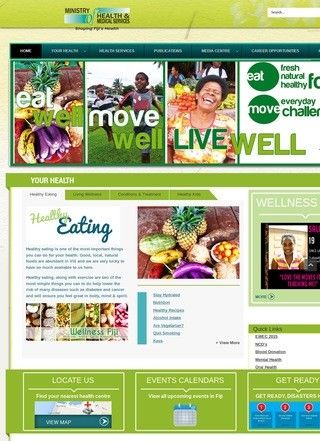
Six public hospitals run through one site here, and the Ministry of Health frames its whole digital presence around them: Colonial War Memorial Hospital in Suva, Lautoka Hospital, Labasa Hospital, St. Giles Psychiatric Hospital, Twomey Hospital, and the Fiji Centre for Disease Control. That is the backbone of healthcare delivery for the country, and the Ministry of Health treats each as its own page instead of folding them into a single brochure. A person trying to work out where to take a relative for psychiatric care versus where to go for a general admission can actually tell the difference from what is written. For a national health body covering a spread of islands, that separation does more practical work than a polished front page would.
Behind the ministry's organisational divisions
Beyond the hospitals, the structure splits into divisions, and this is where the site shows it is built to run an organisation. Executive Support, the Fiji Pharmaceutical and Biomedical Services unit, Wellness Fiji, Family Health, Health Protection, and the SRH/HIV services each get their own space. A business directory entry would capture a fraction of what the Ministry of Health publishes here: someone in the health workforce reading these pages gets a real map of how the ministry is organised, which is useful if you are trying to figure out who handles what. The Family Health and SRH/HIV sections in particular point to frontline care that gets used heavily, and putting them on equal footing with the corporate divisions is a sensible call.
Public health topics for a tropical climate
The public-facing health topics are the part most ordinary visitors will reach for, and they are broad without being shallow. The Ministry of Health publishes on mental health and suicide prevention, stroke awareness, nutrition, and the prevention of non-communicable disease, which is the slow-burn epidemic that quietly does the most damage across the Pacific. Alongside that sit the communicable threats that shape life in a tropical island setting: HIV/AIDS, hepatitis B, sexually transmitted infections, leptospirosis, typhoid, dengue, and the management of diarrheal disease. Anyone who has followed a Fijian wet season knows leptospirosis and dengue are not abstractions, so seeing them given dedicated attention reads as the Ministry of Health writing for its actual climate and its actual caseload.
Pediatric focus on asthma and obesity
The Ministry of Health's pediatric content narrows in on childhood asthma and obesity, two conditions that often get overlooked until they become chronic. It is a small set, but a deliberate one. Rather than trying to cover every childhood ailment, the pages pick the problems that compound over a lifetime if they are missed early, which is a more honest use of limited editorial space than a sprawling A-to-Z would be.
Tracking medicine through the supply chain
The pharmacy side is more substantial than these sections usually are. A Free Medicine Scheme is described under the pharmaceutical services area, and the same part of the site covers medication regulation and the supply chain, including the mSupply platform used to track and move stock. That last detail is the sort of thing most government health sites would never bother to surface, because logistics are unglamorous. Naming the platform that keeps medicine moving from a central store to a rural health centre tells a reader something concrete about how the system functions. It is the difference between a Ministry of Health that says it provides care and one that shows the plumbing behind it.
Free medicine in a country with significant rural and outer-island populations is a meaningful policy, and the fact that it is documented rather than merely announced gives a citizen something to check their eligibility against. Pair that with the standard treatment guidelines the Ministry of Health also publishes, and a clinician working in a remote post has both the supply mechanism and the clinical protocol available in one place. For a health system that has to stretch across water, that combination is genuinely practical.
Governance documents and parliamentary responses
The document library extends past clinical material into governance. Corporate documents, official forms, ministerial speeches, and parliamentary responses all sit on the site. The speeches and parliamentary answers will not interest a parent looking up a fever, but they are exactly what a journalist, a researcher, or an opposition health spokesperson needs, and their presence shows a willingness to put the Ministry of Health's official positions on the record where anyone can read them. Transparency of that kind is easy to claim and harder to actually publish, and the Ministry of Health has chosen to publish it.
Where can Fijians find the nearest health centre?
One feature deserves a specific mention: the interactive health-centre locator map. In a geography of scattered islands and dispersed settlements, a tool that pinpoints the nearest facility is more than a convenience. It turns the abstract idea of national coverage into a usable answer to a real question, which is where do I go right now. A static list of addresses would have done a fraction of the job. The map is the rare government web feature that solves a problem instead of decorating a page.
The site also runs a vacancy portal listing open medical positions and expressions of interest, which quietly addresses one of the hardest problems any Pacific health system faces: recruiting and keeping qualified staff. Having that channel hosted directly on the Ministry of Health's own pages, instead of buried in a separate government jobs board, lowers the barrier for a doctor or nurse weighing a move. The Ministry of Health linking its Facebook, YouTube, Instagram, and X presence from the homepage rounds this out, giving it routes to push health messaging to a population that increasingly reads its news on a phone.
If there is a limitation worth naming, it is breadth over depth in a few corners. The programme pages cover an impressive range of conditions, but a site this wide inevitably leaves some topics thinner than others, and a visitor with a very specific question may find the answer points them onward instead of resolving it on the page. That is the standard trade-off for a national ministry trying to be everything to everyone, and it is not a flaw so much as a consequence of the mandate. The Ministry of Health is carrying public policy, hospital information, clinical guidelines, drug supply, recruitment, and outbreak communication on a single platform, and no one section can be exhaustive when the remit is that large.
Weighed up, this is a serious working tool, and that is the right verdict. The Ministry of Health has built something a clinician, a policymaker, and an ordinary Fijian can each get real use out of, anchored by the hospital pages, the locator map, the Free Medicine Scheme, and the published guidelines. It will not win design awards, and the deeper you push on any single health topic the sooner you reach its edge. For the job it exists to do, which is to be the authoritative reference point for health in Fiji, the site delivers, and a visitor leaves knowing more about how care in the country is organised than when they arrived. The Ministry of Health is worth consulting on its substance, not its polish, and on that measure it earns the time.